
How PT-141 Works: The Brain, Not the Blood Vessels
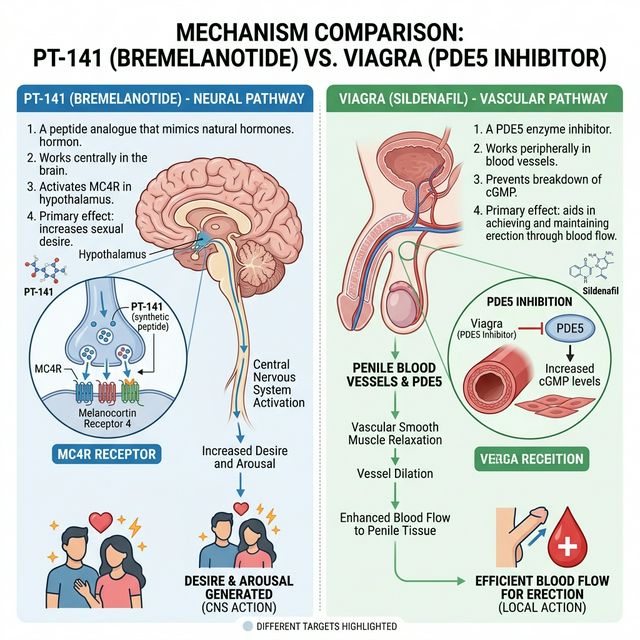
PT-141 (bremelanotide, brand name Vyleesi) is fundamentally different from every other sexual function medication. Viagra, Cialis, and Levitra are PDE5 inhibitors — they work by increasing blood flow to the genitals. They are plumbing solutions. If you are not aroused, they do not make you aroused. They just make the mechanics work better when arousal is already present.
PT-141 works in the brain. It activates melanocortin-4 receptors (MC4R) in the hypothalamus — the same brain region that regulates appetite, body temperature, and sexual arousal. MC4R activation triggers a downstream signaling cascade that generates genuine sexual desire and arousal. It is not a vasodilator. It does not increase blood flow directly. It creates the neurological state of wanting to have sex.
This mechanism was discovered accidentally. Melanotan II, a melanocortin agonist originally developed for UV-free tanning, produced an unexpected side effect in clinical trials: spontaneous erections in male subjects. Researchers isolated the component responsible for the sexual effect, optimized it for MC4R selectivity, and created bremelanotide — PT-141.
FDA Approval and Clinical Evidence
PT-141 (as Vyleesi) received FDA approval in June 2019 for hypoactive sexual desire disorder (HSDD) in premenopausal women. This made it the first and only FDA-approved on-demand treatment for low sexual desire. The approval was based on two Phase III trials (RECONNECT) enrolling 1,267 women with HSDD.
Key results: patients using bremelanotide 1.75 mg subcutaneous injection experienced a statistically significant increase in sexual desire events and a decrease in distress related to low sexual desire, compared to placebo. Approximately 25% of bremelanotide-treated women reported "meaningful improvement" in desire, versus approximately 17% of placebo-treated women. The effect size is modest but statistically significant — and importantly, it represents a real neurological effect, not a placebo response enhanced by vasodilation.
Though FDA-approved specifically for premenopausal women, PT-141 is widely used off-label in men, postmenopausal women, and individuals on medications (antidepressants, particularly SSRIs) that cause sexual dysfunction. The off-label evidence is primarily from clinical experience and smaller studies, but the MC4R mechanism is not sex-specific.
Dosing Protocol and Practical Use
The FDA-approved dose is 1.75 mg subcutaneously, injected into the abdomen or thigh approximately 45 minutes before anticipated sexual activity. This is an on-demand medication — you do not take it daily. Maximum frequency: one dose per 24 hours, no more than 8 doses per month.
For a standard 10 mg vial reconstituted with 2 mL BAC water: concentration = 5 mg/mL = 5,000 mcg/mL. For 1.75 mg (1,750 mcg): draw 35 units on a U-100 syringe. The vial provides approximately 5 doses. Use the CalcMyPeptide reconstitution calculator to verify your math — dose accuracy is important because PT-141 has dose-dependent side effects.
Side effects are common but manageable: nausea (approximately 40% — the most significant side effect, usually peaks 1-2 hours after injection and resolves within 4 hours); flushing (approximately 20%); headache (approximately 11%); and transient blood pressure elevation (approximately 1-3 mmHg systolic). The nausea can be reduced by starting with lower doses (0.5-1.0 mg) for your first few experiences and titrating up. Anti-nausea medication (ondansetron) taken 30 minutes before PT-141 is a common strategy.
PT-141 vs Viagra vs Testosterone: Different Problems, Different Solutions
These three treatments address different parts of the sexual response: (1) PT-141 addresses desire — the neurological drive to want sex. Choose PT-141 if the core problem is "I am not interested in sex" or "I cannot get aroused mentally." (2) Viagra/Cialis addresses mechanics — blood flow to the genitals for erection (men) or clitoral engorgement (women). Choose PDE5 inhibitors if the core problem is "I want sex but the equipment does not cooperate." (3) Testosterone addresses the hormonal foundation — libido, energy, mood, and physiological capacity. Choose testosterone optimization if levels are clinically low.
These are not mutually exclusive. Many patients use testosterone optimization as the foundation, PDE5 inhibitors for mechanical support, and PT-141 for on-demand desire enhancement. The combination addresses all three layers of sexual function.
A noted advantage of PT-141 for women: there are no female equivalents of Viagra with robust clinical evidence. PT-141 is the only FDA-approved on-demand treatment specifically for female sexual desire, making it uniquely valuable for women experiencing HSDD, SSRI-induced sexual dysfunction, or menopausal-related desire changes.