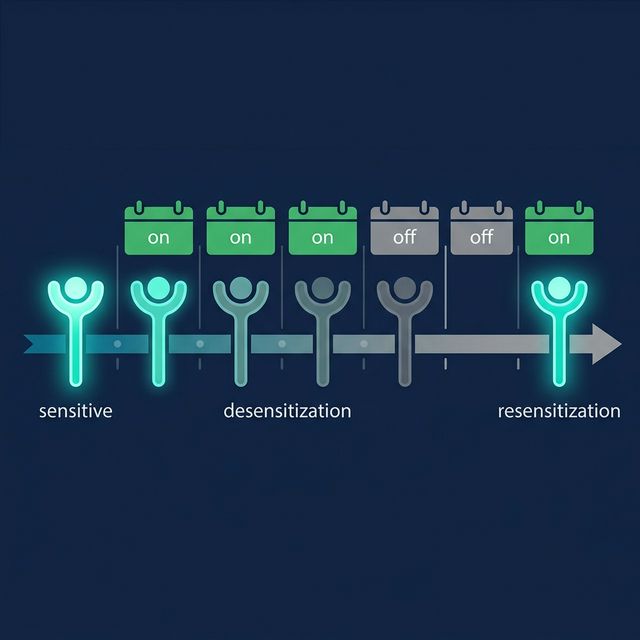
What Is Receptor Desensitization?
Receptor desensitization is a fundamental pharmacological concept: when a receptor is repeatedly stimulated by an agonist, the cell reduces its responsiveness to protect itself from overstimulation. This can occur through several mechanisms: **receptor internalization** (the receptor is pulled inside the cell, reducing surface expression), **receptor downregulation** (the cell produces fewer receptors), **post-receptor signaling changes** (downstream pathways become less responsive even though the receptor is still present), or **tachyphylaxis** (rapid tolerance development, sometimes within minutes to hours).
Not all peptides desensitize equally. This is critically important: some peptides can be used continuously for months or years without losing efficacy, while others show marked tolerance within weeks. The difference depends on the receptor type, the strength of receptor activation, and the specific desensitization mechanisms involved.
Which Peptides Need Cycling?
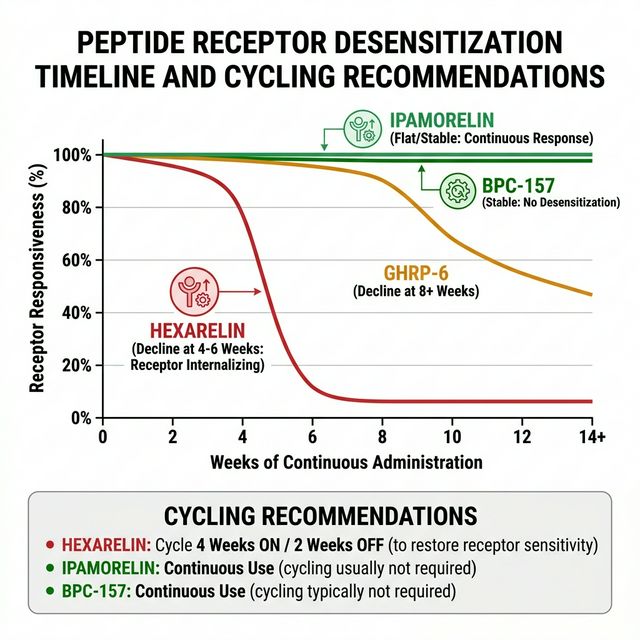
**Hexarelin:** The strongest GHRP available — and the one most prone to desensitization. Studies show GH response to hexarelin significantly diminishes after 4-6 weeks of continuous use. The ghrelin receptor (GHS-R1a) undergoes internalization and downregulation. Recommended cycle: 4 weeks on, 2-4 weeks off. **Melanotan II:** MC1R desensitization occurs with extended use — tanning response plateaus. Most users cycle to a "loading phase" (2-4 weeks) then reduce to maintenance (1-2x weekly). **GHRP-6:** Some desensitization occurs after 8+ weeks, though less than hexarelin. Cycle: 8 weeks on, 4 weeks off.
**Peptides that likely DON'T need cycling:** Ipamorelin — the "selective" GHRP shows minimal desensitization in available data. Its cleaner receptor profile (less cortisol/prolactin elevation) correlates with slower receptor downregulation. BPC-157 — works through growth factor upregulation rather than receptor agonism. No evidence of tolerance. TB-500 — similar mechanism; no reported tolerance. GLP-1 agonists (semaglutide, tirzepatide) — no clinical evidence of receptor desensitization at approved doses over multi-year trials. Epithalon — taken in cycles by default (10-20 day courses), but the cycling is based on Khavinson's protocol design, not desensitization evidence.
**CJC-1295 with DAC — a special case:** The DAC modification creates a 6-8 day half-life, meaning the GHRH receptor is under continuous stimulation (no pulsatile pattern). Some researchers believe this could lead to pituitary desensitization over time, which is why CJC-1295 no DAC (30-minute half-life with natural pulsatile GH release) is often preferred for long-term use.
How to Design a Cycling Protocol
The general framework for peptide cycling: **(1) Identify the receptor** — is your peptide a direct receptor agonist (desensitization likely) or does it work through indirect mechanisms like growth factor upregulation (desensitization unlikely)? **(2) Check the evidence** — has desensitization been documented for this specific peptide in clinical or preclinical studies? (3) Match the cycle to the half-life — short half-life peptides (hexarelin, 60 min) desensitize faster because they create rapid on/off receptor stimulation. Long half-life peptides (semaglutide, 7 days) create steady-state receptor occupancy, which the cell adapts to differently.
Practical cycling patterns: **Standard on/off**: 4-8 weeks on, 2-4 weeks off. Works for most GHRPs. **Pulse cycling**: use 5 days on, 2 days off (weekdays only). Provides regular receptor rest periods. Common for hexarelin and MK-677. **Course cycling**: 10-20 day intensive courses with 3-6 month breaks. This is the Khavinson bioregulator pattern — designed for gene expression modification rather than receptor agonism.
During off-cycle periods, you can often substitute a different peptide that acts through a different receptor or mechanism, maintaining your goals without desensitizing any single pathway. For example: cycle hexarelin (GHS-R agonist) with ipamorelin (also GHS-R but with different binding characteristics and less desensitization), or take breaks from MK-677 oral (24-hour GH elevation) by switching to injectable ipamorelin + CJC-1295 no DAC (pulsatile GH release). Use the CalcMyPeptide Half-Life Visualizer to understand how quickly each peptide clears and design your off-period timing accordingly.