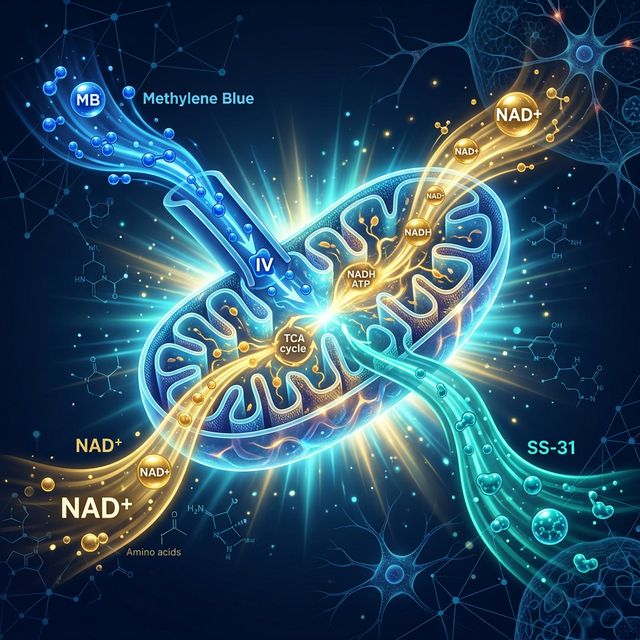
Methylene Blue: The 130-Year-Old Mitochondrial Drug
Methylene blue (methylthioninium chloride) was synthesized in 1876 and has been used medically for over a century — for malaria, methemoglobinemia, urinary tract infections, and as a surgical dye. It is on the WHO's List of Essential Medicines. And in the last decade, it has been repurposed as a mitochondrial enhancer with remarkable bioenergetic properties.
The mechanism is elegant. Methylene blue functions as an alternative electron carrier in the mitochondrial electron transport chain (ETC). Normally, electrons flow from Complex I → ubiquinone → Complex III → cytochrome c → Complex IV → oxygen. If Complex I or III is damaged or inefficient (as occurs with aging), electrons leak, producing superoxide radicals. Methylene blue can accept electrons from NADH at Complex I and donate them directly to cytochrome c, effectively bypassing damaged portions of the ETC.
This electron shuttle function means methylene blue: (1) increases ATP production even when ETC complexes are partially dysfunctional, (2) reduces electron leak and ROS production by providing an alternative path, (3) cycles between its oxidized form (blue) and reduced form (colorless) continuously — it is a renewable catalyst, not a one-time antioxidant. At low doses (0.5-4 mg/kg), methylene blue enhances mitochondrial function. The key: low-dose. At high doses, methylene blue has pro-oxidant effects — the hormetic dose-response is critical.
NAD+ Precursors: Fueling the Cellular Engine
NAD+ (nicotinamide adenine dinucleotide) is the essential cofactor for mitochondrial energy production and for sirtuins — the "longevity enzymes" that regulate DNA repair, gene expression, and cellular stress response. NAD+ levels decline approximately 50% between ages 40 and 60. This decline is now considered a hallmark of aging.
NAD+ precursor supplementation aims to restore youthful NAD+ levels. The three main precursors: (1) NMN (nicotinamide mononucleotide) — the immediate precursor to NAD+, converted by the enzyme NMNAT. Clinical studies (including the Phase II NMNN trial by Igarashi et al.) have shown that 250-500 mg/day NMN increases blood NAD+ levels by 40-80% and improves muscle insulin sensitivity and aerobic capacity in older adults. (2) NR (nicotinamide riboside) — converted to NMN and then to NAD+ via a two-step pathway. The CHROMADEX study and others have confirmed dose-dependent NAD+ elevation. (3) Niacin (nicotinic acid/B3) — the original NAD precursor, effective but dose-limited by flushing. Each precursor has different tissue distribution, bioavailability, and side effect profiles.
The peptide connection: NAD+ is the fuel. Mitochondria are the engine. If the engine is structurally damaged (cardiolipin oxidation, ETC disassembly), adding more fuel alone is insufficient. This is why the combination of NAD+ precursors with mitochondrial-targeted peptides (SS-31, MOTS-c) represents a mechanistically complementary approach.
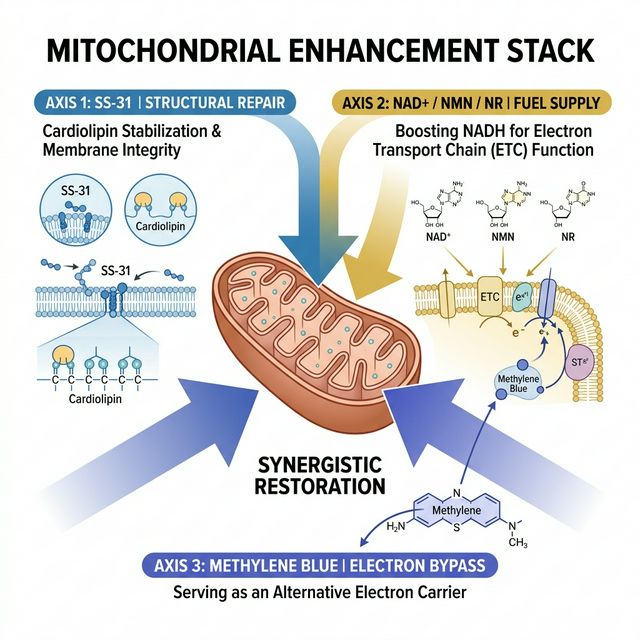
The Mitochondrial Enhancement Stack
The "mitochondrial stack" combines three mechanistically distinct interventions: (1) SS-31 (elamipretide) — structural repair of the inner mitochondrial membrane, stabilizing ETC supercomplex organization. This is the architectural foundation. (2) NAD+ precursor (NMN 500 mg/day or NR 300 mg/day) — substrate restoration for the ETC and sirtuin enzymes. This is the fuel supply. (3) Methylene blue (low-dose, 0.5-2 mg/kg) — alternative electron carrier that bypasses damaged ETC components and provides a renewable antioxidant shuttle.
Each component addresses a different bottleneck. SS-31 fixes the hardware. NAD+ replenishes the consumables. Methylene blue provides a backup circuit. Together, they target mitochondrial dysfunction from three independent angles — this is why the combination has theoretical synergy beyond any individual intervention.
Additional stack components used by some practitioners: CoQ10 (200-400 mg/day) as ubiquinone replenishment for the ETC; PQQ (20 mg/day) for mitochondrial biogenesis stimulation; and MOTS-c peptide (5-10 mg/week) for metabolic regulation via the mitochondrial-derived peptide pathway.
Practical Protocols and Monitoring
Methylene blue dosing for mitochondrial enhancement: 0.5-2 mg/kg orally, taken in the morning (it has mild nootropic/stimulant effects). Start at the lowest dose. Pharmaceutical-grade methylene blue (USP grade, >98% purity) is essential — industrial-grade methylene blue contains heavy metal contaminants. Expect blue-green urine — this is normal and harmless. Avoid combining with serotonergic medications (SSRIs, SNRIs, MAOIs, tramadol) — methylene blue has MAO-A inhibitory activity and the combination can cause serotonin syndrome.
NAD+ precursor dosing: NMN 250-1000 mg/day sublingual or oral, taken in the morning; NR 300-600 mg/day oral. Both are generally well-tolerated. Some users report disrupted sleep if taken late in the day.
Monitoring: baseline and 90-day labs should include organic acids testing (evaluating mitochondrial function via citric acid cycle intermediaries), lactate/pyruvate ratio (elevated ratio suggests mitochondrial dysfunction), CoQ10 levels, and standard metabolic panels. Subjective improvements in energy, exercise tolerance, and cognitive clarity typically appear within 2-4 weeks. Use the CalcMyPeptide dose calculators for any injectable components (SS-31, MOTS-c) to ensure accurate reconstitution and dosing.