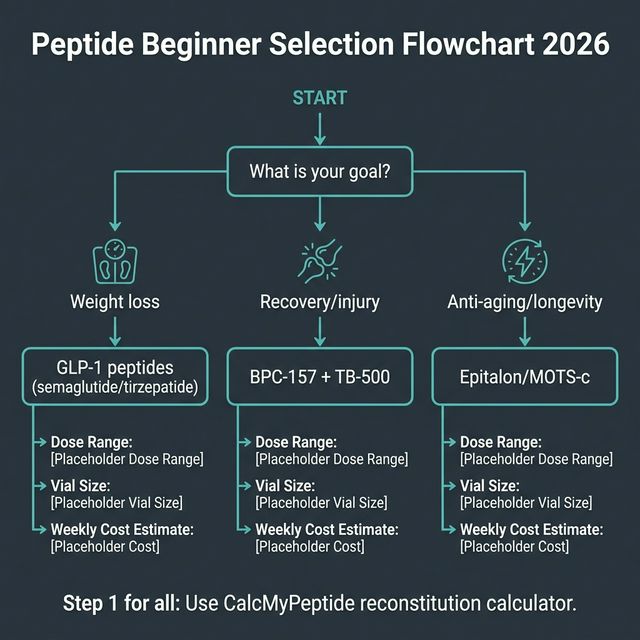
What Are Peptides? A Beginner's Guide for 2026
Peptides are short chains of amino acids — the same building blocks as proteins, but smaller. While proteins contain hundreds to thousands of amino acids, peptides typically contain 2–50. This size difference is critical: peptides are small enough to interact with highly specific receptor targets in the body, making them precise signaling molecules. Hormones like insulin (51 amino acids) and growth hormone-releasing hormone (GHRH, 44 amino acids) are peptides. The pharmaceutical class of therapeutic peptides has expanded dramatically since 2020 — GLP-1 agonists like semaglutide (Wegovy, Ozempic) and tirzepatide (Mounjaro) are now the most commercially successful peptide drugs in history. CalcMyPeptide provides free dose calculators for GLP-1 peptides and research peptides alike.
This guide is designed for 2026 beginners: people who have heard about peptides through GLP-1 weight loss drugs, sports recovery communities, biohacking, or longevity research, and want a factual, evidence-based foundation before exploring further.
Types of Peptides: What's Available in 2026
Peptides used in research and clinical contexts fall into several functional categories:
| Category | Examples | Primary Use |
|---|---|---|
| GLP-1 agonists | Semaglutide, tirzepatide | Weight management, T2D |
| GH secretagogues | Ipamorelin, CJC-1295, sermorelin, MK-677 | Growth hormone optimization |
| Healing/recovery | BPC-157, TB-500 | Tissue repair, injury recovery |
| Cognitive | Semax, Selank, Dihexa | Neuroprotection, focus |
| Longevity | Epitalon, MOTS-c | Anti-aging, telomere support |
| Aesthetic | GHK-Cu, melanotanII, PT-141 | Skin, hair, sexual function |
| Metabolic | AOD-9604, tesamorelin | Fat loss, GH fragment activity |
Each category works through different receptor systems. GLP-1 agonists activate GLP-1 receptors in the gut and brain. GH secretagogues stimulate the pituitary. BPC-157 works through growth factor upregulation (VEGF, FGF). Understanding the mechanism helps you assess how well the available evidence supports each peptide's use.
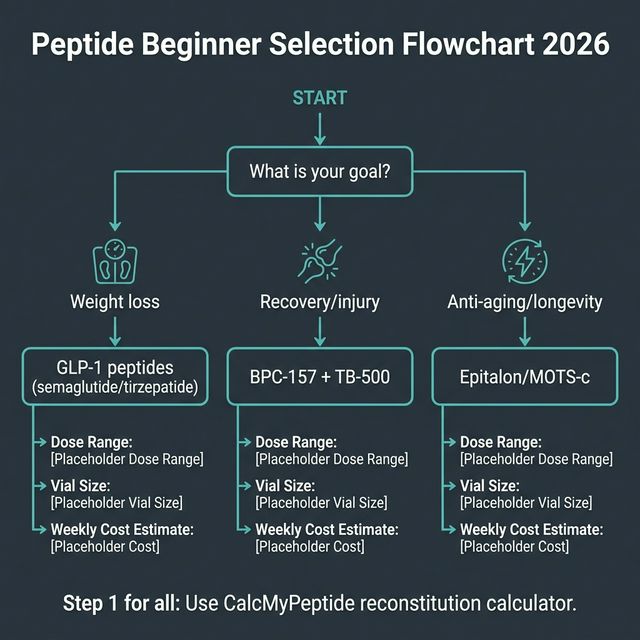
How Are Peptides Different from Steroids?
This is the most common beginner question. The key differences:
• Mechanism: Steroids (testosterone, nandrolone, stanozolol) bind intracellular androgen receptors and directly alter gene transcription broadly. Peptides bind specific extracellular receptors or signal through growth factor pathways — more targeted, shorter duration of action.
• Side effects: Steroids suppress the hypothalamic-pituitary-gonadal (HPG) axis, causing testicular atrophy, infertility risk, elevated hematocrit, and liver stress (especially oral 17-alpha alkylated steroids). Peptides generally do not suppress the HPG axis (growth hormone secretagogues may suppress natural GH pulse amplitude, but the axis recovers quickly).
• Detectability: Both classes appear on WADA prohibited lists. BPC-157 and TB-500 are WADA-listed, as are most GH secretagogues.
• Legal status: Testosterone and most anabolic steroids are Schedule III controlled substances in the US. Most peptides are not scheduled controlled substances — they exist in a regulatory gray area as "research chemicals" or are available as compounded medications.
How to Reconstitute a Peptide: Step-by-Step for Beginners
Reconstitution is the process of dissolving a freeze-dried (lyophilized) peptide powder into sterile liquid for injection. Unlike drugs that come pre-dissolved, most research peptides and many compounded GLP-1 preparations ship as dry powder that must be reconstituted before use. Stability of reconstituted peptide solutions has been well-characterized (Manning MC et al., Pharm Res, 2010, PMID: 20499271).
You need: lyophilized peptide vial, bacteriostatic water (BAC water), insulin syringe, alcohol swabs, clean workspace.
1. Swab the peptide vial rubber stopper with 70% IPA. Air-dry 10 seconds.
2. Draw your chosen BAC water volume (e.g., 2 mL) into an insulin syringe.
3. Insert needle through stopper at a 45° angle. Inject water slowly down the inside wall — never spray directly on the powder.
4. Swirl gently (never shake) until powder is completely dissolved. Solution should be clear and colorless.
5. Label the vial with peptide name, date, and concentration. Refrigerate at 2-8°C. Use within 28 days.
Dose math: For a 5 mg vial + 2 mL BAC water → concentration = 2.5 mg/mL = 2,500 mcg/mL. On a U-100 insulin syringe, each unit = 25 mcg. For 250 mcg: draw 10 units. Use the CalcMyPeptide free reconstitution calculator to get the exact units for any vial and dose combination.
What Peptides Are Best for Beginners?
The best beginner peptides have the most favorable evidence-to-risk ratios: well-studied mechanisms, well-characterized side effect profiles, and meaningful evidence of clinical effect.
Best beginner peptides by category:
• Healing: BPC-157. Extensive preclinical data, excellent tolerability, clear mechanism. Most popular research peptide in the sports recovery community.
• Weight/metabolic: Compounded semaglutide or tirzepatide (with physician oversight). FDA-approved molecules with the most rigorous human clinical trial data of any peptide class.
• GH optimization: Ipamorelin. Highly selective, minimal cortisol/prolactin effect vs older GHRPs. Often stacked with CJC-1295 for synergistic effect.
• Longevity: Epitalon. Longest studied longevity peptide (35+ years, Russian research). Activates telomerase; generally well-tolerated at low doses.
Peptides to avoid as a beginner: CJC-1295 with DAC (long half-life requires careful titration), Hexarelin (potent cortisol elevation), Melanotan II (systemic side effects, nausea common at higher doses).
How Do Peptides Work? The Mechanism Behind the Signals
Most peptides work through receptor binding. A peptide's amino acid sequence creates a specific 3D shape that fits a particular receptor — like a key in a lock. When the peptide binds, it activates an intracellular signaling cascade that changes gene expression or biochemical activity.
Examples: GLP-1 binds GLP-1 receptors on pancreatic beta cells → triggers cAMP → increases insulin release. BPC-157 binds VEGFR (vascular endothelial growth factor receptor) → activates VEGF pathway → promotes new blood vessel formation. Ipamorelin binds ghrelin receptors in the pituitary → triggers GH pulse.
The specificity of receptor binding is what makes peptides precise: ipamorelin targets only GH secretion with minimal cortisol or prolactin effect (Raun K et al., Eur J Endocrinol, 1998, PMID: 9703375), while older GHRPs like GHRP-6 non-specifically activate multiple pathways including cortisol and prolactin.
What Is the Difference Between Subcutaneous and Intramuscular Peptide Injection?
Subcutaneous (SubQ) injection deposits the peptide into the fat layer just under the skin. Intramuscular (IM) injection deposits it directly into muscle tissue. The vast majority of research peptides are injected subcutaneously — into the abdominal fat, thigh, or upper arm. SubQ offers: slower absorption (smooth pharmacokinetic curve), less pain, easier self-injection, no requirement for muscle mass.
IM injection: faster absorption peak (but shorter duration), more discomfort, requires deeper injection technique. Some GLP-1 protocols and TB-500 loading protocols use IM for faster onset during acute treatment periods. However, SubQ is standard for most peptide protocols and is the route used in major clinical trials (Wilding JPH et al., N Engl J Med, 2021). Use our peptide injection master guide for site maps and technique.
Is It Safe to Mix Multiple Peptides?
Stacking peptides (using two or more simultaneously) is common in experienced user communities. Known safe combinations: BPC-157 + TB-500 (Wolverine Stack) — complementary mechanisms, no known interactions. Ipamorelin + CJC-1295 — synergistic GH release, well-characterized combination. GHK-Cu added to either stack — additive collagen/repair signaling.
Caution: Stacking increases complexity and makes it harder to identify which peptide is causing any side effects. Always introduce new peptides one at a time, waiting 2-4 weeks to assess tolerability before adding the next. Never stack peptides with active cancer history due to shared angiogenic mechanisms (BPC-157, TB-500, GHK-Cu all promote VEGF-related angiogenesis).