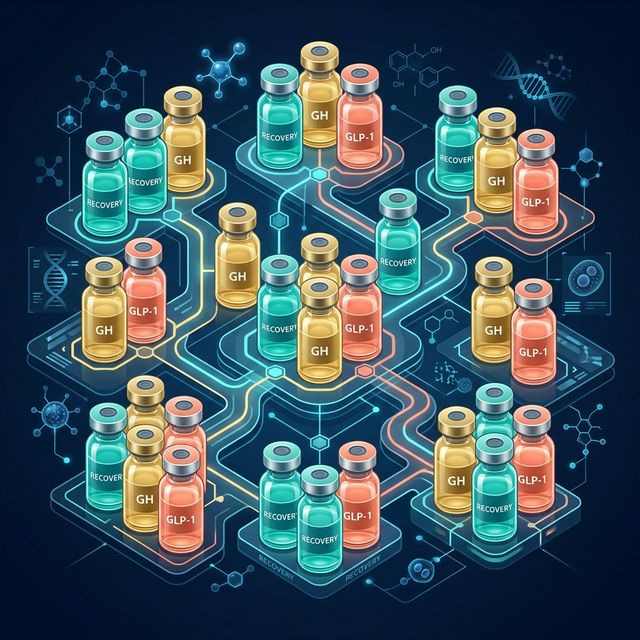
The Logic Behind Peptide Stacking
Peptide stacking — using two or more peptides simultaneously — is predicated on a simple pharmacological principle: different peptides activate different receptors through different mechanisms. When you combine peptides that target complementary pathways, you can achieve results that neither peptide could produce alone. The classic example is the GHRP + GHRH stack: ipamorelin (a GHRP that initiates the GH pulse via the ghrelin receptor) combined with CJC-1295 no DAC (a GHRH analog that amplifies the pulse via the GHRH receptor). Together, they produce 2-3x more GH release than either alone.
But stacking isn't just about "more is better." Smart stacking follows three principles: (1) Mechanism complementarity — stack peptides that work through different pathways converging on the same outcome. (2) Timing optimization — understand pharmacokinetics so peptides peak at the right times. (3) Safety consideration — avoid stacking peptides with overlapping side effect profiles that could amplify adverse effects.
Proven Stacks by Category
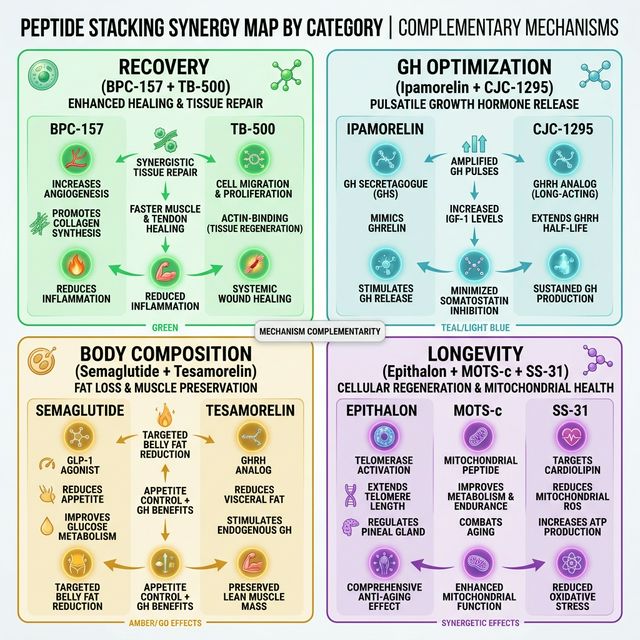
**Recovery Stack (Wolverine Protocol):** BPC-157 (250 mcg 2x daily) + TB-500 (2 mg 2x weekly). BPC-157 provides localized healing via VEGF/FGF upregulation; TB-500 provides systemic recovery via actin regulation and thymosin beta-4 anti-inflammatory effects. Together, they address both local tissue repair and systemic inflammation. Inject BPC-157 near the injury site, TB-500 subcutaneously anywhere.
**GH Optimization Stack:** Ipamorelin (200-300 mcg) + CJC-1295 no DAC (100 mcg), injected together 2-3x daily on empty stomach. The GHRP+GHRH synergy produces physiological pulsatile GH release. Add MK-677 (10-25 mg oral, morning) if you want sustained baseline GH elevation throughout the day — but monitor for water retention and insulin resistance.
**Body Composition Stack:** Semaglutide (0.25-2.4 mg weekly, dose escalated) + Tesamorelin (1-2 mg daily). Semaglutide reduces appetite and total body fat via GLP-1 receptor agonism; tesamorelin selectively reduces visceral adipose tissue via GH-mediated lipolysis. Different mechanisms, same goal, minimal overlapping side effects.
**Longevity Stack:** Epithalon (5-10 mg daily, 10-20 day cycles) + MOTS-c (5-10 mg 3-5x weekly) + SS-31 (5-10 mg daily). Epithalon activates telomerase; MOTS-c activates AMPK for metabolic resilience; SS-31 stabilizes mitochondrial membrane cardiolipin. Three independent longevity mechanisms with no known interactions.
Stacking Safety Rules
**Never stack peptides with overlapping side effects at full doses.** If both peptides cause nausea (e.g., GLP-1 agonists + Melanotan II), start each at a reduced dose and escalate separately. **Never stack two GHRP peptides** (e.g., ipamorelin + hexarelin) — they compete for the same receptor, and hexarelin's cortisol/prolactin elevation combined with another GHRP provides no benefit and more side effects.
**Timing matters.** GH secretagogues should be taken on an empty stomach (2 hours fasted). GLP-1 agonists are given weekly regardless of meals. BPC-157 works best injected near the injury site. Melanotan II should be taken 30-60 minutes before UV exposure. If stacking multiple injections, they can go in the same syringe ONLY if both are reconstituted with the same diluent and neither manufacturer prohibits mixing. Otherwise, use separate injection sites.
**Monitor and adjust.** When starting a new stack, add one peptide at a time — never start two new peptides on the same day. This allows you to attribute any side effects to the correct peptide. Run each peptide solo for at least 1-2 weeks before adding the next. Use the CalcMyPeptide Blend/Stack calculator to verify that your combined concentrations are correct if reconstituting into a single vial.