What Are Peptides for Gut Health?
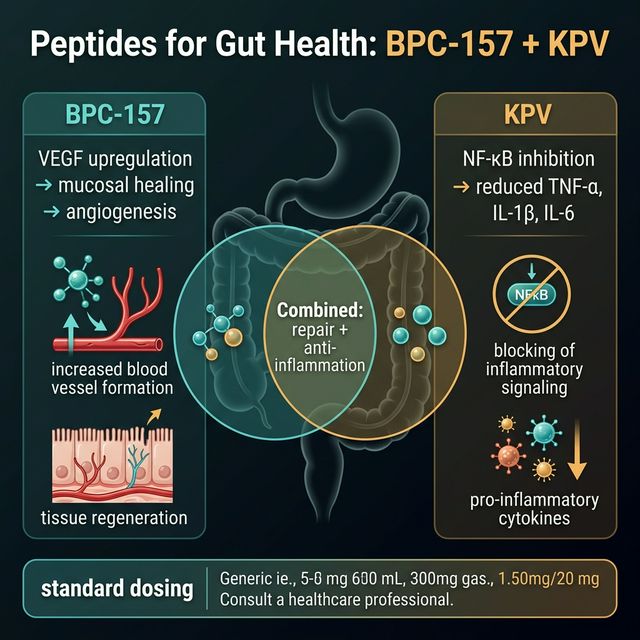
Peptides for gut health are amino acid chains that target specific pathways in gastrointestinal inflammation, mucosal repair, and intestinal permeability. Unlike broad-spectrum anti-inflammatories (NSAIDs, corticosteroids), therapeutic peptides can act on specific molecular targets — making them attractive for conditions like inflammatory bowel disease (IBD), irritable bowel syndrome (IBS), and leaky gut syndrome. BPC-157 (Body Protection Compound-157) and KPV (Lys-Pro-Val) are the two most studied gut health peptides, each addressing a distinct axis of GI pathology. CalcMyPeptide provides free dose calculators for both peptides.
BPC-157 was originally isolated from human gastric juice — it has an inherent affinity for GI tissue and has been shown to protect and repair the gastric mucosa in over 30 animal studies across multiple GI conditions. KPV is a 3-amino-acid tripeptide fragment of alpha-melanocyte stimulating hormone (α-MSH) that specifically inhibits NF-κB, reducing pro-inflammatory cytokines TNF-α, IL-1β, and IL-6.
How Does BPC-157 Heal the Gut?
BPC-157 heals gastrointestinal tissue through several complementary mechanisms, all stemming from its original isolation from human gastric juice (Sikiric P et al., J Physiol Pharmacol, 2006, PMID: 17106110):
1. VEGF upregulation: BPC-157 increases vascular endothelial growth factor (VEGF), promoting angiogenesis — new blood vessel formation — in damaged mucosal tissue. New capillaries deliver oxygen and nutrients for repair.
2. FGF activation: Fibroblast growth factor (FGF) activation promotes epithelial cell proliferation to replace damaged mucosal cells.
3. Growth hormone receptor expression: BPC-157 upregulates GH receptor expression in fibroblasts, amplifying the local tissue repair signal.
4. Direct cytoprotection: BPC-157 has direct cytoprotective effects on gastric epithelial cells independent of growth factor upregulation, preserving mucosal integrity under chemical and physical stress.
Animal models have shown BPC-157 effectiveness in: NSAID-induced gastric ulcers, colitis (IBD model), short bowel syndrome, fistula healing, esophageal damage, and anastomosis healing after bowel surgery.
What Is KPV and How Does It Reduce GI Inflammation?
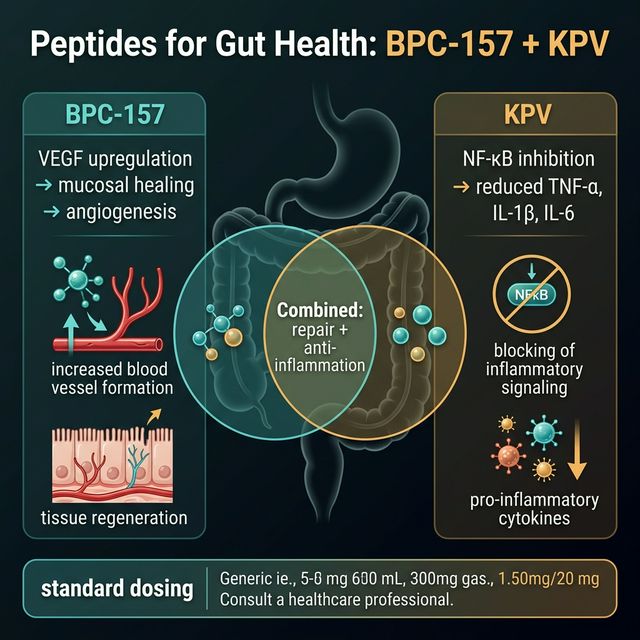
KPV (Lysine-Proline-Valine) is a tripeptide fragment of the C-terminus of alpha-melanocyte stimulating hormone (α-MSH). It inhibits NF-κB (nuclear factor kappa-light-chain-enhancer of activated B cells), the master transcription factor that drives the expression of pro-inflammatory cytokines (Luger TA et al., Ann Rheum Dis, 2000, PMID: 10817504).
When NF-κB is blocked, production of TNF-α (tumor necrosis factor-alpha), IL-1β (interleukin-1 beta), and IL-6 decreases. These are the primary cytokines driving mucosal inflammation in IBD, Crohn's disease, and ulcerative colitis. KPV also inhibits pro-inflammatory pathways in intestinal epithelial cells and macrophages — the immune cells that drive chronic gut inflammation. Dalmasso G et al. (Clin Exp Immunol, 2008, PMID: 18826494) demonstrated that KPV reduces NF-κB activity in intestinal cells and decreases colitis severity in mouse models.
KPV is particularly interesting because it can also be delivered orally via a nanoparticle delivery system that protects it from gut proteases — making it theoretically viable as an oral therapeutic for IBD.
BPC-157 + KPV Stack Protocol
Combined protocol for gut health applications (based on animal research and clinical community data):
| Peptide | Dose | Frequency | Route |
|---|---|---|---|
| BPC-157 | 250–500 mcg | Once or twice daily | SubQ (near abdomen) or oral |
| KPV | 500 mcg | Once daily | SubQ or emerging oral |
Reconstitution for BPC-157 5 mg vial with 2 mL BAC water: concentration = 2,500 mcg/mL. On a U-100 syringe, each unit delivers 25 mcg. For 250 mcg: draw 10 units. Use the CalcMyPeptide reconstitution calculator for your exact vial configuration.
Cycle length: 4–8 weeks for active gut conditions. Some protocols continue at lower frequency (3–5×/week) for maintenance.
Note on oral BPC-157: Animal studies suggest BPC-157 survives gastric acid and accumulates in GI tissue when taken orally, making it a potential option specifically for gut applications (unlike most peptides, which are destroyed by GI proteases). Use our oral vs injectable bioavailability guide for more on this topic.
Clinical Evidence for Gut Health Peptides
The evidence base for BPC-157 is extensive in animal models but limited in human clinical trials. Notable studies:
• Sikiric P et al. (J Physiol Pharmacol, 2006): BPC-157 showed cytoprotective effects in bowel disease models, colitis, and NSAID-induced ulceration in rats
• Sikiric P et al. (Curr Pharm Des, 2019, PMID: 29969968): BPC-157 reverses side effects of NSAIDs and corticosteroids in GI tract animal models
For KPV: Dalmasso G et al. (2008) established the NF-κB inhibition mechanism in intestinal epithelial cells. Research into oral nanoparticle-delivered KPV for colitis has continued, with promising preclinical results.
No large-scale human RCTs have been published for either peptide specifically for IBD or IBS as of 2026. Human evidence is primarily from case reports and observational data in the medical literature.
How Does BPC-157 Protect the Gastric Mucosa?
BPC-157 was originally isolated from human gastric juice, giving it a structural affinity for gastric tissue. Its cytoprotective mechanism operates through prostaglandin E2 (PGE2) pathways and nitric oxide (NO) synthesis — the same pathways that native gastric protective mechanisms use. BPC-157 upregulates cyclooxygenase-2 (COX-2) and eNOS in gastric tissue, promoting mucus secretion, bicarbonate output, and mucosal blood flow. This explains its effectiveness as a protection against NSAID-induced ulcers, which work by inhibiting these exact prostaglandin pathways.
Is KPV Effective for IBD?
Preclinical evidence is promising. KPV reduces NF-κB activity, decreases pro-inflammatory cytokine production, and attenuates colitis severity in mouse models (Dalmasso G et al., 2008). Its mechanism of targeting NF-κB aligns with the pathophysiology of IBD — both Crohn's and ulcerative colitis involve excessive NF-κB activation in intestinal epithelial cells and macrophages. However, no Phase 2 or 3 human clinical trials have been completed for KPV in IBD as of 2026. The research is ongoing and the preclinical rationale is strong.
Can BPC-157 Be Taken Orally for Gut Benefits?
Unlike most peptides, BPC-157 may retain activity when taken orally specifically for gut health. Animal studies show that oral BPC-157 survived gastric acid exposure and accumulated preferentially in GI tissue (not distributed systemically) — this is possible because BPC-157 is resistant to trypsin digestion, an unusual property for a peptide. This makes oral delivery viable for addressing gut-specific issues like mucosal damage, IBD, and gastric ulcers, even while injectable delivery is needed for systemic effects (tendon healing, brain-gut axis). However, oral bioavailability for systemic targets remains essentially zero. For gut-specific therapeutic use, oral BPC-157 is being explored. Always verify with your healthcare provider.