
The Pineal Gland: Master Clock of Aging
The pineal gland is a pine-cone-shaped neuroendocrine organ weighing approximately 150 mg, located at the geometric center of the brain. Despite its tiny size, it serves as the master regulator of circadian rhythm and melatonin production — functions that profoundly influence sleep quality, immune function, antioxidant defense, and aging rate. Melatonin production peaks in youth and declines steadily after age 30, falling to near-undetectable levels by age 80.
Vladimir Khavinson's research program at the Saint Petersburg Institute of Bioregulation and Gerontology spent decades studying the pineal gland's role in aging. His central thesis: organ-specific short peptides, when administered exogenously, can restore gene expression patterns to a more youthful state. For the pineal gland, that peptide is Pinealon (Glu-Asp-Arg), a synthetic tripeptide designed to mimic the regulatory peptides naturally produced by pineal tissue.
Pinealon: Mechanism and Research
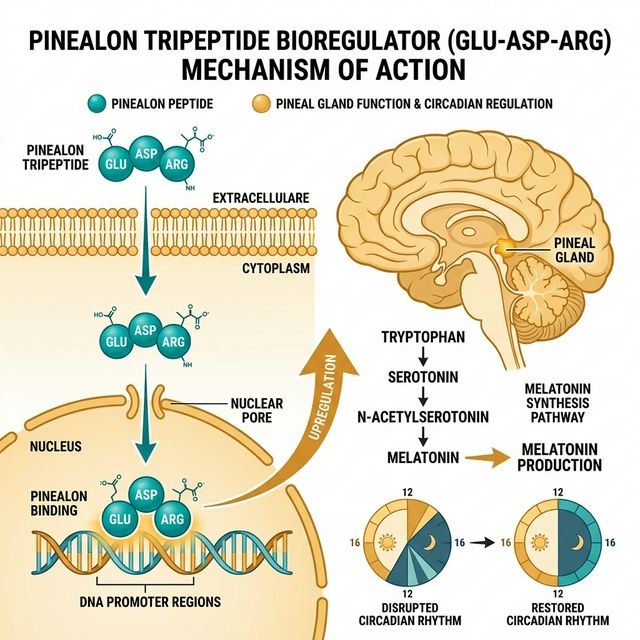
Pinealon (Glu-Asp-Arg, molecular weight 390 Da) is classified as a bioregulatory peptide — a term from Khavinson's framework describing ultra-short peptides (2-4 amino acids) that interact directly with DNA promoter regions to modulate gene expression. The proposed mechanism: Pinealon penetrates cell membranes (due to its small size and charge distribution), enters the nucleus, binds to specific DNA sequences in the promoter regions of genes involved in pinealocyte function, and upregulates their expression.
In cell culture studies, Pinealon has been shown to: increase melatonin synthesis in pinealocyte cultures, promote neuronal survival under oxidative stress conditions, enhance expression of genes involved in circadian rhythm regulation, and reduce markers of cellular senescence in brain tissue cultures. In animal studies, Pinealon administration improved cognitive function in aged rats, normalized disrupted circadian rhythms, and extended survival in irradiated mice.
The clinical evidence base for Pinealon specifically is far less robust than for Epithalon (another Khavinson peptide). Most published data comes from Russian-language journals with limited peer review by Western standards. However, the biological plausibility is strong: pineal function clearly declines with age, melatonin replacement has documented benefits, and short peptides can indeed penetrate cell membranes and bind DNA.
Protocols and Practical Considerations
Pinealon is typically administered as an oral sublingual preparation or via subcutaneous injection. Common protocols from Khavinson's clinical work: sublingual tablets at 200-400 mcg, 2-3 times daily for 10-20 days, repeated every 3-6 months. Injectable: 1-2 mg SubQ or IM daily for 10-20 days per cycle. The cycling pattern mirrors other bioregulators — the theory is that short courses "retrain" gene expression, and the effects persist beyond the administration window.
Pinealon is often stacked with other bioregulators in comprehensive anti-aging protocols: Epithalon for telomere maintenance, Thymalin for immune restoration, and Cortexin or Cerebrolysin for broader neuroprotection. This multi-peptide approach reflects Khavinson's concept of systemic bioregulation — treating aging as a multi-organ coordination failure rather than a single-pathway problem.
Important caveats: (1) Pinealon research is predominantly from one research group, raising independence concerns. (2) Most studies are in Russian journals not indexed in PubMed. (3) Clinical sample sizes are small. (4) Mechanism of "DNA binding" for a tripeptide is theoretically possible but not fully characterized at the molecular level. Consider Pinealon experimental and approach with calibrated expectations.