Thymosin Alpha-1
FDA-orphan-drug thymic peptide (Zadaxin) approved in 35+ countries for hepatitis B/C and as an immune adjunct.
🔬 Mechanism of Action
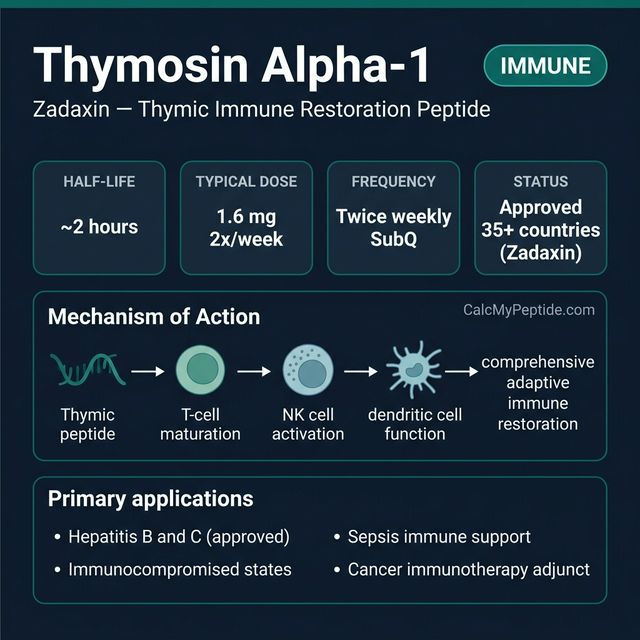
Thymosin Alpha-1 (Tα1) is a 28-amino-acid peptide naturally produced by the thymus gland. It plays a central role in adaptive immunity by orchestrating T-cell maturation, differentiation, and activation. Tα1 activates toll-like receptors (TLR2, TLR9), enhances dendritic cell presentation, stimulates natural killer (NK) cells, and promotes T-helper cell differentiation.
FDA-designated as an orphan drug (Zadaxin) and approved in 35+ countries for hepatitis B and C treatment. Clinical studies also demonstrate efficacy as an immune adjuvant in cancer therapy and vaccine enhancement.
Source: PMID: 17316418
📜Background & History
Thymosin Alpha-1 (Tα1, Thymalfasin) is a 28-amino-acid peptide isolated from the thymus gland in 1972 by Allan Goldstein at Albert Einstein College of Medicine — the same researcher who earlier discovered Thymosin Beta-4. It is one of the most studied immunomodulatory peptides with FDA orphan drug status for multiple conditions and commercial approval in 35+ countries (Zadaxin, SciClone Pharmaceuticals) for hepatitis B, hepatitis C, and various immunocompromised states. It is the flagship "thymic peptide" proven to restore immune competence.
🎯 Research Use Cases
- ✓Hepatitis B and C treatment (approved in 35+ countries as Zadaxin)
- ✓Immunocompromised states: chemotherapy, HIV, organ transplant recovery
- ✓Sepsis and critical illness immune support
- ✓Cancer immunotherapy adjunct — enhancing NK and T-cell activity
- ✓Long COVID immune restoration
💉 Dosing Protocol
| Typical Dose | 1.6-3.2 mg twice weekly |
| Frequency | 2× weekly |
| Half-Life | ~2 hours |
| Common Vial Sizes | 5 mg, 10 mg, 20 mg |
🧪 Reconstitution Example
⚠️Safety & Considerations
FDA orphan drug designation. Approved in 35+ countries. Well-tolerated with over two decades of clinical use. Rare side effects include injection site irritation. Safe for immunocompromised patients — that is its primary clinical application.
⚡Interactions & Contraindications
Very favorable safety profile — used in critically ill patients without significant drug interactions. May potentiate effects of checkpoint inhibitors (immunotherapy drugs); monitor with oncology team. Do not combine with immunosuppressants (cyclosporine, tacrolimus) — opposing mechanisms.
🔗Synergies & Common Stacks
BPC-157 handles tissue repair; Thymosin Alpha-1 restores immune competence. Together support comprehensive recovery from surgery, illness, or infection.
LL-37 provides direct antimicrobial activity while Tα1 amplifies systemic adaptive immune response. Combined immune support across innate and adaptive arms.
❓ Frequently Asked Questions
Is Thymosin Alpha-1 FDA-approved?▼
How does Thymosin Alpha-1 differ from Thymosin Beta-4 (TB-500)?▼
📖 References
- Tuthill C, et al. “Thymosin alpha 1: a comprehensive review of the literature.” Ann N Y Acad Sci (2010). PMID: 20633111
- Matteucci C, et al. “Thymalfasin (thymosin-α1) in the prevention of severe infections in immunocompromised patients.” Ann N Y Acad Sci (2017). PMID: 28493411