VIP
Regulatory neuropeptide studied for chronic inflammatory response syndrome (CIRS) and post-COVID immune modulation.
🔬 Mechanism of Action
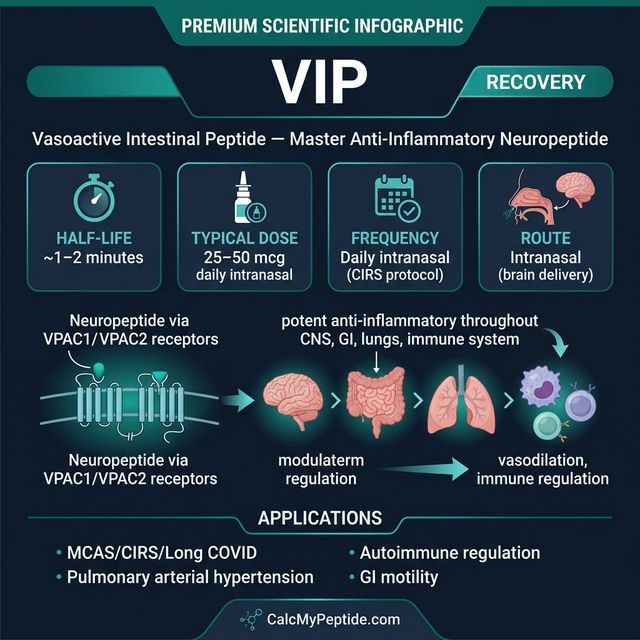
VIP (Vasoactive Intestinal Peptide) is a 28-amino-acid regulatory neuropeptide that acts through VPAC1 and VPAC2 receptors. It has potent vasodilatory, anti-inflammatory, and immunomodulatory effects.
VIP plays a critical role in pulmonary homeostasis — it regulates airway smooth muscle tone, pulmonary arterial pressure, and local immune responses. It has been studied extensively for Chronic Inflammatory Response Syndrome (CIRS), post-COVID immune dysregulation, and mast cell activation syndrome (MCAS). VIP also has neuroprotective properties and supports circadian rhythm regulation.
Source: PMID: 15271596
📜Background & History
VIP (Vasoactive Intestinal Peptide) is a 28-amino-acid neuropeptide discovered in 1970 by Said and Mutt in porcine intestinal tissue. It functions as both a neurotransmitter and hormone, with receptors VPAC1 and VPAC2 distributed throughout the CNS, GI tract, lungs, and immune system. VIP is one of the most potent endogenous anti-inflammatory neuropeptides known, with emerging roles in autoimmune disease, pulmonary arterial hypertension, and chronic inflammatory conditions including MCAS and Long COVID.
🎯 Research Use Cases
- ✓Chronic inflammatory conditions: MCAS, CIRS, Long COVID
- ✓Pulmonary arterial hypertension (PAH)
- ✓Autoimmune regulation: rheumatoid arthritis, Crohn's, MS research
- ✓Gastrointestinal motility disorders
- ✓Neuroprotection in Parkinson's and Alzheimer's (preclinical)
💉 Dosing Protocol
| Typical Dose | 50-200 mcg (intranasal) |
| Frequency | 1-2× daily (intranasal) |
| Half-Life | ~2 minutes |
⚠️Safety & Considerations
Research peptide used clinically for CIRS protocols. Primarily administered intranasally. May cause transient vasodilation (facial flushing, mild hypotension). Not for use in patients with active diarrhea. Monitor blood pressure with initial doses.
⚡Interactions & Contraindications
Potent vasodilator — risk of blood pressure drop, especially with concurrent antihypertensive medications. Very short half-life (1-2 min) requires intranasal or continuous IV administration. Compounded intranasal VIP is most common route in CIRS protocols.
🔗Synergies & Common Stacks
VIP provides broad anti-inflammatory signaling; BPC-157 handles specific tissue repair post-inflammation. Comprehensive for inflammatory GI conditions.
VIP modulates the immune system centrally; KPV blocks NF-κB locally. Together address inflammation from systemic and cellular levels.
❓ Frequently Asked Questions
What is VIP used for in CIRS?▼
How is VIP administered?▼
📖 References
- Petkov V, et al. “Vasoactive intestinal peptide as a new drug for treatment of primary pulmonary hypertension.” J Clin Invest (2003). PMID: 12618522