The Core Difference: Why DAC Changes Everything
CJC-1295 exists in two fundamentally different forms, and the peptide community routinely confuses them. This matters because the pharmacokinetics are not just slightly different — they are categorically different, producing entirely different patterns of growth hormone release.
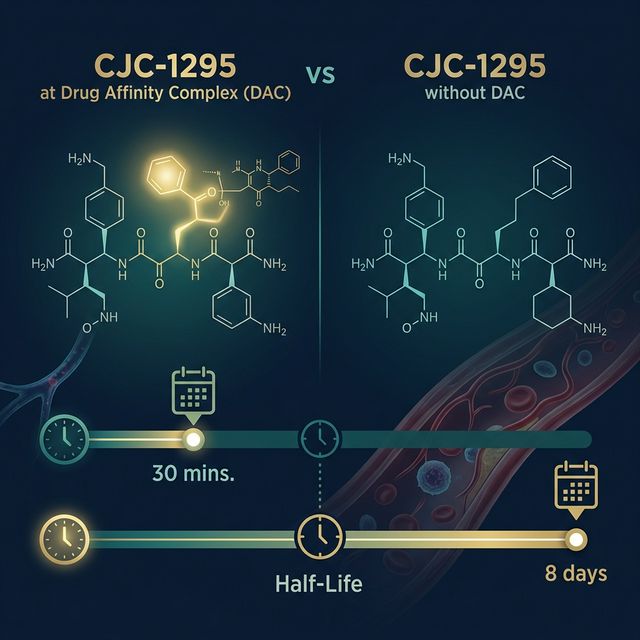
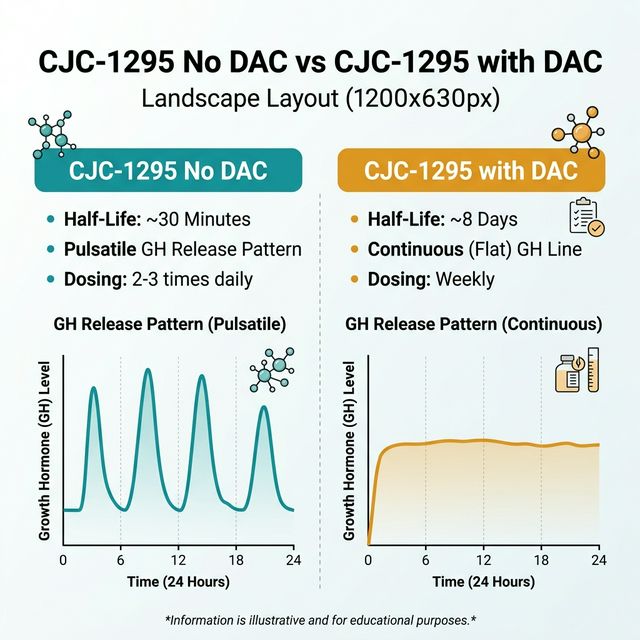
CJC-1295 without DAC — correctly called Modified GRF (1-29) or Mod GRF 1-29 — is a 29-amino-acid GHRH analog with four amino acid substitutions (Ala2, Gln8, Ala15, Leu27) that protect it from enzymatic degradation. Its plasma half-life is approximately 30 minutes. This means it produces a sharp, physiological GH pulse — a burst of growth hormone that rises rapidly, peaks within 30-60 minutes, and returns to baseline within 2-3 hours. This closely mimics natural nocturnal GH pulsatility.
CJC-1295 with DAC (Drug Affinity Complex) adds a maleimidopropionic acid-lysine linker that covalently binds to serum albumin after injection. Albumin has a half-life of approximately 21 days. By hitchhiking on albumin, CJC-1295 with DAC achieves a plasma half-life of 6-8 days. This means a single injection produces sustained, elevated GH levels for nearly a week — not a pulse, but a continuous plateau.
Pharmacokinetic Data: The Numbers Behind Each Version
The pivotal pharmacokinetic study for CJC-1295 with DAC was conducted by Teichman et al. (JCEM, 2006). In 33 healthy subjects, a single 30 mcg/kg subcutaneous dose increased mean GH levels 2-10 fold above baseline, sustained for 6 or more days. IGF-1 levels rose by 1.5-3 fold and remained elevated for 9-11 days after a single injection. The GH elevation was continuous, not pulsatile.
CJC-1295 without DAC (Mod GRF 1-29) does not have comparable published clinical data. The pharmacokinetic profile is extrapolated from its structural similarity to naturally produced GHRH(1-29)NH2 and from community clinical experience. After subcutaneous injection, peak GH occurs at approximately 30-60 minutes, with GH returning to baseline by 2-3 hours. IGF-1 elevation is more modest (approximately 50-100% increase) and transient, requiring repeated daily dosing.
The practical consequence: CJC-1295 with DAC requires injection only 1-2 times per week. CJC-1295 without DAC requires injection 1-3 times daily, typically stacked with a GHRP (most commonly ipamorelin) before bed and optionally upon waking and pre-workout.
Why Most Practitioners Recommend No-DAC
Despite the obvious convenience advantage of weekly dosing, the predominant clinical and community consensus now favors CJC-1295 without DAC for most applications. The reason is physiological: the body releases GH in pulses, not in sustained plateaus.
Natural GH secretion follows a pulsatile pattern — the majority of daily GH output (approximately 70%) occurs in 3-5 discrete pulses during slow-wave sleep, with smaller pulses upon waking and after exercise. This pulsatility is not arbitrary; it is essential for GH receptor sensitivity. Studies in GH-deficient patients (Hindmarsh PC et al., Lancet 1995) demonstrated that pulsatile GH delivery produced significantly better growth outcomes than continuous infusion at identical total GH doses.
CJC-1295 with DAC produces continuous GH elevation that mimics constant GH infusion — the pattern that produces hepatic GH receptor desensitization, excessive IGF-1 elevation, and greater water retention. The sustained IGF-1 elevation is also a theoretical concern for cancer risk, since IGF-1 is a growth factor that promotes cell proliferation.
CJC-1295 without DAC produces the sharp pulse that upregulates GH receptors during the off-period between pulses — the same mechanism that makes natural GH so effective. When combined with ipamorelin (which triggers GH release through a separate ghrelin receptor pathway), the result is an amplified, physiological GH pulse that closely mimics the body's own nocturnal GH release.
Dosing Comparison: Practical Protocols
CJC-1295 with DAC: The standard dose is 1-2 mg subcutaneously, once or twice per week. Because of the long half-life, timing around meals and other peptides is less critical. However, most practitioners inject in the evening to roughly align with nocturnal GH physiology. Do not combine with a GHRP — the sustained GHRH signaling from DAC renders the synergistic GHRH+GHRP timing irrelevant.
CJC-1295 without DAC (Mod GRF 1-29): 100-300 mcg subcutaneously, 1-3 times daily. The most important dose is before bed (30-60 minutes prior to sleep) combined with 100-200 mcg ipamorelin. Optional additional doses upon waking and 30 minutes pre-workout. Inject on an empty stomach — insulin from food blunts the GH pulse. Do not eat for 30 minutes after injection.
For dosing math on either version, the CalcMyPeptide reconstitution calculator handles the conversion from milligrams and water volume to syringe units automatically. For a 5 mg vial of CJC-1295 no DAC reconstituted with 2.5 mL BAC water: concentration = 2 mg/mL = 2000 mcg/mL. For 200 mcg: 200 ÷ 2000 × 100 = 10 units on a U-100 syringe.
When to Choose DAC vs No-DAC
Choose CJC-1295 with DAC if: (1) injection compliance is a major concern and you cannot commit to daily injections; (2) your primary goal is elevated IGF-1 for recovery or muscle growth and you accept the trade-off of non-physiological GH pattern; (3) you have experience with sustained GH elevation and tolerate water retention well.
Choose CJC-1295 without DAC (Mod GRF 1-29) if: (1) you want the most physiological GH release pattern; (2) you plan to stack with ipamorelin for synergistic GHRH+GHRP effect; (3) your goals include fat loss (pulsatile GH is lipolytic between pulses); (4) you want to minimize sustained IGF-1 elevation; (5) you are comfortable with daily subcutaneous injections.
For most people reading this, the answer is CJC-1295 without DAC combined with ipamorelin — it is the most widely used and clinically supported GH secretagogue protocol in the peptide optimization community.