What Is BPC-157?
BPC-157 (Body Protection Compound-157) is a synthetic pentadecapeptide (15 amino acids) derived from a naturally occurring protein in human gastric juice. It has been studied extensively in animal models for its tissue-healing properties, including tendon repair, ligament regeneration, gut mucosal protection, and neuroprotection.
Common vial sizes: 5 mg and 10 mg lyophilized powder.
Typical Dosing Range
Animal studies use doses ranging from 1-10 mcg/kg body weight. Community dosing typically ranges from 200-500 mcg per injection, administered 1-2 times daily via subcutaneous injection near the site of injury.
• Light dose: 200 mcg/day (general wellness)
• Standard dose: 250-300 mcg twice daily (injury recovery)
• Higher dose: 500 mcg twice daily (acute tendon/ligament injuries)
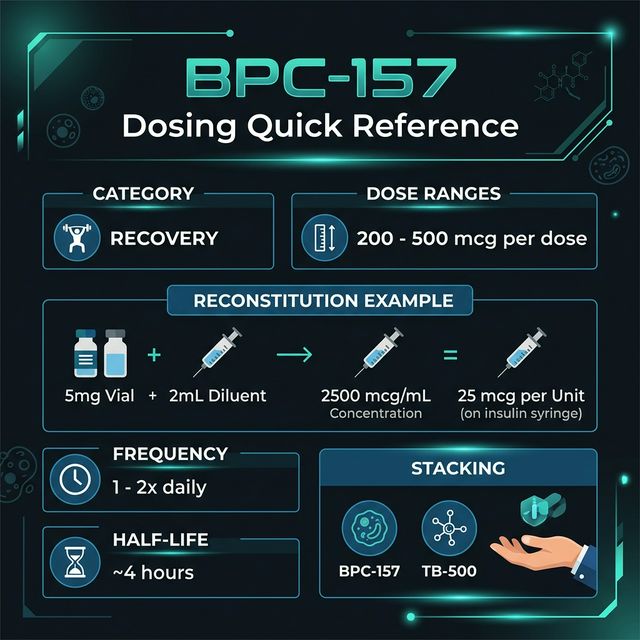
Reconstitution Example: 5 mg Vial
Add 2 mL of BAC water to a 5 mg vial:
• Concentration = 5 mg ÷ 2 mL = 2.5 mg/mL = 2,500 mcg/mL
• Using a 100-unit syringe: each unit = 25 mcg
• For a 250 mcg dose: draw 10 units
• For a 500 mcg dose: draw 20 units
The vial contains 5,000 mcg total. At 500 mcg/day (250 mcg × 2), the vial lasts 10 days.
BPC-157 + TB-500 Stack
Many researchers combine BPC-157 with TB-500 (Thymosin Beta-4) for synergistic healing effects. TB-500 promotes cell migration and angiogenesis, while BPC-157 modulates growth factor expression and reduces inflammation.
A common protocol: BPC-157 250 mcg + TB-500 750 mcg, both injected subcutaneously near the injury site, twice daily for 4-8 weeks.
Use our Blend / Stack Calculator to determine reconstitution volumes and units for multi-peptide protocols.
Half-Life and Injection Frequency
BPC-157 has an estimated half-life of approximately 4 hours, which is why twice-daily dosing is common. Some protocols use a single daily injection at a higher dose (e.g., 500 mcg once daily) for convenience.
Subcutaneous injection near the injury site is most common, though systemic (abdominal) injection is also used for gut healing or systemic effects.
Safety Considerations
BPC-157 has shown a favorable safety profile in animal studies with no reported LD50. However, human clinical trials are limited. Potential concerns include effects on angiogenesis (theoretical concern for those with active cancers) and the general risks associated with injectable peptides (injection site reactions, contamination if sourced from non-reputable vendors).
This information is for educational purposes only. Consult a qualified healthcare provider before using any peptide.