Epitalon
Tetrapeptide (Ala-Glu-Asp-Gly) studied for telomerase activation and anti-aging.
🔬 Mechanism of Action
Epitalon (Epithalon, Эпиталон) is a synthetic tetrapeptide (Ala-Glu-Asp-Gly) and the biologically active component of Epithalamin, a peptide extract from the pineal gland. Confirmed endogenous in pineal extracts in 2017. Developed by Professor Vladimir Khavinson at the St. Petersburg Institute of Bioregulation and Gerontology.
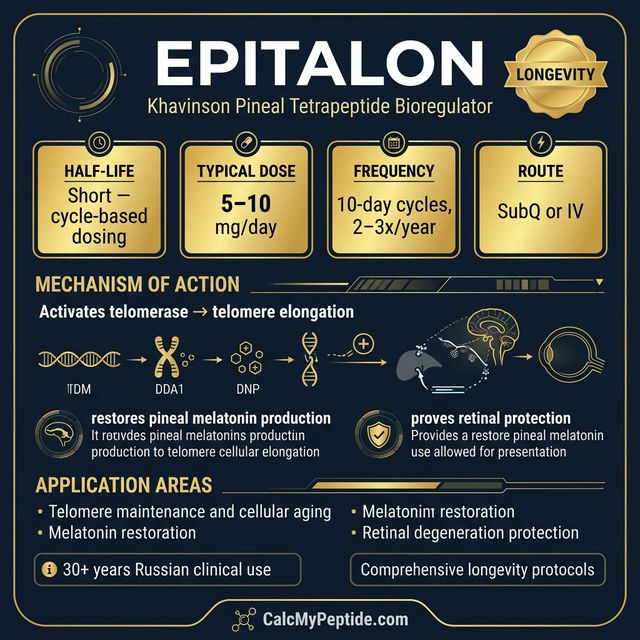
Epitalon operates through four complementary pathways: (1) TERT gene activation — inducing telomerase expression to elongate telomeres, (2) chromatin remodeling — decondensing heterochromatin to reactivate silenced genes, (3) melatonin synthesis — stimulating pineal gland melatonin production for circadian rhythm restoration, and (4) immune/antioxidant modulation. Studies show 33% average telomere length increase and 13.6% lifespan extension in Drosophila models.
Source: PMID: 12937225
📜Background & History
Epitalon (AEDG) is a synthetic tetrapeptide bioregulator developed by Vladimir Khavinson at the Saint Petersburg Institute of Bioregulation and Gerontology in the 1980s–90s. It was designed to mimic the effects of Epithalamin — a natural polypeptide extract from the pineal gland — through a shorter, more practical synthetic form. Khavinson's landmark 2003 study showed Epitalon induced telomerase activity in somatic cells, extending telomere length — one of the first peptides demonstrated to reverse a key biomarker of cellular aging. It has been used in Russian clinical practice for over 20 years.
🎯 Research Use Cases
- ✓Telomere length maintenance and telomerase activation
- ✓Melatonin restoration and circadian rhythm normalization
- ✓Retinal degeneration protection and vision preservation
- ✓Longevity and anti-aging protocols via cellular rejuvenation
- ✓Immune system modulation and cancer protective effects (preclinical)
💉 Dosing Protocol
| Typical Dose | 5-10 mg/day |
| Frequency | 1× daily for 10-20 days, cycle 2-3× per year |
| Half-Life | ~2-4 hours (estimated) |
| Common Vial Sizes | 10 mg, 50 mg |
🧪 Reconstitution Example
⚠️Safety & Considerations
Research peptide with over 35 years of study. No reported toxicity in clinical literature. The 2017 confirmation of endogenous presence supports biological safety. Consult healthcare provider before use. Potential anti-cancer properties (68% tumor reduction in animal models).
⚡Interactions & Contraindications
Excellent safety profile across 30+ years of Russian clinical use. May potentiate sedative effects at night. Theoretically avoid with melanoma or retinal tumors (minimal risk but unestablished safety). Cycle-based dosing (10-day cycles) is the standard Khavinson protocol.
🔗Synergies & Common Stacks
Both are Khavinson pineal bioregulators. Epitalon restores telomerase and melatonin production; Pinealon protects neuronal DNA and melatonin synthesis. Often used in sequence as a comprehensive pineal and longevity protocol.
Thymalin (thymic bioregulator) + Epitalon (pineal bioregulator) is the classic Khavinson longevity stack. Clinical data shows this combination reduces mortality risk in elderly subjects over 12-year follow-up.
❓ Frequently Asked Questions
How does Epitalon extend lifespan?▼
What is the Epitalon dosing protocol?▼
Is Epitalon safe?▼
📖 References
- Khavinson VK. “Peptide regulation of aging: 35-year research experience.” Bull Exp Biol Med (2010). PMID: 21516878
- Khavinson VK, et al. “Epitalon activates telomerase in human somatic cells.” Bull Exp Biol Med (2003). PMID: 14631600
- Anisimov VN, et al. “Effect of Epitalon on biomarkers of aging, life span and spontaneous tumor incidence in female SHR mice.” Biogerontology (2003). PMID: 14501183