Kisspeptin
Neuropeptide that stimulates GnRH release, studied for reproductive health, hypogonadism, and as a diagnostic tool.
🔬 Mechanism of Action
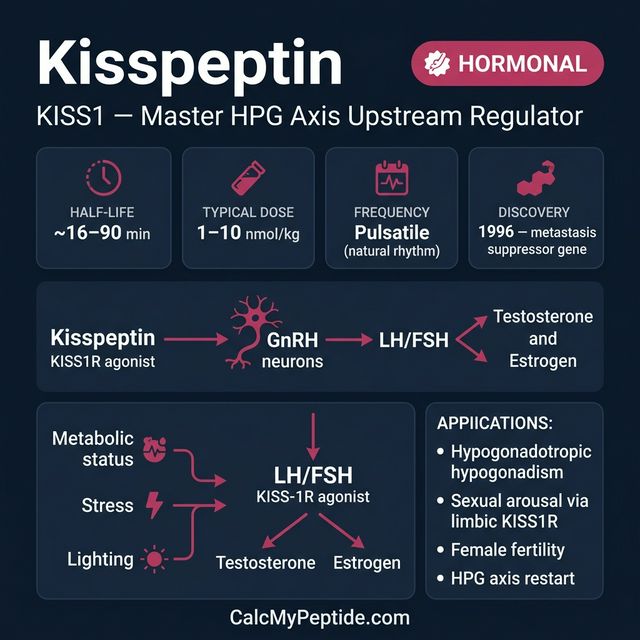
Kisspeptin is a neuropeptide encoded by the KISS1 gene that acts as the master upstream regulator of the reproductive hormone cascade. It activates GPR54 (KISS1R) receptors on hypothalamic GnRH neurons, triggering pulsatile GnRH release which drives LH and FSH secretion.
Kisspeptin sits at the very top of the HPG axis — above GnRH. Loss-of-function mutations in KISS1 or GPR54 cause hypogonadotropic hypogonadism (failure to enter puberty). Exogenous kisspeptin is studied as a diagnostic tool for reproductive disorders and as a therapeutic for functional hypothalamic amenorrhea and male hypogonadism.
Source: PMID: 16140907
📜Background & History
Kisspeptin is a 54-amino-acid peptide encoded by the KISS1 gene, first identified in 1996 as a metastasis suppressor by Danny Welch at Pennsylvania State University. Its role as the master regulator of the hypothalamic-pituitary-gonadal (HPG) axis was discovered in 2003 independently by multiple groups who found KISS1 receptor mutations caused hypogonadotropic hypogonadism. Kisspeptin neurons directly activate GnRH neurons — it is upstream of GnRH in the reproductive endocrine hierarchy. It integrates metabolic status, stress, and environmental cues to regulate fertility and sexual function.
🎯 Research Use Cases
- ✓Hypogonadotropic hypogonadism: restoring LH/FSH/testosterone naturally
- ✓Male sexual arousal via limbic system KISS1R activation
- ✓HPG axis restart after exogenous testosterone suppression
- ✓Female fertility: stimulating ovulation in hypothalamic amenorrhea
- ✓Research: endocrine disruption assessment (clinical probe)
💉 Dosing Protocol
| Typical Dose | 100-500 mcg/dose |
| Frequency | 1-2× daily |
| Half-Life | ~28 minutes |
| Common Vial Sizes | 5 mg |
🧪 Reconstitution Example
⚠️Safety & Considerations
Endogenous neuropeptide with clinical trial data. Short-acting. May cause facial flushing. Being studied in multiple clinical trials for reproductive disorders. Not yet FDA-approved for therapeutic use.
⚡Interactions & Contraindications
Kisspeptin pulses are required for efficacy — continuous GnRH output leads to downregulation. Exogenous testosterone suppresses kisspeptin neurons (negative feedback) — less effective while on TRT. Elevated estrogen also provides negative feedback. Leptin deficiency blunts kisspeptin response (anorexia, extreme caloric restriction).
🔗Synergies & Common Stacks
Kisspeptin drives GnRH neuron firing; Gonadorelin replaces the GnRH signal directly at the pituitary. Together offer complete HPG axis stimulation cascade.
Kisspeptin addresses the hormonal axis (LH, testosterone, ovulation); PT-141 addresses the neurological arousal dimension. Comprehensive sexual health protocol.
❓ Frequently Asked Questions
How is Kisspeptin different from Gonadorelin?▼
Can Kisspeptin be used for PCT?▼
📖 References
- Seminara SB, et al. “Kisspeptin signaling in the HPG axis.” N Engl J Med (2003). PMID: 14573733
- Dhillo WS, et al. “Kisspeptin as a diagnostic tool and therapeutic target in reproductive disorders.” Neuroendocrinology (2012). PMID: 22538355