⚕️ Medical Disclaimer
⚕️ Medical Disclaimer: This article is for educational and informational purposes only. It does not constitute medical advice. Consult a qualified healthcare provider before using any peptide.
The Performance Enhancement Landscape: Three Paths, Very Different Risk Profiles
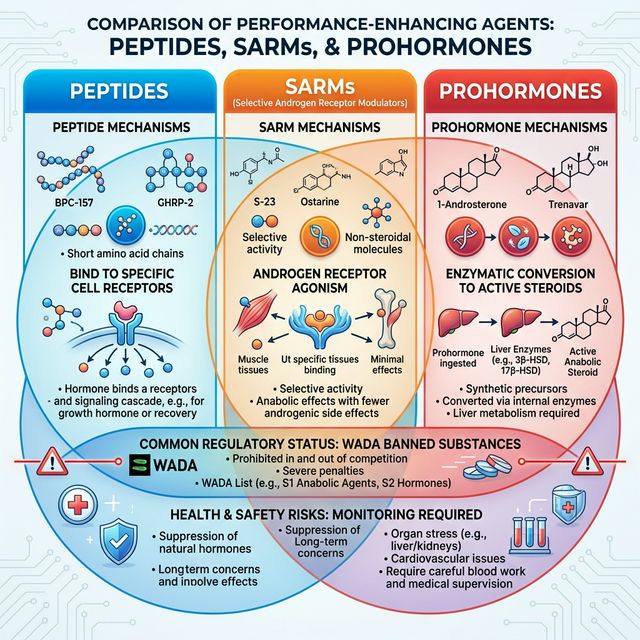
The biohacking and fitness community frequently debates peptides, SARMs, and prohormones as though they are interchangeable tools. They are not. Each category operates through fundamentally different biological mechanisms, carries distinct risk profiles, and occupies a different legal and regulatory space.
Last updated: March 2026
This guide provides a clear, evidence-based comparison to help you understand what each category actually does, how they differ mechanistically, and — critically — which ones carry risks that the marketing materials conveniently omit.
Spoiler: peptides are the broadest category with the most diverse safety profile. SARMs are narrower tools with underappreciated risks. Prohormones are the riskiest of the three despite being the most familiar. Let us break it down.
What Are Peptides (and What Are They Not)?
Peptides are short chains of amino acids (2-50 amino acids) that act as signaling molecules, binding specific receptors to modulate biological processes. They are not hormones (though some stimulate hormone release), not steroids, and not androgens.
Categories of peptides relevant to performance:
• GH Secretagogues — Ipamorelin, CJC-1295, GHRP-2, MK-677 (oral). Stimulate pituitary GH release. Used for recovery, body composition, sleep. See our ipamorelin guide and MK-677 guide.
• Repair Peptides — BPC-157, TB-500, GHK-Cu. Promote tissue healing, angiogenesis, collagen synthesis. See our BPC-157 guide and TB-500 guide.
• GLP-1 Agonists — Semaglutide, tirzepatide, retatrutide. Appetite suppression and metabolic improvement. See our semaglutide calculator.
• Bioregulators — Epithalon, thymalin, cortexin (Khavinson peptides). Gene expression regulation for longevity. See our bioregulator guide.
Key characteristic: Peptides generally work with your body's existing systems rather than overriding them. GH secretagogues ask your pituitary to release more GH — they do not inject synthetic GH. BPC-157 upregulates your tissue repair pathways — it does not replace them.
What Are SARMs?
SARMs (Selective Androgen Receptor Modulators) are synthetic molecules designed to selectively activate androgen receptors in muscle and bone while theoretically sparing prostate, skin, and liver tissue. The promise: steroid-like muscle growth without steroid-like side effects.
Common SARMs:
• Ostarine (MK-2866): Mildest SARM, 1-3 mg/day for osteoporosis research; fitness users take 10-25 mg/day
• LGD-4033 (Ligandrol): Stronger, 5-10 mg/day, significant lean mass gains in trials
• RAD-140 (Testolone): Most potent, 10-20 mg/day, marked testosterone suppression
• S23: Experimental, near-steroid potency, intense suppression
The reality check: Despite the "selective" name, SARMs suppress your hypothalamic-pituitary-gonadal (HPG) axis dose-dependently. LGD-4033 at 1 mg/day reduced testosterone by 55% in a clinical trial over 21 days (Basaria et al., 2013, PMID: 22459616). RAD-140 and S23 cause near-complete suppression at performance doses.
No SARM has ever received FDA approval. All are sold as "research chemicals" — a legal fiction that provides zero quality assurance for the end user.
What Are Prohormones?
Prohormones are precursor compounds that convert into active anabolic-androgenic steroids via enzymatic reactions in your body. They are, functionally, oral steroids with an extra conversion step.
Examples (many now banned):
• DHEA — Converts to testosterone and estrogen. Legal as a supplement. Mild effects.
• 1-Andro (1-DHEA) — Converts to 1-testosterone. Stronger anabolic effect. Legal in some jurisdictions.
• 4-Andro (4-DHEA) — Converts to testosterone directly. Moderate anabolic effect.
• Epistane, Superdrol, DMZ — Methylated prohormones (essentially designer steroids). Banned by DASCA 2014. Extremely hepatotoxic.
The critical issue: methylated prohormones (the most effective ones) cause dose-dependent liver toxicity. Multiple case reports of cholestatic liver injury, jaundice, and liver failure from methylated prohormone use have been published (Stolz et al., 2019, PMID: 31013492). The 2014 Designer Anabolic Steroid Control Act (DASCA) banned most methylated prohormones, but gray-market variants continue to appear.
Head-to-Head Comparison
| Factor | Peptides | SARMs | Prohormones |
|---|---|---|---|
| Mechanism | Receptor signaling, hormone stimulation | Androgen receptor modulation | Enzymatic conversion to active steroids |
| Testosterone impact | Indirect (GH secretagogues may modestly support via sleep/recovery) | Direct suppression (dose-dependent, 40-90%) | Direct conversion to androgens + HPG suppression |
| Liver toxicity | Negligible | Low-moderate (some show liver enzyme elevation) | High (especially methylated compounds) |
| PCT required? | No (most peptides) | Yes (8+ week cycles cause significant suppression) | Yes (always) |
| Legal status (US) | Legal for research use; GLP-1s prescription only | Legal to possess; illegal to sell for human consumption | Mostly banned (DASCA 2014); DHEA legal |
| WADA status | Many banned (S0, S2 categories) | All banned (S1 category) | All banned (S1 category) |
| FDA-approved examples | Semaglutide, tirzepatide (GLP-1); thymalin (overseas) | None | None (DHEA exempt as supplement) |
| Quality assurance | Variable (research grade); prescription GLP-1s are pharmaceutical grade | Very poor (research chemical market) | Very poor (gray market) |
| Typical use case | Recovery, body composition, metabolic health, longevity | Lean mass gain, recomposition | Muscle mass, strength |
| Risk-reward ratio | Favorable for most compounds | Moderate risk, moderate reward | High risk, moderate reward |
Hormonal Suppression: The Critical Difference
This is the single most important distinction between peptides and the other two categories. Most peptides do not suppress your HPG axis. SARMs and prohormones both do — and the recovery consequences are real.
Peptides (GH secretagogues): Ipamorelin, CJC-1295, and MK-677 stimulate your pituitary to produce more GH. They do not directly affect testosterone production. No PCT (post-cycle therapy) is needed. The exception: exogenous GH (not a secretagogue) at supraphysiological doses can suppress natural GH production via negative feedback — but this is HGH, not a peptide secretagogue.
SARMs: Dose-dependent testosterone suppression is established in every clinical trial. Ostarine at 3 mg/day for 12 weeks reduced total testosterone by ~35%. LGD-4033 at 1 mg/day for 21 days reduced testosterone by ~55%. At the doses fitness users commonly take (10-25 mg), suppression can reach 80-90%. Recovery requires 4-8 weeks minimum and sometimes a formal PCT protocol (clomiphene, enclomiphene).
Prohormones: Full HPG axis suppression, identical to oral steroids. PCT is mandatory. Failure to PCT adequately can result in months of low testosterone with associated fatigue, libido loss, mood changes, and muscle loss.
If maintaining your natural hormone production is a priority, peptides are the rational choice. For lab monitoring frameworks, see our blood work guide.
Legal and Regulatory Landscape (2026)
The legal status of each category varies significantly by jurisdiction and evolves frequently:
• Peptides (US): Research peptides are legal to possess and purchase for research use. BPC-157, TB-500, GHRP-2, and similar compounds are not FDA-approved for human use but are not scheduled substances. GLP-1 agonists (semaglutide, tirzepatide) are FDA-approved prescription medications. Compounded versions exist in a regulatory gray zone post-FDA guidance change in 2024.
• SARMs (US): Legal to possess but illegal to sell for human consumption under the SARMs Control Act of 2018 (attempted, not yet passed as of 2026). Currently sold as "research chemicals not for human consumption." The FDA has issued multiple warning letters to SARM vendors.
• Prohormones (US): Most methylated prohormones are Schedule III controlled substances under DASCA 2014. DHEA remains legal as a dietary supplement. 1-Andro and 4-Andro occupy a disputed legal status.
• International: Australia bans all three categories without prescription. The UK allows personal possession of SARMs but prohibits sale. EU status varies by member state. Check your local regulations.
Frequently Asked Questions
Are SARMs safer than steroids? SARMs cause less liver toxicity and less prostate enlargement than traditional oral steroids at equivalent anabolic doses. However, they still suppress testosterone significantly, and the lack of quality control in the research chemical market means you may not be getting what the label says. Third-party testing has found SARM products contaminated with prohormones, heavy metals, and incorrect dosages.
Can I stack peptides with SARMs? Technically yes — BPC-157 or TB-500 for recovery alongside a SARM cycle is a common practice in the community. However, combining suppressive compounds (SARMs) with GH-boosting peptides (ipamorelin, MK-677) complicates your hormonal picture and makes blood work interpretation more challenging.
Do peptides build muscle like SARMs or steroids? Not in the same way. GH secretagogues improve body composition (more muscle, less fat) over months but do not produce the rapid lean mass gains of SARMs or steroids. Peptides work by optimizing your natural physiology rather than overriding it. The gains are more moderate but more sustainable.
What is the safest option for a first-time user interested in body recomposition? A GH secretagogue like ipamorelin + CJC-1295 (see our ipamorelin guide) provides body composition benefits without testosterone suppression, liver toxicity, or PCT requirements. Pair with proper training and nutrition.
Why do people still choose SARMs over peptides? Speed of visible results. A 12-week ostarine cycle can add 3-5 lbs of lean mass visibly. GH peptides take longer and produce subtler recomposition. Some users prioritize observable muscle gain over long-term hormonal health — an informed choice, but one that should come with lab monitoring.
Final Word
⚕️ Medical Disclaimer: This article is for educational and informational purposes only. It does not constitute medical advice. Consult a qualified healthcare provider before using any peptide.