IGF-1 LR3
Modified IGF-1 with extended half-life and reduced IGF binding protein affinity for enhanced bioavailability.
🔬 Mechanism of Action
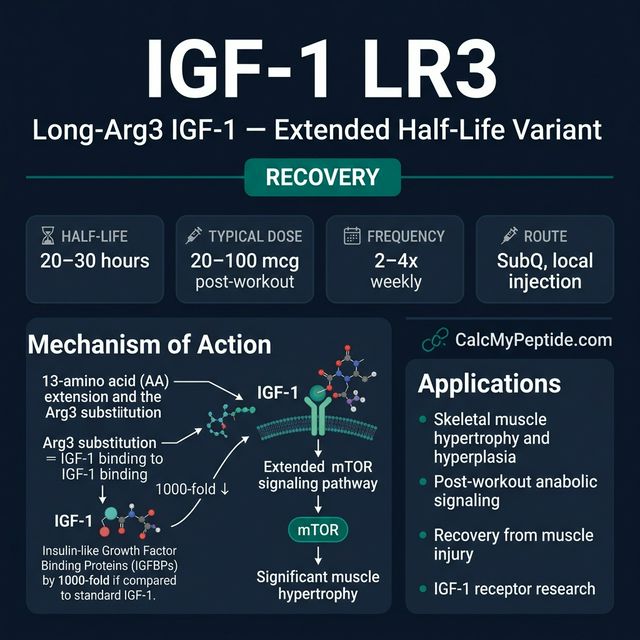
IGF-1 LR3 (Long R3 Insulin-like Growth Factor-1) is a modified version of natural IGF-1 with two key changes: a 13-amino-acid extension at the N-terminus and an Arg→Glu substitution at position 3. These modifications dramatically reduce binding to IGF binding proteins (IGFBPs), resulting in a 2-3× increase in biological potency and an extended half-life of ~20-30 hours (vs <15 minutes for native IGF-1).
IGF-1 LR3 activates IGF-1 receptors to promote muscle protein synthesis, nitrogen retention, and glucose uptake. Its reduced IGFBP binding means more free, biologically active IGF-1 in circulation.
Source: PMID: 7488657
📜Background & History
IGF-1 LR3 (Long-Arg3) is a recombinant human IGF-1 with two modifications: a 13-amino-acid N-terminal extension and substitution of glutamic acid with arginine at position 3. These changes reduce binding to IGF-1 binding proteins (which inactivate native IGF-1) by 1000-fold, dramatically extending the active half-life from ~10 minutes to 20-30 hours. Developed for research use, it allows prolonged direct cellular IGF-1 receptor stimulation without the binding protein "buffering" that limits native IGF-1.
🎯 Research Use Cases
- ✓Skeletal muscle hypertrophy and hyperplasia (satellite cell activation)
- ✓Post-workout anabolic signaling augmentation
- ✓Recovery from muscle injury with enhanced mTOR signaling
- ✓Research on IGF-1 receptor-mediated growth pathways
💉 Dosing Protocol
| Typical Dose | 20-100 mcg/day |
| Frequency | 1× daily |
| Half-Life | ~20-30 hours |
| Common Vial Sizes | 1 mg |
🧪 Reconstitution Example
⚠️Safety & Considerations
Research peptide — not FDA-approved. Risk of hypoglycemia — monitor blood glucose. May promote growth of existing tumors. Very potent — precise dosing is critical. Do not exceed 100 mcg/day. Start at low doses.
⚡Interactions & Contraindications
Hypoglycemia risk is significant — always inject post-workout with carbohydrates available. Do not use with active cancer (strong mitogenic signal). Monitor with insulin — risk of compounded hypoglycemia. Localized fat at injection site if injected in same area repeatedly.
🔗Synergies & Common Stacks
Ipamorelin raises endogenous GH (which then creates IGF-1 in the liver); IGF-1 LR3 directly stimulates the tissue receptor. Dual-pathway IGF-1 pathway activation.
BPC-157 drives VEGF/angiogenesis at repair sites; IGF-1 LR3 provides the anabolic mTOR signal for new tissue synthesis. Full regenerative stack.
❓ Frequently Asked Questions
What is the difference between IGF-1 LR3 and regular IGF-1?▼
Does IGF-1 LR3 cause hypoglycemia?▼
📖 References
- Samani AA, et al. “Insulin-like growth factor-I (IGF-I) and its receptor in health and disease.” Endocr Rev (2007). PMID: 17409286