⚕️ Medical Disclaimer
⚕️ Medical Disclaimer: This article is for educational and informational purposes only. It does not constitute medical advice. Consult a qualified healthcare provider before using any peptide.
What Is TB-500 (Thymosin Beta-4)?
TB-500 is a synthetic analog of thymosin beta-4, a naturally occurring 43-amino-acid peptide involved in tissue repair, wound healing, cell migration, and angiogenesis (new blood vessel formation). It is one of the most widely used recovery peptides in the biohacking community, often stacked with BPC-157 for synergistic healing effects.
Last updated: March 2026
Thymosin beta-4 was first isolated from the thymus gland in the 1960s, and its role in wound healing was elucidated over the following decades. TB-500 reproduces the active region of the full thymosin beta-4 molecule, specifically the actin-binding domain responsible for cell migration and tissue repair. It is not a hormone, not a steroid, and does not directly affect testosterone, estrogen, or growth hormone pathways — though it is frequently confused with GH secretagogues due to its recovery-promoting effects.
The key mechanism: TB-500 upregulates actin, a cell-building protein that plays a critical role in cell migration, blood vessel formation, and tissue repair. When you injure a tendon, muscle, or ligament, TB-500 accelerates the process by which repair cells migrate to the injury site and build new tissue (Goldstein et al., 2005, PMID: 15820553).
Use our Reconstitution Calculator to convert your TB-500 vial into precise syringe draws for any dose.
TB-500 Dosing Protocols: Loading vs Maintenance
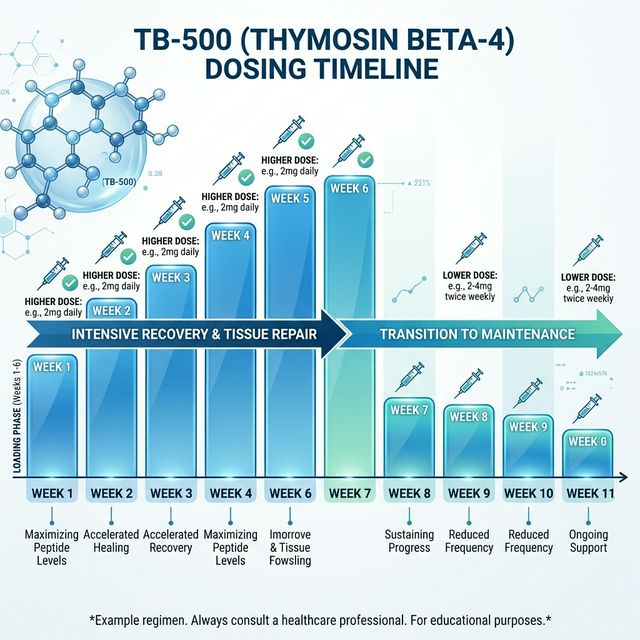
The standard TB-500 protocol uses a 4-6 week loading phase at higher doses followed by a maintenance phase at reduced frequency. This mirrors the natural healing cascade: aggressive repair early, consolidation later.
| Phase | Duration | Dose per Injection | Frequency | Weekly Total |
|---|---|---|---|---|
| Loading | Weeks 1-4 (or 1-6 for severe injuries) | 2,000-2,500 mcg (2-2.5 mg) | 2x per week | 4,000-5,000 mcg |
| Maintenance | Weeks 5-12+ | 2,000-2,500 mcg | 1x per week | 2,000-2,500 mcg |
| Acute injury (aggressive) | Weeks 1-2 | 5,000 mcg (5 mg) | 2x per week | 10,000 mcg |
Reconstitution example: A 5 mg TB-500 vial reconstituted with 2 mL BAC water = 2.5 mg/mL = 2,500 mcg/mL. For a 2,500 mcg dose using a 100-unit syringe: draw 100 units (1 mL). For a 2,000 mcg dose: draw 80 units.
Use the CalcMyPeptide Reconstitution Calculator to get exact syringe draws for your specific vial size and BAC water volume. The injection guide covers SubQ technique, which is the standard route for TB-500.
Stacking TB-500 with BPC-157: The Recovery Protocol
The TB-500 + BPC-157 stack is the most popular recovery peptide combination in biohacking, and there is a logical reason: they work through complementary mechanisms.
BPC-157 promotes angiogenesis (blood vessel growth) in tendons and ligaments, upregulates growth hormone receptors in injured tissue, and has potent anti-inflammatory effects. It works primarily at the local tissue level — which is why injection close to the injury site improves results.
TB-500 promotes systemic cell migration and tissue repair through actin upregulation. Unlike BPC-157, TB-500 acts systemically regardless of injection site — injecting SubQ in the abdomen still delivers recovery benefits to an injured knee.
Combined stack protocol:
• BPC-157: 250-500 mcg SubQ, 2x daily (morning and evening), injected near the injury site when possible
• TB-500: 2-2.5 mg SubQ, 2x per week (loading) then 1x per week (maintenance), any injection site
• Duration: 4-8 weeks depending on injury severity
Read our BPC-157 dosage guide for detailed BPC-157 protocol information and our oral vs injectable comparison if you prefer oral BPC-157. For reconstitution math with multiple peptides, use our Blend/Stack Calculator.
What Does the Evidence Say?
TB-500 research is primarily preclinical (animal models) with limited but growing human data:
• Wound healing: Thymosin beta-4 promoted corneal wound healing and reduced inflammation in multiple controlled studies. It demonstrated accelerated dermal wound closure in diabetic mice (Sosne et al., 2007, PMID: 17360118).
• Cardiac repair: A Phase 1/2 trial of thymosin beta-4 in acute myocardial infarction patients showed safety and potential improvement in cardiac function (Shah et al., 2020, per clinical trial NCT01311518).
• Tendon repair: Animal models show accelerated tendon healing with thymosin beta-4 treatment, including improved collagen organization and tensile strength.
• Hair growth: Thymosin beta-4 has been shown to stimulate hair follicle stem cells in animal models, promoting hair growth in wound-adjacent tissue.
Important caveat: most published evidence uses the full thymosin beta-4 molecule, not the TB-500 synthetic analog. While TB-500 contains the active region of TB-4, equivalence between the two compounds has not been formally established in controlled human trials. Interpret community anecdotal reports accordingly.
For the broader evidence landscape on peptide safety, review our comprehensive safety guide.
Side Effects, Risks, and Monitoring
TB-500 is generally well-tolerated in the anecdotal community, but some effects warrant monitoring:
• Injection site reactions: Redness, swelling, or mild pain at the SubQ site. This is common with any injectable peptide. Rotate sites per our injection guide.
• Transient fatigue or flu-like symptoms: Some users report mild fatigue during the loading phase, potentially related to immune modulation.
• Head rush or lightheadedness: Reported occasionally, possibly related to vasodilation from angiogenesis effects.
• Theoretical cancer concern: TB-500 promotes angiogenesis and cell migration — both processes that could theoretically accelerate existing tumor growth. There is no clinical evidence linking TB-500 to cancer initiation, but individuals with active malignancies or elevated cancer risk should exercise extreme caution. Discuss with an oncologist before use.
• WADA prohibition: Thymosin beta-4 is on the WADA prohibited list under category S0 (Non-Approved Substances). Athletes subject to drug testing should not use TB-500. For a broader comparison, see our peptides vs SARMs vs prohormones guide.
Recommended blood work before starting TB-500: CBC and inflammatory markers (CRP, ESR) as baselines. Recheck CRP at 6-8 weeks to validate anti-inflammatory effects.
Frequently Asked Questions
How quickly does TB-500 work? Most users report noticeable improvement in injury recovery within 2-3 weeks of starting the loading phase. Full protocol results (significant healing) typically manifest over 6-8 weeks. Chronic injuries may take longer.
Can I inject TB-500 anywhere or does it need to be near the injury? TB-500 acts systemically — injecting SubQ in the abdomen provides the same systemic benefit as injecting near an injured knee. This is different from BPC-157, which benefits from local injection near the injury site.
Is TB-500 the same as thymosin beta-4? TB-500 is a synthetic fragment containing the active region (amino acids 17-23) of the full 43-amino-acid thymosin beta-4 molecule. They share the same mechanism but are not identical molecules.
Does TB-500 need to be refrigerated? Lyophilized (powder): stable at room temperature for weeks, but best stored at 2-8°C. Reconstituted: must be refrigerated at 2-8°C and used within 28 days. See our reconstitution guide for storage details. If traveling, check our travel guide.
Can I use TB-500 for joint pain specifically? Yes — see our dedicated guide on peptides for joint pain and cartilage repair, which covers TB-500 alongside BPC-157 and GHK-Cu for joint-specific protocols.
Final Word
⚕️ Medical Disclaimer: This article is for educational and informational purposes only. It does not constitute medical advice. Consult a qualified healthcare provider before using any peptide.