⚕️ Medical Disclaimer
⚕️ Medical Disclaimer: This article is for educational and informational purposes only. It does not constitute medical advice. Consult a qualified healthcare provider before using any peptide.
Why Traveling with Peptides Requires Planning
You have spent weeks dialing in your reconstitution volumes, stacking your BPC-157 and ipamorelin, and timing your doses like a Swiss watch. Then you book a flight, and suddenly the entire protocol is at risk — not from pharmacology, but from airport security theater and cold chain logistics.
Last updated: March 2026
Reconstituted peptides are temperature-sensitive biological solutions stored in glass vials. Syringes look suspicious at airport security. Lyophilized powders look even more suspicious. Without proper documentation, packing, and cold chain management, you can lose hundreds of dollars in product — or worse, trigger a secondary screening that delays your flight and your nerves.
This guide covers everything you need to fly domestically (TSA rules), travel internationally (customs considerations), and maintain the cold chain from door to door. Use our Reconstitution Calculator to estimate how many doses your current vial has left — worth knowing before you decide whether to bring a reconstituted vial or a fresh lyophilized one.
TSA Rules for Peptide Vials, Syringes, and Needles
The TSA allows medically necessary liquids, gels, and injectable medications (including syringes and needles) through security checkpoints — they are exempt from the 3.4 oz liquid rule. Here is how to stay compliant:
• Declare your medications at the checkpoint. Before placing your bag on the belt, tell the TSA officer you have injectable medication. This triggers a manual inspection but prevents surprises.
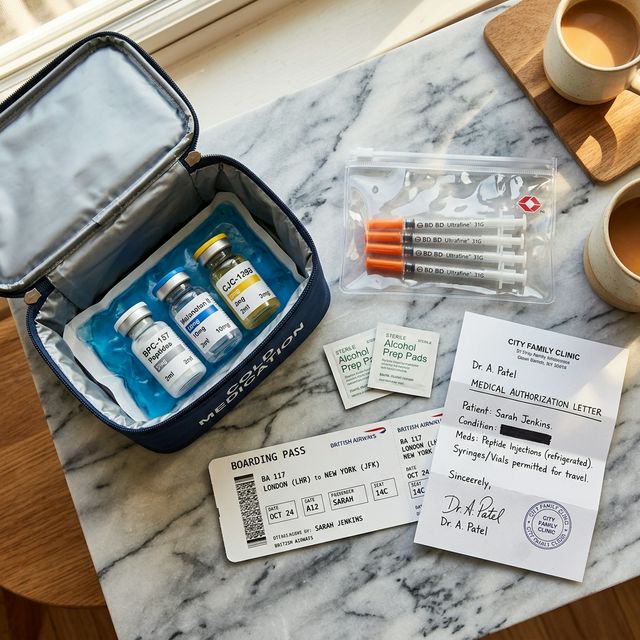
• Keep everything in a clear, separate pouch. Use a transparent TSA-compliant zip pouch for your vials, syringes, alcohol swabs, and any documentation. Accessibility speeds up the process.
• Syringes must accompany medication. TSA permits unused syringes when they accompany an injectable medication. Loose syringes without an associated supply may be confiscated.
• Labels help. Pharmacy labels, prescription labels, or a doctor's letter reduce friction. While not technically required by TSA for domestic flights, they prevent delays. Print a letter on clinic letterhead naming each compound, its purpose, and your dosing schedule.
• BAC water is allowed. Bacteriostatic water vials pass through TSA as medical liquid, exempt from the 3-1-1 rule.
• Sharps container (optional but recommended). A small portable sharps container demonstrates responsibility and prevents needle sticks in your luggage.
TSA's official guidance: "Medications in liquid form are allowed in carry-on bags in reasonable quantities for the flight" (Source: TSA.gov). For specific peptide storage requirements before and after reconstitution, review our peptide safety guide.
Cold Chain Packing: Keeping Peptides at 2-8°C in Transit
Reconstituted peptides must stay between 2-8°C (36-46°F) continuously. Use an insulated medical cooler bag with gel ice packs — never place vials in direct contact with ice or frozen packs. Here is the system:
Essential gear:
• An insulated medical cooler bag (FRIO wallets or PackIt Freezable bags are popular choices)
• Two to four gel ice packs (pre-frozen 12+ hours before departure)
• A small digital thermometer with min/max read (to verify temp at arrival)
• Paper towels or bubble wrap to insulate vials from direct pack contact
• Ziploc bags for leak containment
Packing protocol:
• Wrap each vial in bubble wrap or a paper towel sleeve to prevent direct ice contact and thermal shock.
• Place gel packs at the bottom and sides of the insulated bag — never directly touching vials.
• Maintain air gaps using paper towels or cloth, creating a buffer zone.
• Close the bag tightly and place it in your carry-on. Never check peptides in luggage — cargo holds can freeze or overheat.
• A FRIO wallet activated with water maintains 18-26°C for 45+ hours without refrigeration. This is adequate for lyophilized (unreconstituted) peptides but borderline for reconstituted solutions. For reconstituted vials, use proper gel packs.
Upon arrival, immediately transfer vials to a refrigerator. If you are staying in a hotel, request a mini-fridge at booking. Most hotels provide medical refrigerators upon request at no charge. Calculate how many doses remain in your vials using our Vial Duration Calculator to plan your trip supply.
Lyophilized vs Reconstituted: What to Bring?
The decision depends on trip duration and logistics:
| Factor | Lyophilized (Powder) | Reconstituted (Solution) |
|---|---|---|
| Cold chain need | Room temp OK for weeks | Must stay 2-8°C |
| TSA friction | Looks unusual (white powder) | Looks like standard injectable |
| Trip duration ideal | 5+ days | 1-4 days |
| Convenience | Need BAC water + syringe to reconstitute on site | Draw and inject immediately |
| Risk | Less degradation risk | Higher degradation if cold chain breaks |
For trips over 5 days, consider bringing an unreconstituted vial plus a vial of BAC water and reconstituting at your destination. For short weekend trips, a pre-reconstituted vial in a cold pack is more practical. For dosing calculations, our reconstitution guide walks through the exact process.
International Travel: Customs and Legal Considerations
Peptide legality varies dramatically by country. Research your destination's regulations before packing — what is legal in the US may be a controlled substance elsewhere. Key considerations:
• Australia: Therapeutic Goods Administration (TGA) classifies most research peptides as Schedule 4 (prescription only). Bringing them without a valid Australian prescription can result in seizure and fines.
• United Kingdom: Peptides for personal use are generally tolerated, but quantities suggesting resale may trigger scrutiny. SARMs are outright prohibited for sale. Review our peptides vs SARMs comparison for legal status details.
• European Union: Varies by member state. Germany is generally stricter than Spain. GLP-1 agonists like semaglutide require a prescription in all EU countries.
• UAE/Middle East: Extremely strict. Many substances legal in the US are controlled. Do not travel with peptides to the UAE without explicit legal guidance.
• Canada: Health Canada regulates peptides similarly to the US. Personal-use quantities with a physician letter typically pass. Semaglutide brands (Wegovy, Ozempic) require a Canadian prescription.
• Japan/South Korea: Import of injectable medications generally requires advance notification to customs. Carry documentation in English and the local language.
Universal best practices: carry a doctor's letter translated into the destination language, keep all vials in original packaging with labels, and declare everything at customs. When in doubt, ship peptides to your destination via a temperature-controlled courier service rather than carrying them in person.
Travel Checklist: What to Pack
Print this and tape it inside your travel bag:
• ☐ Peptide vials (reconstituted or lyophilized, depending on trip length)
• ☐ BAC water (if bringing lyophilized peptides)
• ☐ Insulin syringes (sealed packages — 1 per dose + 2 extras)
• ☐ Alcohol swabs (individually wrapped)
• ☐ Insulated cooler bag with 2-4 gel packs
• ☐ Digital thermometer (min/max)
• ☐ Doctor's letter on clinic letterhead
• ☐ Prescription label or pharmacy receipt
• ☐ Small sharps container
• ☐ Ziploc bags (leak containment)
• ☐ Log your dose times with a peptide tracker app — travel disrupts routines
For dose calculations on the go, bookmark our Reconstitution Calculator on your phone — it works offline after first load.
Frequently Asked Questions
Can TSA confiscate my peptides? TSA can confiscate any item they deem a security threat, but injectable medications are explicitly allowed under their medical exemption policy. Having documentation and declaring your supplies proactively virtually eliminates confiscation risk. The TSA website states: "Medication in liquid form is allowed in carry-on bags in reasonable quantities."
What if my peptides warm up during a long layover? A brief temperature excursion (30-60 minutes at room temperature) is unlikely to destroy most reconstituted peptides, but prolonged exposure degrades potency. If your layover exceeds 2 hours, find an airport lounge with a refrigerator or ask a restaurant to store your cooler bag in their walk-in. The degradation curves vary by peptide — semaglutide is more stable than BPC-157 at room temp.
Should I bring my entire supply or just enough for the trip? Bring only what you need plus one extra day of doses. Less product = less potential loss, less scrutiny, and easier packing. Calculate your exact needs using our Vial Duration Calculator.
Does BPC-157 need cold storage if taken orally (capsules)? Oral BPC-157 capsules are more temperature-stable than reconstituted injectable solutions but should still be kept cool and dry. Avoid leaving capsules in hot cars or direct sunlight. See our oral vs injectable guide for bioavailability comparisons.
Can I ship peptides to my hotel instead of flying with them? Yes — courier services like FedEx and UPS offer temperature-controlled shipping. Ship in advance with cold packs, address to yourself at the hotel front desk with your check-in date, and include a note requesting refrigerator storage upon arrival. This avoids all TSA/customs friction entirely.
Final Word
⚕️ Medical Disclaimer: This article is for educational and informational purposes only. It does not constitute medical advice. Consult a qualified healthcare provider before using any peptide.