Cagrilintide
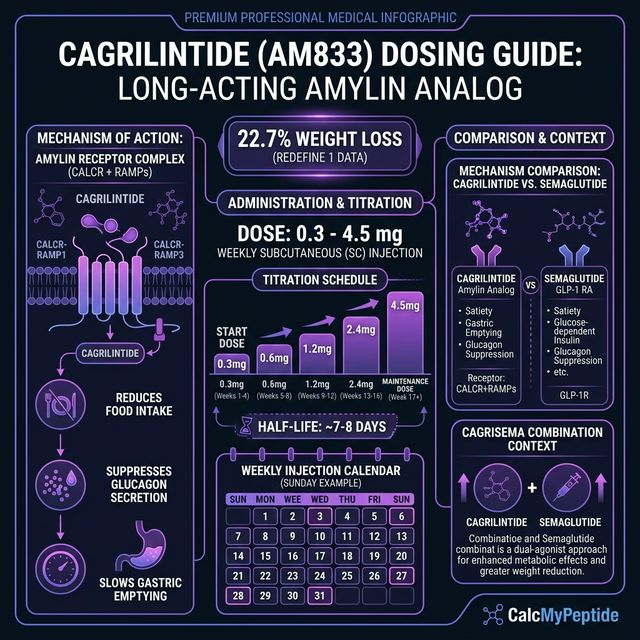
Long-acting amylin analog from Novo Nordisk in Phase III combination trials (CagriSema). Amylin suppresses post-prandial glucagon, slows gastric emptying, and produces CNS satiety via a distinct pathway to GLP-1.
🔬 Mechanism of Action
Cagrilintide is a fatty acid-modified long-acting analog of human amylin (islet amyloid polypeptide, IAPP) — a 37-amino-acid peptide co-secreted with insulin from pancreatic beta cells. Cagrilintide's modifications (two amino acid substitutions + C20 fatty acid chain) extend its half-life from ~24 minutes (native amylin) to approximately 7-8 days, enabling once-weekly dosing.
Amylin acts on calcitonin receptor complex (CALCR + RAMP1/2/3) in the area postrema and nucleus tractus solitarius (NTS) of the brainstem — regions distinct from GLP-1 receptor locations. This anatomical separation is why amylin + GLP-1 produce additive rather than redundant satiety signaling. Effects include: suppression of post-prandial glucagon, slowing of gastric emptying (complementary to GLP-1), and activation of central satiety pathways.
In the Phase 2 CAGRISEMA trial, cagrilintide 2.4 mg/week alone produced ~5.1% body weight loss. Combined with semaglutide 2.4 mg/week, it produced ~15.6% body weight loss — demonstrating clear pharmacological complementarity that gave rise to the REDEFINE Phase 3 program.
Source: PMID: 35948058 (CAGRISEMA Phase 2)
📜Background & History
Cagrilintide (AM833) is a long-acting amylin analog developed by Novo Nordisk. Amylin (islet amyloid polypeptide, IAPP) is a peptide co-secreted with insulin from pancreatic beta cells that plays a critical role in post-prandial satiety. The only previously approved amylin analog was pramlintide (Symlin) — a 37-residue synthetic amylin requiring three daily injections. Cagrilintide overcomes this limitation with half-life extension to approximately 7-8 days via fatty acid chain modification, enabling once-weekly dosing. Clinical development accelerated significantly when Phase 2 CAGRISEMA trial results (2022) showed the cagrilintide + semaglutide combination produced superior weight loss (~15.6%) compared to either agent alone.
🎯 Research Use Cases
- ✓Obesity management as part of the CagriSema combination
- ✓Post-prandial glucagon suppression and satiety via amylin pathway
- ✓Weight loss in GLP-1-intolerant or non-responder patients
- ✓Research: amylin receptor biology and CNS satiety circuitry
💉 Dosing Protocol
| Typical Dose | 0.3-4.5 mg/week |
| Frequency | 1× weekly |
| Half-Life | ~7-8 days |
| Common Vial Sizes | 3 mg, 5 mg |
🧪 Reconstitution Example
⚠️Safety & Considerations
Investigational compound — not FDA-approved as a standalone agent. Common side effects include nausea, vomiting, and decreased appetite (similar to GLP-1 agonists). Additive GI effects when combined with semaglutide (more nausea during escalation). Monitor blood glucose in T2D patients — amylin + insulin can cause hypoglycemia. Available only through compounding pharmacies or clinical trials.
⚡Interactions & Contraindications
Amylin analogs slow gastric emptying — additive effect with GLP-1 agonists (beneficial for weight loss, but increased GI side effect risk). Monitor blood glucose carefully especially in T2D patients — amylin + insulin effects on post-prandial glucose can cause hypoglycemia. Not for use with severe GI disease. Investigational outside of clinical trials.
🔗Synergies & Common Stacks
The definitive synergy — this is the basis of the CagriSema combination. Amylin (cagrilintide) and GLP-1 (semaglutide) activate entirely different receptor systems, producing additive weight loss beyond either alone.
Theoretically complementary — tirzepatide provides GLP-1 + GIP agonism; cagrilintide adds the amylin pathway. This triple-mechanism combination is not yet in trials but represents the next frontier of obesity pharmacotherapy.