⚕️ Medical Disclaimer
⚕️ Medical Disclaimer: This article is for educational and informational purposes only. It does not constitute medical advice. Consult a qualified healthcare provider before using any peptide.
Why Blood Work Is Non-Negotiable Before Peptides
Here is a fact that stops most biohackers mid-scroll: MK-677 (ibutamoren) raised IGF-1 levels by 40-60% in elderly subjects over 12 months — but it also elevated fasting glucose, highlighting why baseline HbA1c testing is absolutely essential before use (Svensson et al., 1998, PMID: 10404019). That single study captures the entire argument for pre-peptide blood work in a nutshell. Every compound you introduce into your body acts on specific biochemical pathways, and those pathways have measurable baseline values that can — and should — be recorded before you change anything.
Last updated: March 2026
Whether you are starting a GLP-1 agonist for weight management, a GH secretagogue for recovery, or BPC-157 for gut healing, a pre-protocol blood panel is your insurance policy. It gives you a reference point to measure progress, catch early warning signs, and prove to yourself (and your clinician) that what you are doing is either working or needs adjustment. Use the CalcMyPeptide Reconstitution Calculator to nail your dosing math — but let your blood work tell you whether those doses are doing what you planned.
Think of it this way: you would not start a road trip without checking your fuel gauge, oil level, and tire pressure. Blood work is the pre-flight checklist for your metabolic engine. Skip it, and you are flying blind.
What blood panels should I order before starting peptide therapy?
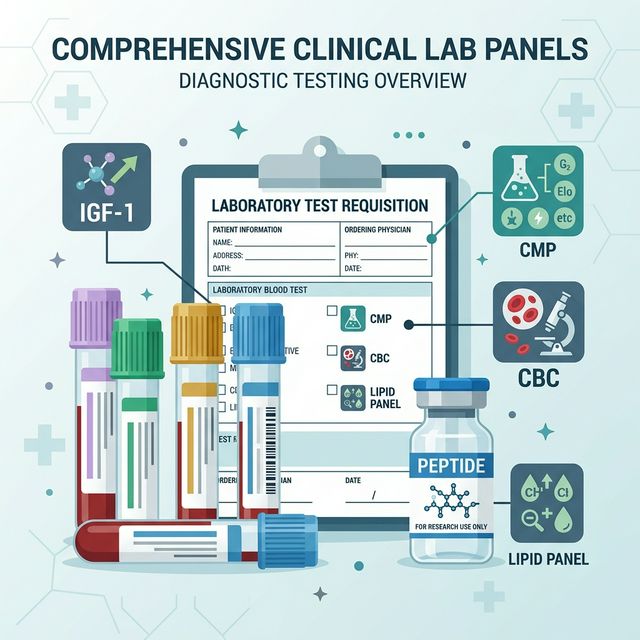
Order a comprehensive baseline panel that covers metabolic, hormonal, inflammatory, and organ-function markers — the specific panels depend on which peptide class you plan to use. Here is the complete matrix:
| Panel Name | Key Markers | Relevant Peptide Classes | Normal Reference Range | Retest Interval |
|---|---|---|---|---|
| Comprehensive Metabolic Panel (CMP) | Glucose, BUN, creatinine, ALT, AST, ALP, electrolytes | All peptides | Glucose: 70-100 mg/dL; ALT/AST: 7-56 U/L | Baseline, 6 wk, 12 wk |
| Complete Blood Count (CBC) | WBC, RBC, hemoglobin, hematocrit, platelets | GH secretagogues, thymosin peptides | Hgb: 12-17.5 g/dL; WBC: 4,500-11,000 | Baseline, 12 wk |
| HbA1c | Glycated hemoglobin (90-day glucose average) | MK-677, GLP-1 agonists, tesamorelin | 4.0-5.6% (normal); 5.7-6.4% (prediabetic) | Baseline, 12 wk |
| Fasting Insulin | Serum insulin | GLP-1s, MK-677, GH secretagogues | 2.6-24.9 µIU/mL | Baseline, 12 wk |
| IGF-1 | Insulin-like growth factor 1 | All GH secretagogues, MK-677, tesamorelin | Age-dependent: 115-307 ng/mL (adults) | Baseline, 6 wk, 12 wk |
| Lipid Panel | Total cholesterol, LDL, HDL, triglycerides | GLP-1s, tesofensine, AOD-9604 | LDL: <100 mg/dL; Trigs: <150 mg/dL | Baseline, 12 wk |
| Thyroid Panel (TSH, Free T4, Free T3) | Thyroid function | GH secretagogues, tesamorelin | TSH: 0.4-4.0 mIU/L | Baseline, 12 wk |
| Liver Function (hepatic panel) | ALT, AST, GGT, bilirubin, albumin | All peptides (especially oral) | ALT/AST: 7-56 U/L | Baseline, 6 wk, 12 wk |
| Inflammatory Markers (CRP, ESR) | C-reactive protein, sed rate | BPC-157, TB-500, thymosin alpha-1 | CRP: <3.0 mg/L; ESR: 0-22 mm/hr | Baseline, 8 wk |
| Kidney Function (eGFR) | Estimated glomerular filtration rate | All peptides | >60 mL/min/1.73m² | Baseline, 12 wk |
For GH secretagogues like MK-677 and ipamorelin, IGF-1 and fasting glucose are non-negotiable. For GLP-1 agonists, add HbA1c and a lipid panel. For recovery peptides like TB-500 and BPC-157, inflammatory markers are helpful but not critical.
A baseline panel typically runs $150-400 out of pocket through direct-access labs like Quest, LabCorp, or online services — money well spent for data that could prevent a serious problem down the road (Source: Labs by Request).
How do I read my IGF-1 results after starting GH secretagogues?
IGF-1 is the primary biomarker for GH secretagogue efficacy — your goal is to reach the upper third of your age-adjusted reference range, not to exceed it. IGF-1 is produced by the liver in response to growth hormone and has a half-life of about 12-15 hours, making it a more stable indicator of average GH exposure than GH itself (which pulses unpredictably).
Here is a simplified interpretation framework:
• Below age-adjusted midpoint: Your GH secretagogue dose may be too low, your timing may be off (injecting in a fed state blunts GH release), or you may benefit from a different compound. Recheck timing relative to meals and consider our peptide stacking guide.
• Upper third of reference range (say 250-350 ng/mL for a 30-40-year-old): This is the sweet spot. Maximum anti-aging and recovery benefit with low risk.
• Above reference range (>400+ ng/mL): Reduce your dose. Chronically elevated IGF-1 is associated with increased cancer risk in epidemiological studies. This is where more is definitively not better.
Important nuance: AOD-9604 is a fragment of the hGH molecule designed to stimulate fat loss without raising IGF-1 or affecting overall GH signaling. Studies on AOD-9604 showed it acts through beta-3 adrenergic mechanisms rather than the classical GH/IGF-1 axis (Heffernan et al., 2001, PMID: 11713213). This means if you are using AOD-9604, you do not need a GH panel — focus on metabolic markers instead.
For MK-677 specifically, check out our comprehensive MK-677 dosage guide which breaks down exactly how different dosing tiers affect IGF-1 levels.
When should I retest blood work during a peptide cycle?
Retest at 6 weeks for fast-acting markers (glucose, IGF-1) and at 12 weeks for slow-moving markers (HbA1c, lipids) — with an immediate retest if you experience any red-flag symptoms. Here is the protocol:
Baseline (Week 0 — before first dose): Complete panel. This is your reference point for everything that follows. Fast for 10-12 hours before the draw. Draw blood in the morning between 7-10 AM for consistent results across retests.
Week 6 midpoint check: Retest fasting glucose, IGF-1 (if using GH secretagogues), CMP, and any markers that were borderline at baseline. This is your first opportunity to catch emerging problems like glucose elevation from MK-677 or liver enzyme bumps.
Week 12 comprehensive retest: Full panel repeat. Compare everything against baseline. HbA1c needs 90 days to reflect average glucose, so this is your first valid HbA1c checkpoint. Lipid panels also need 8-12 weeks to show meaningful changes from GLP-1 therapy.
Post-cycle (4 weeks after last dose): Verify that all markers have returned to baseline. This is especially important for GH secretagogues — you want to confirm IGF-1 has normalized. For GLP-1 agonists on the dose escalation schedule, labs should be drawn at each escalation milestone.
Keep a spreadsheet or use one of the best peptide tracker apps to log every set of results with dates. Trending data is infinitely more useful than a single snapshot.
Peptide-Specific Lab Markers: GLP-1s, GH Secretagogues, Recovery, Nootropics
Different peptide classes affect different systems. Here is your cheat sheet for which markers matter most by category:
GLP-1 Receptor Agonists (semaglutide, tirzepatide, retatrutide): HbA1c and fasting glucose are your primary endpoints. These drugs are designed to lower blood sugar and improve insulin sensitivity. A lipid panel (particularly triglycerides) is your secondary outcome — GLP-1s typically lower trigs by 15-25%. Liver enzymes (ALT/AST) should be monitored because GLP-1-mediated weight loss can transiently elevate liver markers as fat is mobilized from the liver. Watch for amylase and lipase if pancreatitis symptoms appear. Read our peptide drug interactions guide for additional medication conflicts.
GH Secretagogues (ipamorelin, CJC-1295, GHRP-2, MK-677, tesamorelin): IGF-1 is the headline number. Fasting glucose and fasting insulin are critical because GH antagonizes insulin — meaning GH secretagogues can push you toward insulin resistance if you are predisposed. Tesamorelin specifically targets visceral fat and has shown favorable lipid profile effects in clinical trials. The TIPO-1 trial of tesofensine demonstrated the importance of cardiovascular monitoring — heart rate and blood pressure should be tracked alongside blood work for weight-loss compounds (Astrup et al., 2008, PMID: 18978768).
Recovery Peptides (BPC-157, TB-500, thymosin alpha-1): For these, a baseline CBC and inflammatory markers (CRP, ESR) provide the best context. BPC-157 is gastroprotective and should not significantly alter standard blood markers, but tracking CRP can validate anti-inflammatory effects. TB-500 (thymosin beta-4) promotes angiogenesis and tissue repair — inflammatory markers should trend downward if the compound is working. Review our peptide safety guide for the full safety landscape.
Fat-Loss Compounds (AOD-9604, 5-Amino-1MQ, tesofensine): Focus on metabolic markers: fasting glucose, HbA1c, lipid panel, and liver enzymes. AOD-9604 should not affect IGF-1 (as noted above). 5-Amino-1MQ inhibits NNMT and boosts NAD+ — consider adding homocysteine to your panel as a related methylation marker. For tesofensine, add heart rate and blood pressure monitoring due to its norepinephrine/dopamine reuptake mechanism.
Nootropic Peptides (selank, semax, pinealon, dihexa): Standard blood panels are less informative here because these compounds act primarily on the CNS. A baseline thyroid panel is worthwhile (semax can modulate BDNF and indirectly affect thyroid axis). Cortisol (AM draw) provides a stress-axis snapshot if you are using selank for anxiety. Monitoring your BMI is also useful context — our colleagues at BMI Calc Now have an excellent guide on BMI health risks and BMI and metabolism that contextualize how body composition affects peptide response.
Red Flags in Your Blood Work: When to Stop and Call Your Doctor
Stop your protocol immediately and contact your healthcare provider if any of the following appear in your blood work.
• Fasting glucose >125 mg/dL or HbA1c >6.4%: This is the diagnostic threshold for diabetes. MK-677 is the most common peptide-related culprit. Do not rationalize this away — address it immediately.
• IGF-1 significantly above reference range: Chronically supraphysiological IGF-1 (>1.5x upper limit) increases cancer risk. Reduce or discontinue GH secretagogues and retest in 4-6 weeks.
• ALT or AST >3x upper limit of normal: This indicates potential liver injury. Pause all oral peptides and any hepatically-metabolized compounds. Recheck in 2 weeks. If still elevated, advanced imaging may be warranted.
• eGFR sudden drop >25%: Acute kidney function decline warrants immediate medical evaluation. While uncommon with peptides, it should be caught early.
• Hematocrit >54% (men) or >48% (women): Elevated red blood cell mass increases thrombosis risk. This is more common with testosterone therapy than peptides, but GH can stimulate erythropoiesis.
• Lipase or amylase >3x upper limit of normal with GI symptoms: Possible pancreatitis, particularly associated with GLP-1 agonists. Seek emergency evaluation if accompanied by severe abdominal pain.
• Sudden, unexplained increase in inflammatory markers: A CRP spike from <1 to >10 during a recovery peptide protocol could indicate infection at an injection site or an unrelated acute illness. Do not assume it is peptide-related without evaluation.
Bottom line: blood work exists to protect you. No peptide goal is worth ignoring a clear warning signal. You can read more about overall peptide safety in our comprehensive safety guide. And for context on how compounds interact with existing medications, check the drug interactions guide. You can also compare peptides against SARMs and prohormones from a safety perspective in our peptides vs SARMs vs prohormones guide.
Putting It All Together: A Retest Schedule Template
Here is a practical retest schedule you can hand to your phlebotomist or plug into your lab portal:
| Timepoint | What to Order | Focus Areas | Notes |
|---|---|---|---|
| Week 0 (Baseline) | CMP, CBC, HbA1c, fasting insulin, IGF-1, lipid panel, thyroid, CRP | Everything — establish baseline | Fasting 10-12 hrs, morning draw |
| Week 6 | Fasting glucose, IGF-1, CMP | Glucose trends, liver check | Compare IGF-1 to baseline |
| Week 12 | Full panel repeat (all baseline markers) | HbA1c validity window, lipid trends | First valid HbA1c comparison |
| Week 4 post-cycle | CMP, IGF-1, fasting glucose | Confirm return to baseline | All markers should normalize |
If you are running multiple peptide classes simultaneously (say, ipamorelin + semaglutide + BPC-157), order the full panel at every checkpoint — the interaction effects are not well-studied and broader monitoring is prudent.
Set calendar reminders or use a tracker app. Our guide to the best peptide tracker apps for 2026 covers tools that let you set lab-retest reminders alongside dose logging.
One practical tip from clinical practice: ask your lab to run the same panels on the same analyzers each time. Inter-lab variability can muddy the comparison. If you used Quest for baseline, use Quest for retests (Source: Age Well ATL).
Frequently Asked Questions
How much does baseline blood work cost without insurance? Through direct-access labs (Quest, LabCorp, or services like Walk-In Lab and Marek Health), a comprehensive baseline panel runs $150-350 depending on which markers you include. IGF-1 alone is often $50-80 if ordered as an add-on. HbA1c costs $15-30. These prices are for self-pay — many peptide users specifically avoid running labs through insurance to keep their records private.
Do I need a doctor's order for peptide-related labs? In most US states, you can order labs yourself through direct-access services without a physician order. However, a handful of states (NY, NJ, RI, and a few others) still require a doctor's signature. Even in DTC-friendly states, having a clinician review your results adds value — they can flag patterns you might miss. Our peptide beginner guide walks through setting up a provider relationship.
Should I fast before my blood draw for peptide labs? Yes — a 10-12 hour overnight fast is essential for accurate fasting glucose, fasting insulin, and lipid panel results. Morning draws (7-10 AM) also control for diurnal cortisol and hormone variation. You can drink plain water. Do not inject your morning GH secretagogue dose until after the draw.
Can I use at-home finger-prick tests instead of venous draws? Finger-prick tests (like those from Everlywell or LetsGetChecked) are acceptable for screening-level HbA1c and lipid panels. However, they are not ideal for IGF-1, insulin, or comprehensive metabolic panels — these require venous blood for accuracy. Use finger-prick for convenience between formal draws, but do not rely on them for your critical baseline or 12-week assessment.
What if my IGF-1 comes back high before I've started anything? A naturally elevated IGF-1 (above the upper end of your age-adjusted range) warrants further investigation before adding any GH-stimulating compound. Causes include acromegaly (rare), high protein diets, genetic variation, or lab error. Ask your physician about an oral glucose tolerance test (OGTT), which should suppress GH if your pituitary is functioning normally. Do not start MK-677, ipamorelin, or any GH secretagogue until this is resolved.
Final Word
⚕️ Medical Disclaimer: This article is for educational and informational purposes only. It does not constitute medical advice. Consult a qualified healthcare provider before using any peptide.
Last updated: March 2026. Medical guidance evolves — verify with your clinician.