Liraglutide
First-generation once-daily GLP-1 receptor agonist FDA-approved for type 2 diabetes (Victoza) and weight management (Saxenda 3 mg). The predecessor to semaglutide with a shorter half-life requiring daily dosing.
🔬 Mechanism of Action
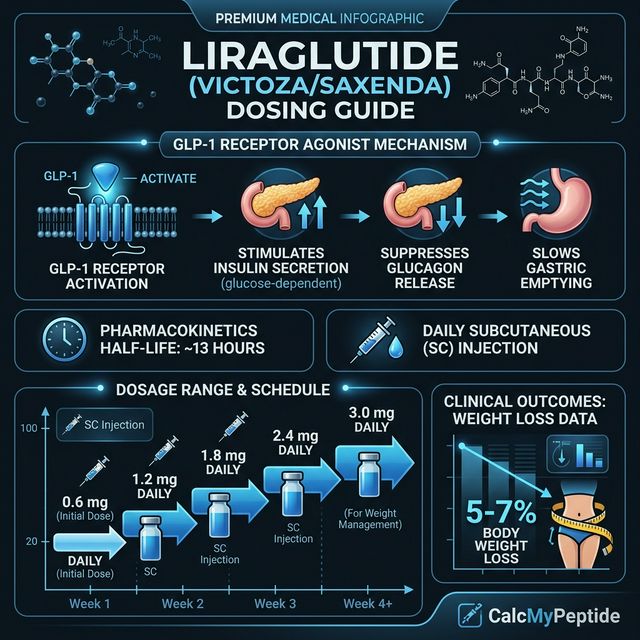
Liraglutide is a GLP-1 receptor agonist with 97% sequence homology to native human GLP-1. A C18 fatty acid chain attached to Lys26 enables reversible albumin binding, extending the half-life from ~2 minutes (native GLP-1) to approximately 13 hours — enabling once-daily dosing.
Liraglutide activates the GLP-1 receptor via multiple pathways: (1) Glucose-dependent insulin secretion from pancreatic beta cells — only active when blood glucose is elevated, reducing hypoglycemia risk. (2) Glucagon suppression from pancreatic alpha cells. (3) Gastric emptying delay — slowing nutrient absorption and extending satiety. (4) Central appetite suppression via hypothalamic GLP-1 receptors and the brainstem area postrema, reducing food intake by 15-30%.
The LEADER cardiovascular outcomes trial (2016) demonstrated a 13% reduction in major cardiovascular events in T2D patients, establishing GLP-1 agonists as cardioprotective — a class effect extended and amplified in subsequent semaglutide and tirzepatide trials.
Source: FDA Label (Saxenda), PMID: 24665709 (SCALE trial)
📜Background & History
Liraglutide was developed by Novo Nordisk and approved by the FDA in 2010 as Victoza for type 2 diabetes and in 2014 as Saxenda (3 mg/day) for obesity — making it the first GLP-1 agonist approved specifically for weight management. It has 97% sequence homology to human GLP-1 and a C18 fatty acid chain that enables albumin binding, extending the half-life from 2 minutes (native GLP-1) to 13 hours. Clinical trials (SCALE, 2015) demonstrated 8% body weight loss at the 3 mg dose. While now partially succeeded by semaglutide in the market, liraglutide remains widely prescribed globally due to its long safety record (13+ years), mature generics pipeline, and once-daily dosing flexibility.
🎯 Research Use Cases
- ✓Type 2 diabetes management (Victoza, 1.2-1.8 mg/day)
- ✓Chronic weight management (Saxenda, 3 mg/day)
- ✓Cardiovascular risk reduction in T2D (LEADER trial: 13% CV mortality reduction)
- ✓NASH (non-alcoholic steatohepatitis) — signal in Phase II trials
- ✓Bridging therapy before higher-potency GLP-1 agents
💉 Dosing Protocol
| Typical Dose | 0.6-3 mg/day |
| Frequency | 1× daily |
| Half-Life | ~13 hours |
| Common Vial Sizes | 6 mg, 18 mg |
🧪 Reconstitution Example
⚠️Safety & Considerations
FDA-approved for T2D (Victoza) and weight management (Saxenda). Well-established safety profile with 13+ years of real-world data. Common side effects: nausea, vomiting, diarrhea (usually transient). Boxed warning: thyroid C-cell tumor risk (rodent data) — contraindicated in personal/family history of medullary thyroid carcinoma or MEN 2. Monitor for pancreatitis. Not recommended in pregnancy.
⚡Interactions & Contraindications
Same MTC/MEN2 contraindications as all GLP-1 agonists. Daily injections vs weekly for semaglutide — important adherence consideration. GI side effects (nausea, diarrhea) are more sustained than semaglutide due to shorter half-life creating less smooth exposure. Adjust timing of oral medications (slowed gastric emptying affects absorption). Pancreatitis risk — discontinue if persistent abdominal pain.
🔗Synergies & Common Stacks
BPC-157's GI-protective effects may help manage liraglutide-induced nausea and gastric side effects during dose escalation, improving tolerability.
Liraglutide drives appetite suppression and metabolic improvement; AOD-9604 adds targeted lipolysis. Complementary fat loss approaches without GLP-1 receptor overlap.
❓ Frequently Asked Questions
How does Saxenda (liraglutide) differ from Ozempic (semaglutide)?▼
What is the Saxenda dose escalation schedule?▼
Can I inject liraglutide anywhere?▼
Is compounded liraglutide available?▼
📖 References
- Armstrong MJ, et al. “Liraglutide safety and efficacy in patients with non-alcoholic steatohepatitis (LEAN).” Lancet (2016). PMID: 26318520
- Pi-Sunyer X, et al. “A randomized, controlled trial of 3.0 mg of liraglutide in weight management.” N Engl J Med (2015). PMID: 26132939