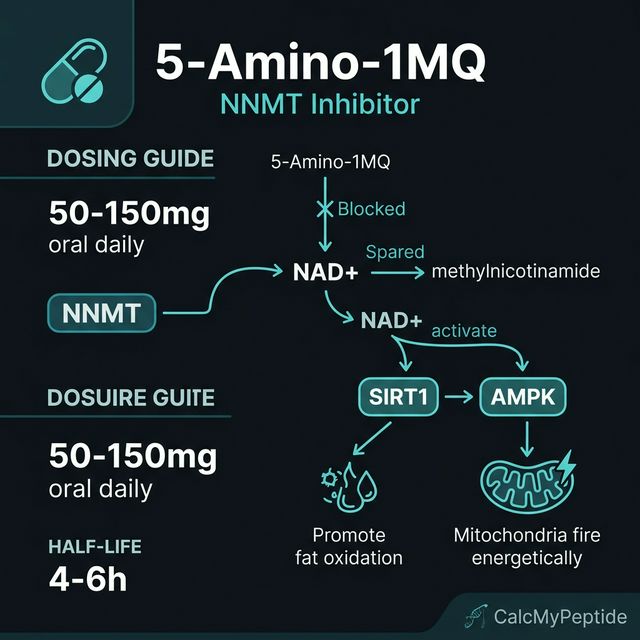
5-Amino-1MQ
Small-molecule NNMT inhibitor that raises intracellular NAD+ levels and activates AMPK — trending in biohacking as an oral metabolic compound for fat loss, energy, and longevity.
🔬 Mechanism of Action
5-Amino-1MQ (5-Amino-1-methylquinolinium) is a cell-permeable small molecule that selectively inhibits nicotinamide N-methyltransferase (NNMT), an enzyme that consumes S-adenosylmethionine (SAM) to methylate nicotinamide — diverting NAD+ precursors away from metabolic function.
By blocking NNMT, 5-Amino-1MQ preserves NAD+ biosynthesis precursors (particularly 1-methylnicotinamide and related metabolites), raising intracellular NAD+ levels in adipocytes and skeletal muscle. Elevated NAD+ activates SIRT1 (a longevity-associated sirtuin deacetylase) and AMPK (the master metabolic sensor). In obese mouse models, NNMT inhibition with 5-Amino-1MQ prevented weight gain without caloric restriction, improved insulin sensitivity, and reduced adipose tissue inflammation. The compound also raises the SAM:SAH ratio, supporting methylation of other critical substrates.
Unlike NAD+ precursors (NMN, NR) that supply the NAD+ pool from above, 5-Amino-1MQ reduces NAD+ depletion from below — a mechanistically distinct approach that works synergistically with direct NAD+ supplementation.
Source: PMID: 31028097
📜Background & History
5-Amino-1MQ (5-Amino-1-methylquinolinium) is a small-molecule cell-permeable inhibitor of nicotinamide N-methyltransferase (NNMT) developed by researchers at Vanderbilt University. NNMT is an enzyme expressed primarily in fat tissue that consumes S-adenosylmethionine (SAM) to methylate nicotinamide — effectively diverting NAD+ precursors away from energy metabolism. First published in Nature Communications (2018), 5-Amino-1MQ demonstrated that NNMT inhibition in obese mice prevented weight gain without caloric restriction. It has since exploded in biohacking communities as a novel oral compound for metabolic optimization and fat loss.
🎯 Research Use Cases
- ✓Metabolic optimization: fat loss without caloric restriction (preclinical)
- ✓NAD+ restoration and longevity via NNMT pathway
- ✓Skeletal muscle energy metabolism and AMPK activation
- ✓Prevention of obesity-associated adipogenesis
- ✓Companion to NAD+ IV therapy or NMN for comprehensive NAD+ optimization
💉 Dosing Protocol
| Typical Dose | 50-100 mg/day (oral) |
| Frequency | 1× daily (oral) |
| Half-Life | ~4-6 hours (estimated) |
⚠️Safety & Considerations
Research compound — very limited human clinical data. All efficacy data is from in vitro and rodent studies (2018-2024). NNMT inhibition could affect SAM-dependent methylation reactions beyond NAD+ metabolism. Avoid with MAOI antidepressants. Monitor liver enzymes. Oral compound — no reconstitution needed. Not FDA-approved for any indication.
⚡Interactions & Contraindications
Very limited human safety data — primarily mouse studies. NNMT inhibition affects SAM methylation metabolism; theoretically could affect methylation of other substrates (neurotransmitters, DNA). Avoid with MAOI medications. Monitor liver enzymes during use. Not approved for human use. Oral compound — no reconstitution required.
🔗Synergies & Common Stacks
5-Amino-1MQ preserves NAD+ precursors by blocking their methylation; NAD+ IV directly replenishes the pool. Together they maximize cellular NAD+ availability from both supply and demand sides.
MOTS-c activates AMPK mitochondrial signaling; 5-Amino-1MQ raises NAD+ which also activates SIRT1/AMPK. Complementary metabolic enhancement from different entry points.
GLP-1 agonist suppresses appetite/caloric intake; 5-Amino-1MQ may enhance lipolysis and metabolic rate via NNMT inhibition. Complementary mechanisms for body composition.