KPV
C-terminal tripeptide of alpha-MSH with potent anti-inflammatory properties without melanocortin receptor activation.
🔬 Mechanism of Action
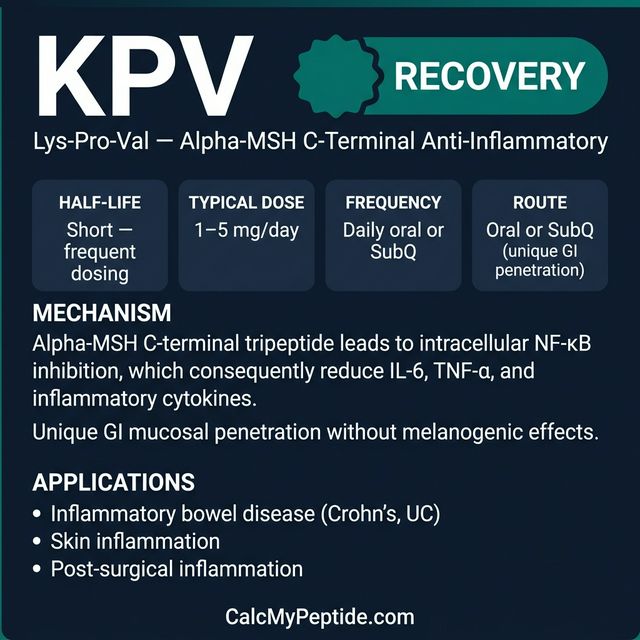
KPV (Lysine-Proline-Valine) is the C-terminal tripeptide of alpha-melanocyte stimulating hormone (α-MSH). It retains the potent anti-inflammatory properties of the parent molecule while being too small to activate melanocortin receptors — meaning it does not cause skin darkening.
KPV inhibits the NF-κB signaling pathway, the master switch for inflammatory gene expression. This reduces production of TNF-α, IL-6, IL-1β, and other pro-inflammatory cytokines. Uniquely, KPV is effective via multiple routes: subcutaneous injection, topical application, and oral/capsule administration.
Source: PMID: 10817504
📜Background & History
KPV (Lys-Pro-Val) is a tripeptide derived from the C-terminus of alpha-MSH (α-MSH) that retains the anti-inflammatory potency of the parent peptide without its melanogenic effects. Developed by researchers at Harvard Medical School (Bhardwaj et al., 1996), it was shown to penetrate cells and interact directly with NF-κB components to reduce inflammatory cytokine production. Its small size enables unique tissue penetration including the GI mucosa, making it particularly relevant for intestinal inflammatory conditions.
🎯 Research Use Cases
- ✓Inflammatory bowel disease: Crohn's disease and ulcerative colitis
- ✓Skin inflammation: psoriasis, eczema, wound healing
- ✓Reducing systemic inflammatory markers (IL-6, TNF-α, NF-κB)
- ✓Post-infection or post-surgical inflammatory resolution
💉 Dosing Protocol
| Typical Dose | 200-500 mcg/day |
| Frequency | 1-2× daily (or topical/oral) |
| Half-Life | ~30 minutes (estimated) |
| Common Vial Sizes | 5 mg, 10 mg |
🧪 Reconstitution Example
⚠️Safety & Considerations
Research peptide. Fragment of an endogenous human hormone. No significant safety concerns reported. Available in injectable, topical, and oral formulations. Oral bioavailability is notable for a peptide.
⚡Interactions & Contraindications
Anti-inflammatory mechanism — may reduce effectiveness of pro-inflammatory vaccines if taken in close proximity to immunization. No significant drug interactions documented at research doses. Oral bioavailability in GI conditions makes it uniquely suited for intestinal applications without systemic injection.
🔗Synergies & Common Stacks
KPV suppresses the inflammatory cascade; BPC-157 repairs the tissue damage from that inflammation. Powerful combination for GI healing protocols (IBD, leaky gut).
LL-37 antimicrobial + KPV anti-inflammatory — a comprehensive mucosal defense and repair stack.
❓ Frequently Asked Questions
Can KPV be taken orally?▼
Does KPV cause tanning like Melanotan?▼
📖 References
- Luger TA, et al. “Alpha-MSH tripeptide analogs activate the melanocortin receptors and anti-inflammatory pathways.” Ann N Y Acad Sci (2003). PMID: 12846038
- Kannengiesser K, et al. “KPV, an α-MSH C-terminal tripeptide, prevents intestinal inflammation via NF-κB pathway inhibition.” J Biol Chem (2008). PMID: 18025089