
What Is Actually in Your Vial?
This is the question that every peptide user should ask and most never do. The uncomfortable truth: if you are using research-grade peptides from unregulated vendors, you are trusting a supply chain that has no mandatory quality standards, no governmental oversight, and no accountability for what is in the vial. The vial might contain exactly what the label says. It might not.
Independent analyses of research peptides have revealed concerning findings: purity levels ranging from 60% to 99% (when the Certificate of Analysis claims ≥98%); heavy metal contamination exceeding pharmaceutical limits; bacterial endotoxin levels that explain injection site reactions; residual synthesis solvents (TFA, DMF) that cause local tissue irritation; and in some cases, completely mislabeled products where the vial contains a different peptide than what was ordered.
This is not meant to be alarmist — many research peptide vendors maintain high quality standards. But without testing, you have no way to distinguish between a reputable vendor and a dangerous one. Knowledge of contamination testing is your most important safety tool.
How to Read a Certificate of Analysis (CoA)
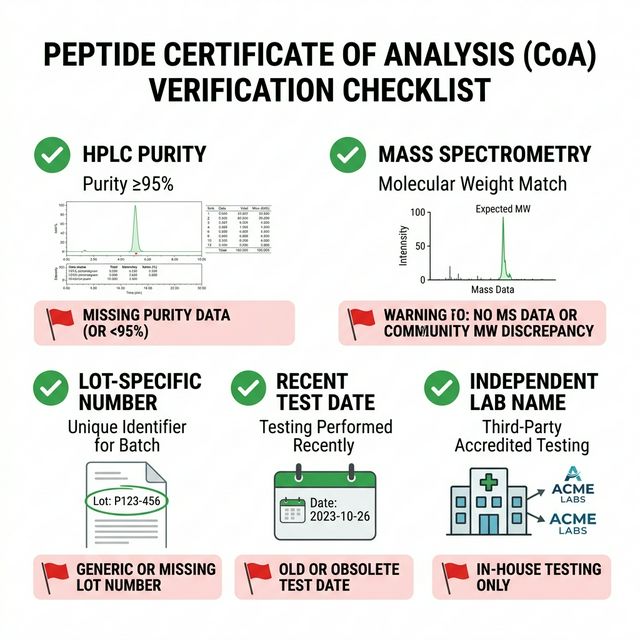
A legitimate CoA should contain the following, and you should demand all of them: (1) HPLC Purity — High Performance Liquid Chromatography. This is the gold standard for peptide purity testing. The CoA should report a percentage (e.g., "98.7% by HPLC") and include a chromatogram showing the peptide peak and any impurity peaks. A purity below 95% is concerning for injectable peptides. Look for: the purity percentage, the retention time of the main peak, and whether impurity peaks are identified.
(2) Mass Spectrometry (MS) — This confirms the molecular identity of the peptide. The observed molecular weight should match the theoretical molecular weight within 1 dalton. If the MS data shows a different molecular weight, the vial may contain a degradation product, a different peptide, or a synthesis truncation. This is your "is this actually what I ordered?" check.
(3) Lot Number — every CoA must reference a specific production lot. If the CoA has no lot number, or the lot number does not match the vial label, the CoA may be generic (applied to any batch regardless of actual testing). This is a common red flag with low-quality vendors.
(4) Test Date — the CoA should be recent enough to be relevant to the batch you received. A CoA dated more than 12 months before your purchase is suspect. (5) Laboratory Name — ideally an independent third-party lab, not just the vendor's in-house testing (which has obvious conflicts of interest).
The Tests You Should Demand
Beyond HPLC and MS (which are standard), for injectable peptides specifically, the following tests address the most dangerous contamination risks: (1) Bacterial Endotoxin Testing (BET/LAL) — endotoxins are lipopolysaccharide fragments from gram-negative bacteria that cause fever, inflammation, and in severe cases, septic shock. Even sterile solutions can contain endotoxins if the synthesis or handling environment was contaminated. The LAL (Limulus Amebocyte Lysate) test detects endotoxins at extremely low levels. Pharmaceutical standard: <5 EU/kg body weight per dose.
(2) Heavy Metal Testing (ICP-MS) — Inductively Coupled Plasma Mass Spectrometry detects heavy metals at parts-per-billion levels. The relevant metals for peptide synthesis contamination are: lead (Pb), mercury (Hg), cadmium (Cd), arsenic (As), and chromium (Cr). Pharmaceutical limits vary by element but generally require <10 ppm for most heavy metals.
(3) Residual Solvent Analysis — Peptide solid-phase synthesis uses solvents including trifluoroacetic acid (TFA), N,N-dimethylformamide (DMF), and dichloromethane (DCM). Residual solvents should be tested via headspace gas chromatography. ICH Q3C guidelines specify acceptable limits for each solvent. TFA in particular is a common contaminant that causes injection site pain and tissue irritation.
(4) Sterility Testing — For injectable preparations, USP sterility testing (14-day incubation in TSB and FTM media) confirms no viable bacteria or fungi. This test is expensive and time-consuming, which is why many research vendors skip it. If sterility testing is absent, proper reconstitution technique and sterile handling become even more critical.
Third-Party Testing Services
If your vendor's CoA seems insufficient (or you simply want independent verification), consumer peptide testing services exist: Janoshik Analytical offers HPLC, MS, and purity testing for approximately $50-100 per sample. Vanta BioSciences provides comprehensive pharmaceutical-grade testing including endotoxin and heavy metals for approximately $150-300 per sample. These services accept consumer-submitted samples via mail.
How to submit: send a small portion (typically 1-5 mg of lyophilized powder) or an aliquot of reconstituted solution per the lab's instructions. Results are typically returned within 1-3 weeks. Compare the independent results to the vendor's CoA — if the vendor claimed 98% purity and the independent lab shows 85%, you have a problem.
The cost of testing ($50-300) may seem significant relative to a $40-60 peptide vial. But consider: you are injecting this substance into your body. A single contamination event causing a systemic infection could result in hospitalization costs exceeding $10,000 and permanent health consequences. Testing is the cheapest insurance policy in the peptide world.