
The Two Types of Compounding Pharmacies
Not all compounding pharmacies are created equal. In fact, there are two fundamentally different legal frameworks under which pharmacies compound medications in the United States, and understanding the difference is essential if you are obtaining peptides through a prescriber.
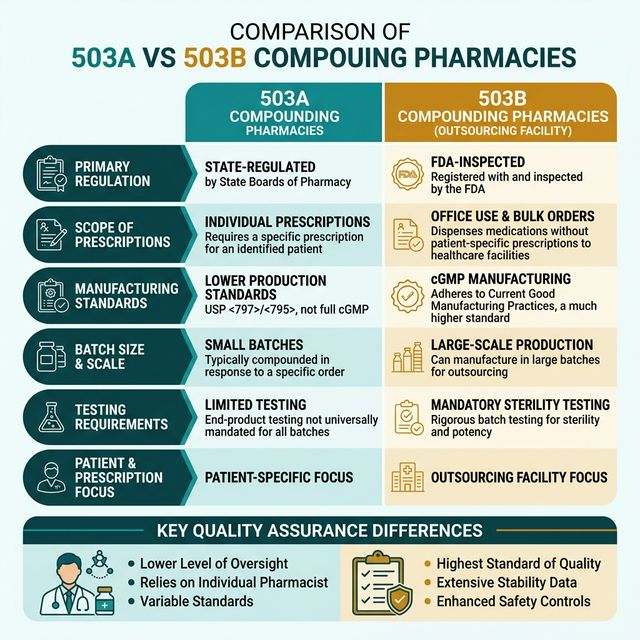
Section 503A pharmacies are traditional compounding pharmacies that prepare medications for individual patients based on specific prescriptions. They operate under state pharmacy board oversight. A 503A pharmacy receives a prescription from your physician, compounds the medication specifically for you, and dispenses it directly. These pharmacies do not need FDA registration for compounding and are primarily regulated at the state level. The limitation: each preparation must be patient-specific, and there are restrictions on compounding in anticipation of receiving prescriptions (no large-batch manufacturing).
Section 503B pharmacies, created by the Drug Quality and Security Act (DQSA) of 2013, are "outsourcing facilities" that can compound medications without patient-specific prescriptions. They operate under direct FDA oversight, must register with the FDA, are subject to FDA inspections using current Good Manufacturing Practice (cGMP) standards, and must report adverse events. 503B facilities can produce larger batches and distribute to healthcare facilities. The advantage: standardized manufacturing, FDA inspection, and higher quality assurance.
Why This Matters for Peptides
Peptides are particularly sensitive to manufacturing quality. Unlike small-molecule drugs (Tylenol, ibuprofen), peptides are amino acid chains whose biological activity depends on correct sequence, folding, and purity. Contamination during compounding — heavy metals from synthesis, endotoxins from non-sterile handling, or degradation products from improper storage — can cause injection site reactions, immune responses, or reduced efficacy.
A 503A pharmacy compounding individual peptide prescriptions may have varying quality depending on the specific pharmacy's facilities, procedures, and testing protocols. Some 503A pharmacies operate excellent clean rooms with validated analytical testing. Others may have less stringent quality controls. There is no federal standard — it depends on the state board and individual pharmacy.
A 503B outsourcing facility must meet FDA cGMP requirements: validated manufacturing processes, in-process controls, environmental monitoring, finished product testing (typically HPLC purity, endotoxin testing via LAL, sterility testing, potency verification), and batch records. These are the same standards applied to pharmaceutical manufacturers. When you receive a peptide from a 503B facility, you are getting a product manufactured under pharmaceutical-grade conditions.
How to Verify Your Pharmacy
If your physician prescribes compounded peptides, ask which type of pharmacy will be filling the prescription: (1) For 503B outsourcing facilities, verify their registration on the FDA's Outsourcing Facility Registry (publicly searchable). Check their most recent FDA inspection results (Form 483 observations are public record). Look for facilities with no critical observations. (2) For 503A pharmacies, verify licensure through your state pharmacy board. Ask about their quality testing — specifically, do they perform HPLC purity testing and endotoxin testing on finished peptide preparations? Request a lot-specific Certificate of Analysis for your prescription.
Red flags regardless of pharmacy type: no COA provided, generic (non-lot-specific) testing documentation, unwillingness to share testing methodology, no environmental monitoring of clean room facilities (if they even have one), and prices that seem too good to be true. Quality peptide compounding requires analytical equipment, clean room facilities, validated processes, and trained personnel — all of which cost money.
The practical recommendation: when possible, prefer 503B outsourcing facilities for compounded peptides. The FDA oversight, cGMP requirements, and standardized testing provide a quality floor that 503A pharmacies are not uniformly required to maintain.
Pricing Differences and Access Reality
Compounded peptides from 503A or 503B pharmacies typically cost significantly less than brand pharmaceutical equivalents (when they exist). Compounded semaglutide costs approximately $100-400/month versus $1,000-1,600/month for brand Wegovy. Compounded tirzepatide costs approximately $200-500/month versus $1,000-1,200/month for Mounjaro.
For peptides without branded equivalents (BPC-157, TB-500, ipamorelin) — when available under Category 1 — compounding pharmacy pricing typically runs $50-200/month per peptide, depending on the peptide, dose, and pharmacy. This includes the pharmaceutical-grade quality, prescriber oversight, and proper labeling that research-grade peptides do not provide.
The access pathway: find a prescriber familiar with peptide therapy (telehealth clinics specializing in peptides have proliferated since 2024), get a prescription, and the pharmacy handles compounding and shipping. Use CalcMyPeptide calculators to verify your dosing and reconstitution math — regardless of where your peptides come from, the concentration and syringe calculations are the same.