What Is MOTS-c?
MOTS-c (Mitochondrial ORF of the 12S rRNA Type-C) is a mitochondria-derived peptide — technically a "mitokine" — encoded within the 12S rRNA gene of human mitochondrial DNA. Unlike most peptides which are encoded in the nuclear genome, MOTS-c originates directly from the mitochondrion and is secreted into the bloodstream, where it acts systemically as a hormone-like signaling molecule. It was first identified and characterized by Dr. Changhan David Lee at the University of Southern California in 2015 (Lee C et al., Cell Metab, 2015, PMID: 25738459). CalcMyPeptide provides a free reconstitution calculator for MOTS-c and all research peptides.
MOTS-c is 16 amino acids in length and is the first mitokine discovered to regulate nuclear gene expression — bridging mitochondrial function and whole-body metabolic health in a previously unknown way.
How Does MOTS-c Mimic Exercise at the Cellular Level?
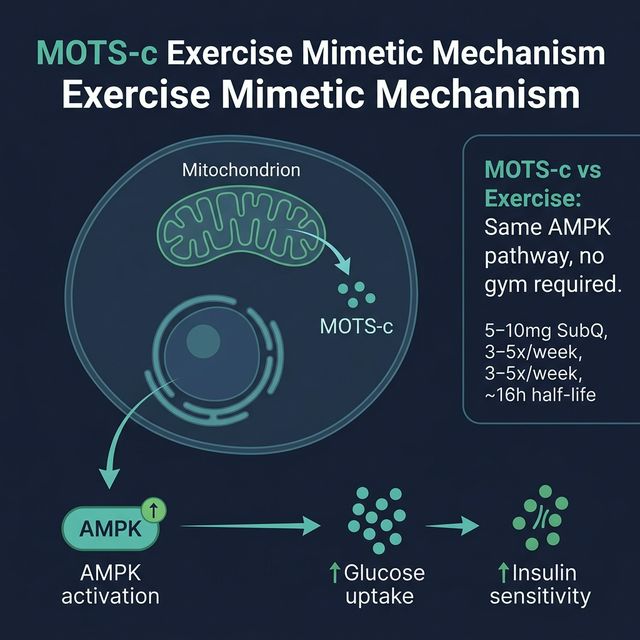
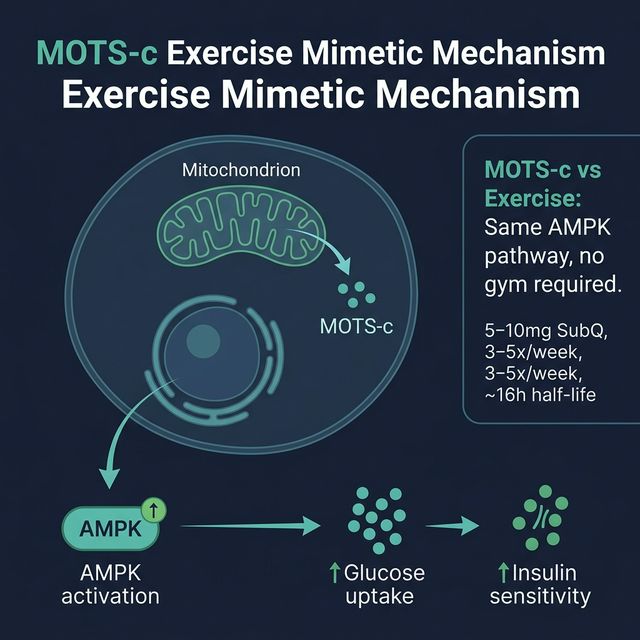
MOTS-c activates AMPK (AMP-activated protein kinase), which is often called the master switch of cellular energy metabolism. When cellular energy (ATP) falls — as it does during exercise — AMP/ADP ratios rise, activating AMPK. AMPK then triggers a cascade of metabolic adaptations: it stimulates GLUT4 glucose transporters to migrate to the cell membrane, dramatically increasing glucose uptake into skeletal muscle; it promotes fatty acid oxidation (fat burning); and it triggers mitochondrial biogenesis (new mitochondria formation).
These are the same metabolic adaptations produced by aerobic exercise. MOTS-c appears to activate the AMPK pathway through mitochondrial stress signaling — essentially telling cells to switch on their fuel-burning and repair machinery as if exercise had occurred, without physical exertion. This is why researchers classify it as an exercise mimetic (Reynolds JC et al., Nat Commun, 2021, PMID: 34620869).
Blood levels of MOTS-c naturally rise during and after exercise, suggesting it may partly mediate the systemic benefits of physical activity — from metabolic regulation to anti-aging effects.
MOTS-c and Insulin Sensitivity: What the Research Shows
Insulin resistance is one of the earliest and most consequential metabolic failures in aging, obesity, and type 2 diabetes. MOTS-c directly targets this pathway. In the original Lee 2015 study, MOTS-c treatment in obese mice improved insulin sensitivity, reduced fat accumulation, and enhanced exercise capacity — all without dietary change.
MOTS-c levels have been shown to decline with age and in people with obesity and metabolic syndrome. A 2020 study by Yen K et al. (Aging Mech Dis, PMID: 32435058) showed MOTS-c extends lifespan and improves metabolic markers through AMPK and DAF-16 pathways, and that MOTS-c concentrations are positively correlated with insulin sensitivity across different age groups.
Practical implication: MOTS-c may be particularly relevant for individuals with pre-diabetes, metabolic syndrome, or age-related insulin resistance — beyond its use as a general exercise-mimetic or longevity peptide.
MOTS-c Dosing Protocol and Reconstitution
Research protocol (based on available literature and community data):
• Dose: 5–10 mg per injection
• Frequency: 3–5 times per week (Monday/Wednesday/Friday or Monday/Tuesday/Thursday/Saturday)
• Route: Subcutaneous injection
• Half-life: Approximately 12–16 hours (relatively long for a small peptide)
• Cycle: 4–8 weeks on, 2–4 weeks off
Reconstitution example for MOTS-c 10 mg vial with 2 mL BAC water: Concentration = 10 ÷ 2 = 5 mg/mL = 5,000 mcg/mL. On a U-100 (100-unit) insulin syringe, each unit delivers 50 mcg. For a 5 mg dose: 5,000 ÷ 50 = 100 units (draw to the 100 line — an entire 1 mL syringe). For more practical dosing at 5 mg/vial with 1 mL BAC water: concentration = 5 mg/mL. Each unit = 50 mcg. For 5 mg dose: still 100 units. Use the CalcMyPeptide free reconstitution calculator for any vial configuration.
MOTS-c Clinical Evidence and Current Research Limitations
Current evidence is primarily animal-based. Human clinical trials for MOTS-c as a therapeutic peptide are limited as of 2026. The foundational studies are:
• Lee C et al. (Cell Metab, 2015): Discovery paper — MOTS-c activates AMPK, improves insulin sensitivity in obese mice, increases exercise capacity
• Yen K et al. (Aging Mech Dis, 2020): MOTS-c extends lifespan in mice through AMPK/DAF-16 pathways; correlates with insulin sensitivity in humans
• Reynolds JC et al. (Nat Commun, 2021): MOTS-c produced during exercise; mediates adaptive metabolic response
No phase 1 or 2 human clinical trials have published results for MOTS-c injections as of this writing. The peptide is used in research settings and in the biohacking community based on the strong mechanistic rationale from animal data. For related longevity peptides with longer research histories, see our Epitalon guide.
How Does MOTS-c Activate AMPK at the Cellular Level?
MOTS-c does not act like a conventional signaling peptide that binds a cell-surface receptor. Instead, it appears to act intracellularly — entering the nucleus and directly regulating gene expression. The leading hypothesis is that MOTS-c disrupts complex I of the mitochondrial electron transport chain (ETC), elevating cellular AMP/ADP ratios in a way that mimics energy depletion. This elevated AMP/ADP ratio directly activates AMPK (which binds AMP), triggering the full metabolic cascade: GLUT4 translocation, fatty acid oxidation, mitochondrial biogenesis, and autophagy.
This mechanism explains why MOTS-c specifically mimics exercise — exercise deprives cells of ATP (AMP/ADP ratios rise), AMPK activates, and the same cascade occurs. MOTS-c shortcuts the exercise trigger while producing the same metabolic downstream effects.
Is MOTS-c the Same as an Exercise Mimetic?
MOTS-c is classified as an exercise mimetic because it activates the same molecular pathway (AMPK) as aerobic exercise. However, it does not replicate all aspects of exercise — it does not produce mechanical loading on bone and muscle, it does not improve cardiovascular fitness directly, and it does not engage neuromuscular adaptations.
What it does replicate: improved insulin sensitivity, increased fat oxidation, enhanced glucose uptake into skeletal muscle, and some of the anti-aging transcriptional changes seen after exercise. Think of it as replicating the metabolic signal of exercise, not the full exercise response.
How Does MOTS-c Compare to Epitalon for Longevity?
MOTS-c and Epitalon are both studied as longevity peptides but target entirely different mechanisms. MOTS-c works through metabolic pathways (AMPK activation, mitochondrial signaling) with a focus on insulin sensitivity and metabolic health. Epitalon (Ala-Glu-Asp-Gly) activates telomerase, potentially extending telomere length in aging cells (Khavinson VK et al., Bull Exp Biol Med, 2003, PMID: 14631600). Epitalon has a 35+ year research record from Russian gerontological studies. MOTS-c is newer (discovered 2015) with stronger mechanistic clarity around its AMPK pathway but fewer intervention studies. See our Epitalon longevity peptides guide for comparison. Both can be calculated using the CalcMyPeptide reconstitution calculator.