Why Peptide Purity Matters
Peptide purity directly impacts safety and efficacy. A peptide marketed as "98% pure" contains 2% impurities — which could include truncated sequences, deletion sequences, oxidized forms, or other synthetic byproducts. At higher doses, those impurities become biologically significant.
Understanding how to read a Certificate of Analysis (CoA), interpret HPLC chromatograms, and verify mass spectrometry data empowers you to evaluate any supplier objectively.
Certificate of Analysis (CoA): What to Look For
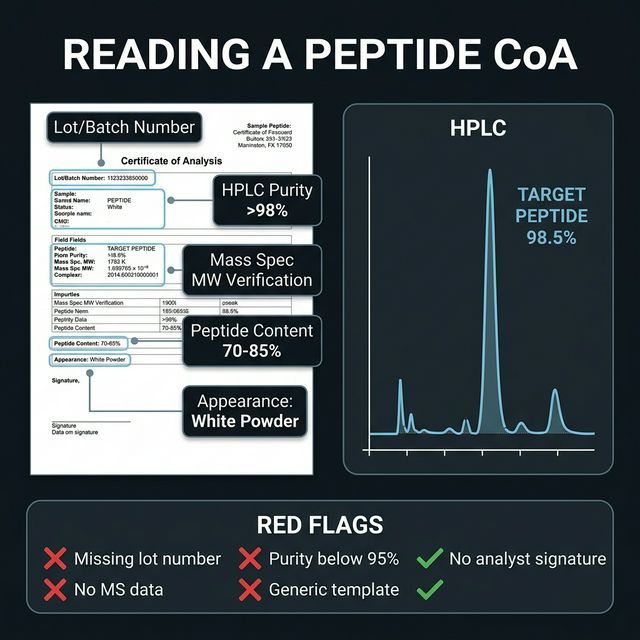
A legitimate CoA should contain at minimum:
• Product identification — peptide name, sequence, lot/batch number
• HPLC purity — reported as a percentage (>98% is generally acceptable, >99% is excellent)
• Mass spectrometry (MS) — molecular weight verification confirming correct sequence
• Appearance — should state "white lyophilized powder" or similar
• Solubility — tested reconstitution characteristics
• Peptide content — percentage of net weight that is actual peptide (vs salts/moisture), typically 70-85%
Red flags: Missing lot number, no MS data, purity below 95%, generic/template-looking documents, or no QC analyst signature.
HPLC Testing Explained
HPLC (High-Performance Liquid Chromatography) is the standard method for measuring peptide purity. It separates a sample into individual components based on their interaction with a column.
How it works: The sample is dissolved and pushed through a column filled with packing material. Different components travel at different speeds. A UV detector measures each component as it exits the column, producing a chromatogram — a chart with peaks representing each substance.
Reading the chromatogram: The main peak represents your target peptide. Its percentage of total peak area = purity percentage. Smaller peaks represent impurities. A sharp, symmetrical main peak at >98% area indicates high-quality synthesis.
Common HPLC conditions: C18 reversed-phase column, acetonitrile/water gradient with 0.1% TFA, UV detection at 220 nm. These conditions resolve most peptide impurities.
Mass Spectrometry: Confirming Identity
While HPLC measures purity (how much of the sample is the correct peptide), mass spectrometry (MS) confirms identity (that the molecule IS actually the correct peptide).
MS measures the molecular weight of the peptide with high precision. The measured molecular weight must match the theoretical molecular weight (calculated from the amino acid sequence) within ±1 Da.
Common MS methods: ESI-MS (Electrospray Ionization) and MALDI-TOF (Matrix-Assisted Laser Desorption/Ionization). Both are standard for peptide verification.
What to check on the CoA: The reported MW (molecular weight) should match the theoretical MW for the peptide. For example, BPC-157 has a theoretical MW of 1419.53 Da. A CoA reporting 1419.5 ± 0.5 Da confirms identity.
Peptide Content vs Purity
These are different measurements that are often confused:
• Purity (HPLC) — percentage of the peptide component that is the correct sequence. A 98% pure peptide has 2% impurities.
• Peptide content — percentage of the total weight that is actual peptide (vs counter-ions, moisture, and residual solvents). Typically 70-85% for TFA salt forms.
Why this matters: A 5 mg vial at 80% peptide content actually contains 4 mg of peptide. This is standard and expected — manufacturers account for this in their labeling. If you need exact dosing, factor in the peptide content percentage.
Verifying Your Supplier
Use these criteria to evaluate peptide supplier quality:
• Lot-specific CoA — each batch should have a unique CoA, not a generic template
• Third-party testing — independent lab verification (not just in-house testing)
• GMP or ISO certification — manufacturing quality standards
• Clear labeling — peptide name, weight, lot number, storage instructions
• Published testing methodology — HPLC conditions and MS method specified
• Responsive customer service — willing to provide additional analytical data on request
No single metric guarantees quality, but a supplier providing detailed, lot-specific analytical data with both HPLC and MS is significantly more trustworthy than one providing a generic PDF.