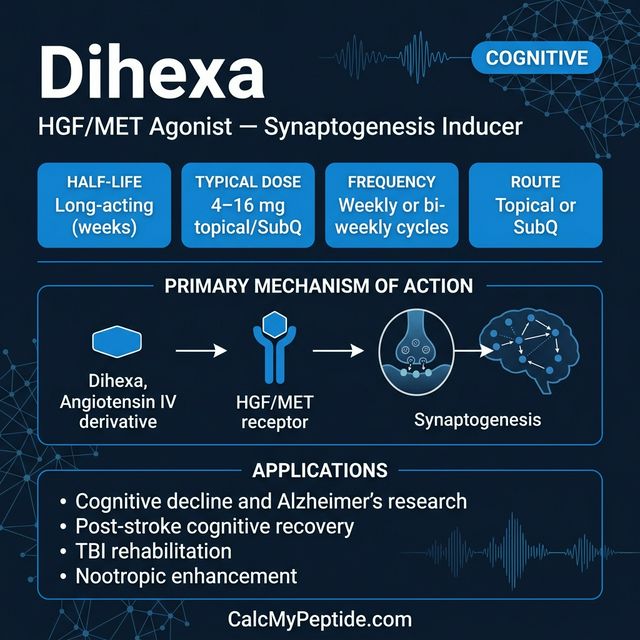
Dihexa
Angiotensin IV analog studied for cognitive enhancement, reported 10^7× more potent than BDNF at synapse formation.
🔬 Mechanism of Action
Dihexa (N-hexanoic-Tyr-Ile-(6)-aminohexanoic amide) is a synthetic peptide analog of angiotensin IV that acts on hepatocyte growth factor (HGF) receptors. It is reported to be 10^7 (ten million) times more potent than BDNF (Brain-Derived Neurotrophic Factor) at promoting spinogenesis — the formation of new dendritic spines that enable synaptic connections.
Dihexa crosses the blood-brain barrier and promotes synaptogenesis, which may enhance learning, memory, and cognitive function. It was developed at Washington State University as a potential therapeutic for neurodegenerative diseases including Alzheimer's.
Source: PMID: 23123685
📜Background & History
Dihexa is a potent cognitive enhancer derived from angiotensin IV, developed by Joseph Harding and John Wright at Washington State University. Published in Science (2012), it was shown to induce synaptogenesis — the formation of new synapses — with potency reportedly 7 orders of magnitude greater than BDNF in some assays. It acts via HGF/MET receptor signaling.
🎯 Research Use Cases
- ✓Cognitive decline in Alzheimer's disease and dementia (animal models)
- ✓Post-stroke cognitive recovery
- ✓Traumatic brain injury recovery
- ✓Nootropic stack component for memory and learning enhancement
💉 Dosing Protocol
| Typical Dose | 10-40 mg/day (oral/intranasal) |
| Frequency | 1× daily |
| Half-Life | ~2-4 hours (estimated) |
⚠️Safety & Considerations
Research peptide with very limited human data. Extremely potent — doses are measured in micrograms. Primarily available as oral or intranasal formulations. Not injectable. Consult a healthcare provider before use.
⚡Interactions & Contraindications
Long-acting — effects may persist for weeks after single dosing. Start at very low doses. Limited human safety data available. Avoid with active brain tumors.
🔗Synergies & Common Stacks
Semax upregulates BDNF; Dihexa promotes synaptogenesis via HGF/MET. Together they support neurotrophic support from multiple angles in cognitive recovery protocols.
Cerebrolysin contains BDNF, NGF, and other neurotrophins; Dihexa promotes the synaptic infrastructure to utilize them. Potentially synergistic for neurological recovery.