Oxytocin
FDA-approved neuropeptide hormone involved in social bonding, trust, and stress reduction. Available as intranasal spray.
🔬 Mechanism of Action
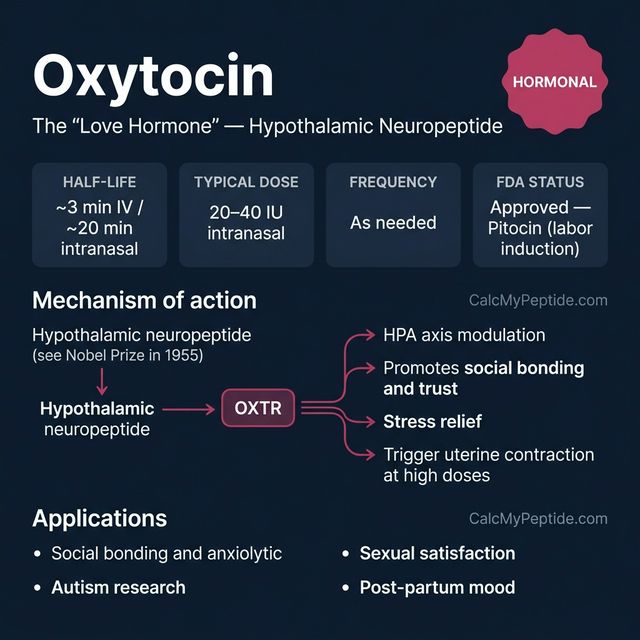
Oxytocin is a nine-amino-acid neuropeptide hormone produced primarily in the hypothalamus (paraventricular and supraoptic nuclei) and released from the posterior pituitary. It plays central roles in social bonding, trust, empathy, anxiety reduction, and pair bonding.
Oxytocin activates oxytocin receptors (OXTR) in the brain, reducing activity in the amygdala (fear/anxiety center) and modulating activity in the prefrontal cortex. FDA-approved (Pitocin) for labor induction. Intranasal oxytocin is studied for autism spectrum disorder, social anxiety, PTSD, and relationship therapy.
Source: PMID: 12573549
📜Background & History
Oxytocin is a nine-amino-acid neuropeptide produced in the hypothalamus (supraoptic and paraventricular nuclei) and released by the posterior pituitary. First synthesized in 1953 by Vincent du Vigneaud (Nobel Prize 1955), it was initially known only for its roles in birth (uterine contractions) and lactation. Research by Paul Zak and others in the 2000s established its roles in social bonding, trust, empathy, and stress regulation — earning it the popular name "love hormone." Synthetic oxytocin (Pitocin) is FDA-approved for labor induction.
🎯 Research Use Cases
- ✓Social bonding, trust, and emotional connection enhancement
- ✓Anxiety and stress reduction via HPA axis modulation
- ✓Post-partum mood support (not FDA-approved for this)
- ✓Autism spectrum disorder social behavior research
- ✓Sexual satisfaction and pair bonding in intimate relationships
💉 Dosing Protocol
| Typical Dose | 10-24 IU (intranasal) |
| Frequency | As needed or 1-2× daily |
| Half-Life | ~3-5 minutes (IV) |
⚠️Safety & Considerations
FDA-approved (Pitocin) for obstetric use. Intranasal formulations are generally well-tolerated. Side effects may include nasal irritation and mild drowsiness. Chronic use may affect vasopressin response. Use under medical guidance.
⚡Interactions & Contraindications
Intranasal route for CNS effects; IV route for labor induction (different dose range). Do not combine with uterotonic drugs in pregnant women without OB oversight — risk of uterine hyperstimulation. SSRIs may blunt oxytocin receptor sensitivity. Alcohol reduces oxytocin receptor expression — chronic alcohol use diminishes efficacy.
🔗Synergies & Common Stacks
PT-141 initiates sexual desire via central MC4R; oxytocin enhances the bonding and satisfaction dimension. Together address both arousal and emotional connection in sexual function.
Kisspeptin enhances sexual motivation via GnRH/testosterone; oxytocin amplifies the social bonding aspect. Comprehensive sexual wellness and relationship quality stack.
❓ Frequently Asked Questions
How is oxytocin used for social anxiety?▼
Is intranasal oxytocin safe for daily use?▼
📖 References
- Ditzen B, et al. “Intranasal oxytocin increases positive communication and reduces cortisol levels during couple conflict.” Biol Psychiatry (2009). PMID: 18814863
- Kirsch P, et al. “Oxytocin modulates neural circuitry for social cognition and fear in humans.” J Neurosci (2005). PMID: 16339030