⚥️ Medical Disclaimer
⚥️ Medical Disclaimer: This article is for educational and informational purposes only. It does not constitute medical advice. Consult a qualified healthcare provider before using any peptide.
What Are Khavinson Bioregulators?
Khavinson bioregulators are a class of short peptides (2-4 amino acids) developed by Professor Vladimir Khavinson at the Saint Petersburg Institute of Bioregulation and Gerontology in Russia over four decades of research. These peptides are theorized to regulate gene expression at the epigenetic level — interacting directly with DNA to modulate specific organ-system functions.
Last updated: March 2026
The concept is radically different from most peptide therapy: rather than binding cell-surface receptors (like semaglutide binds GLP-1R or ipamorelin binds GHSR), Khavinson peptides are proposed to enter the cell nucleus and interact with complementary DNA sequences to upregulate or downregulate gene expression. Think of them as biological “software updates” for specific organs.
This field exists in a fascinating intersection of legitimate research (200+ published studies, some in peer-reviewed journals) and extraordinary claims (life extension, disease prevention, organ rejuvenation) that require healthy scientific skepticism.
Three commercial product families have been developed around Khavinson's work: the Cytogen® synthesized peptide bioregulators, the Cytomax® natural cytamine bioregulators derived from animal organs, and the Vitual® combination supplements. All three lines are produced by Cytomedics and available internationally through select research-grade suppliers.
The Mechanism: Epigenetic Gene Regulation by Short Peptides
Khavinson's central hypothesis: di-, tri-, and tetrapeptides can penetrate cell membranes and nuclear membranes to bind specific DNA sequences, modulating gene expression in a tissue-specific manner (Khavinson et al., 2014, PMID: 25437836).
The proposed mechanism proceeds in four steps:
• Short peptides (2-4 amino acids) have molecular weights small enough to cross cell membranes without receptor-mediated endocytosis.
• Once inside the nucleus, they bind to complementary DNA sequences in promoter regions via electrostatic and hydrogen-bond interactions.
• This binding upregulates transcription of proteins specific to the target organ system — heart cells produce cardioprotective proteins, pineal cells produce melatonin regulators, immune cells produce cytokines.
• The effect is proposed to be organ-specific because different short peptides have affinity for different promoter DNA sequences.
Published evidence includes in vitro DNA-binding studies, animal lifespan research, and a landmark 6-year mortality study in elderly humans treated with thymalin, showing significantly reduced death rates vs controls.
The quality of evidence varies significantly across the bioregulator family. Epithalon has the most data. Thymalin and Cortexin have Russian regulatory approval. Others have substantially less. Approach each compound individually.
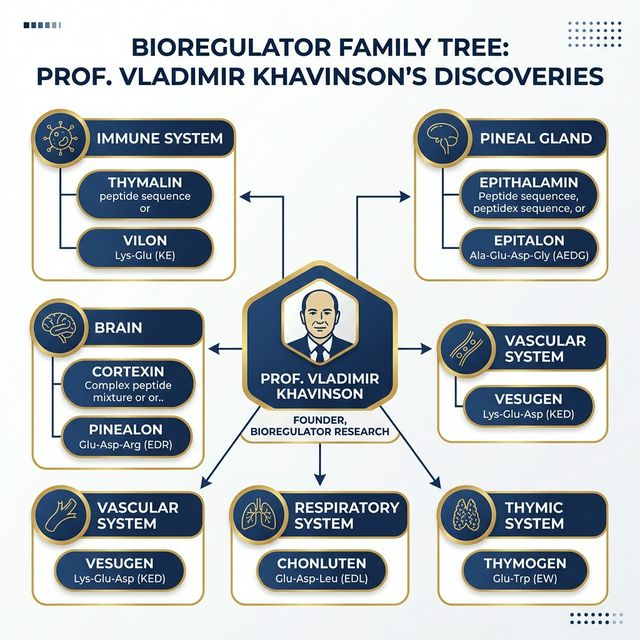
Bioregulator Reference Table
| Peptide | Sequence | Target System | Proposed Function | Evidence Level |
|---|---|---|---|---|
| Epithalon (Epitalon) | Ala-Glu-Asp-Gly | Pineal gland | Telomerase activation, melatonin regulation | Best evidence; animal + limited human |
| Thymalin | Glu-Trp | Immune (thymus) | T-cell maturation, immune reconstitution | Approved in Russia; 6-year mortality data |
| Vilon | Lys-Glu | Immune system | Immune modulation, longevity | Russian clinical trials |
| Cortexin | Complex mix | CNS (brain) | Neuroprotection, cognitive function | Approved in Russia; pediatric + adult use |
| Pinealon | Glu-Asp-Arg | Pineal/CNS | Neuroprotection, circadian regulation | Limited preclinical |
| Vesugen | Lys-Glu-Asp | Vascular system | Endothelial function, vascular health | Limited preclinical |
| Chonluten | Glu-Asp-Gly | Respiratory | Bronchial mucosa health | Limited preclinical |
| Cartalax | Ala-Glu-Asp | Cartilage/Bone | Osteogenic differentiation, cartilage preservation | Limited preclinical |
| Livagen | Lys-Glu-Asp-Gly | Cardiovascular | Cardioprotection, chromatin regulation | Preclinical |
Epithalon: The Flagship Longevity Bioregulator
Epithalon (also spelled Epitalon) is a synthetic tetrapeptide (Ala-Glu-Asp-Gly) analog of epithalamin, a natural extract from the pineal gland. It is the most studied Khavinson bioregulator and the compound that sparked global longevity interest in this class.
Key research findings:
• Telomerase activation: Epithalon activated telomerase in human somatic cells in vitro, potentially extending replicative capacity (Khavinson et al., 2003, PMID: 14523363).
• Life extension in animal models: Epithalamin extended mean lifespan by 25% in rats and reduced spontaneous tumor incidence (Anisimov et al., 2003, PMID: 12946225).
• Melatonin regulation: Epithalon restored nocturnal melatonin production in elderly patients with diminished pineal function.
• Antioxidant effects: Epithalon upregulated superoxide dismutase and catalase in aged animal models, reducing oxidative stress.
• No formal human longevity RCT: No randomized controlled trial has demonstrated lifespan extension in humans. The rodent data is intriguing but the leap to clinical claims requires caution.
Dosing protocol (community standard, not clinically validated):
• 5-10 mg SubQ daily for 10-20 days (one "course")
• Repeat courses every 4-6 months
• Some users run 1-2 mg/day for 30 days as a gentler approach
Use our Reconstitution Calculator for exact syringe draws.
Thymalin and Vilon: Immune Bioregulators
Thymalin (Glu-Trp) is a dipeptide bioregulator targeting the thymus, approved in Russia for immune restoration. The thymus gland involutes with age, contributing to immunosenescence.
• A landmark 6-year non-randomized study in elderly patients (60-80 years) showed thymalin use was associated with significantly reduced mortality vs controls — the strongest long-term clinical data in the Khavinson portfolio.
• Clinical use in Russia: post-operative immune recovery, chronic infection management, geriatric immune support.
• Protocol (Russian clinical): 10 mg IM daily for 5-10 days, repeated every 3-6 months. Community: 5-10 mg SubQ preferred.
Vilon (Lys-Glu) is a dipeptide bioregulator targeting the immune system broadly — often stacked with epithalon in community longevity protocols.
• Often used as "epithalon for telomeres + vilon for immune maintenance" in combined longevity protocols.
• Animal studies showed reduced inflammatory cytokines and improved survival. Human data is observational.
• Protocol: 5-10 mg SubQ, 2-3x weekly for 3-4 weeks per course, repeated quarterly.
Cortexin and Pinealon: Neuroprotection
Cortexin is approved in Russia as a neuroprotective agent for stroke rehabilitation, traumatic brain injury, cognitive decline, and pediatric neurological disorders. Unlike most Khavinson bioregulators, cortexin is a polypeptide complex (not a defined single peptide) extracted from cattle cerebral cortex.
Clinical applications (Russian registry): stroke recovery (motor + cognitive), TBI neuroprotection, age-related cognitive decline, epilepsy adjunct.
Protocol: 10 mg IM or SubQ daily for 10 days. Repeat every 3-6 months.
Pinealon (Glu-Asp-Arg) is a tripeptide targeting both the pineal gland and CNS — proposed to reduce neuronal apoptosis and improve neurotransmitter balance. Evidence is primarily preclinical.
Protocol: 0.5-1 mg SubQ daily for 10-20 days per course.
These two neuroprotective bioregulators are often combined as the core of a cognitive longevity stack, with cortexin/cerluten layered over a base of epithalon + endoluten.
Cytogen® Synthesized Peptide Bioregulators
The Cytogen® line represents the most refined Khavinson bioregulators — chemically synthesized pure peptides with defined amino acid sequences. Unlike the natural cytamine extracts in the Cytomax® line, Cytogen® peptides can be reconstituted for subcutaneous injection or taken as oral tablets.
All Cytogen® products are available through vita-stream.com, a European-based supplier specializing in Khavinson bioregulators.
Key Cytogen® peptides:
Pinealon (Glu-Asp-Arg)
Neuroprotection, circadian support, anti-aging CNS peptide.
Crystagen (Glu-Asp-Ala)
Immune system bioregulator — lymphocyte and cytokine balance support.
Livagen (Lys-Glu-Asp-Gly)
Cardiovascular bioregulator targeting chromatin and cardiac gene regulation.
Ovagen (Glu-Asp-Leu)
Liver health bioregulator — hepatic cell regeneration and detox support.
Chonluten (Glu-Asp-Gly)
Lung/respiratory bioregulator — bronchial mucosa and epithelial support.
Vesugen (Lys-Glu-Asp)
Vascular bioregulator — endothelial function and blood vessel health.
Cartalax (Ala-Glu-Asp)
Cartilage and bone bioregulator — osteogenic differentiation support.
Cytomax® Natural Cytamine Bioregulators
The Cytomax® line consists of cytamine-based bioregulators — natural complexes of proteins, glycoproteins, and peptides extracted from animal organs. These are organ-specific concentrates delivered as enteric-coated oral tablets, allowing intestinal absorption while bypassing gastric degradation.
Key Cytomax® products:
Endoluten (Pineal gland complex)
Most popular cytamine — pineal cytamine for melatonin, longevity, and circadian health.
Vladonix (Thymus complex)
Thymic cytamine for immune restoration and T-cell function — natural alternative to thymalin.
Cerluten (Brain/CNS complex)
CNS cytamine for cognitive support, neuroprotection, memory — natural cortexin analog.
Chelohart (Heart complex)
Cardiac cytamine — cardioprotection and myocardial cell support.
Ventfort (Vascular complex)
Vascular cytamine — blood vessel health and endothelial support.
Svetinorm (Liver complex)
Hepatic cytamine — liver detoxification and regeneration support.
Suprefort (Pancreas complex)
Pancreatic cytamine — insulin regulation and metabolic support.
Sigumir (Cartilage/Bone complex)
Musculoskeletal cytamine — joint health, cartilage preservation, mobility support.
Thyreogen (Thyroid complex)
Thyroid cytamine — thyroid function regulation and metabolic balance.
Vitual® Combination Formulas
The Vitual® line combines multiple bioregulators and synergistic co-factors into targeted oral formulations — a systems-level approach to aging that addresses multiple organ systems simultaneously.
Protector 3 Plus
Neuroprotection stack — CNS, vascular, and immune bioregulators for brain longevity.
Neuro 3 Plus
Cognitive optimization combination — memory, focus, and neurological resilience.
Cardio 3 Plus
Cardiovascular health combination — cardiac, vascular, and energy metabolism support.
All Vitual® products are available from vita-stream.com.
Critical Assessment: Evidence Scorecard
Strengths:
• Four decades of continuous research with 200+ publications
• Russian regulatory approval for thymalin and cortexin provides decades of real-world safety data
• Peptide-DNA interactions are biologically plausible (transcription factors bind DNA — short peptides may do the same)
• Animal lifespan extension data for epithalon is consistent across 20+ years of studies
• 6-year human mortality study (thymalin) showed significantly reduced death rates vs control group
Limitations:
• Most studies originate from Khavinson's own institute — independent Western replication is sparse
• Many studies published in Russian-language journals not indexed in PubMed
• Clinical trial methodology often falls below modern Western standards: small n, no blinding, no placebo, no pre-registration
• The leap from "peptide binds DNA in vitro" to "organ-specific rejuvenation in humans" involves multiple unvalidated steps
| Compound | Human Evidence | Animal Evidence | Overall Grade |
|---|---|---|---|
| Epithalon | Observational (melatonin, circadian) | Strong (lifespan +25%, telomerase) | B |
| Thymalin | 6-year mortality study | Moderate | B+ |
| Cortexin | RCT data (stroke, TBI) — Russian approval | Moderate | A- |
| Vilon | Observational | Moderate | C+ |
| Pinealon/Vesugen/Chonluten | Minimal human | Preclinical | C |
For comparison with better-validated peptide categories, see our peptide safety guide and beginner guide.
How to Access and Use Bioregulators
For Cytogen® synthesized peptides: Reconstitute with bacteriostatic water for subcutaneous injection. Use our Reconstitution Calculator for exact syringe units. Alternatively, oral tablet forms are available for several Cytogen® peptides.
For Cytomax® natural cytamines: Oral enteric-coated tablets — no reconstitution needed. Take with water before meals.
For Vitual® combinations: Oral capsules per the product label.
Sourcing: The most established international source for all three Khavinson lines is vita-stream.com.
Community stack protocol (common starting point):
• Endoluten (pineal cytamine) — 2 capsules/day for 30 days, 2x per year, as the longevity baseline
• Vladonix (thymic cytamine) — add for immune support especially in autumn/winter
• Injectable Epithalon — 10-20 day SubQ courses, 2x per year, for telomere/melatonin axis
• Cortexin or Cerluten — add for cognitive protection, particularly after 50
See our blood work guide for the full monitoring panel.
Frequently Asked Questions
Is epithalon proven to extend human lifespan? No — no controlled human trial has demonstrated lifespan extension with epithalon. The evidence base consists of in vitro telomerase activation, rodent lifespan studies, and observational human data on melatonin normalization. These are encouraging but insufficient to support definitive clinical longevity claims.
Are Khavinson bioregulators safe? The safety profile appears favorable based on decades of Russian clinical use with thymalin and cortexin. Short peptides (2-4 amino acids) are generally considered low-risk due to rapid clearance, water solubility, and lack of receptor-mediated systemic effects.
Can I buy bioregulators legally? Yes — they are sold as research compounds in most Western countries. They are not FDA-approved. Quality varies dramatically between suppliers — vita-stream.com is among the most established European sources for authentic Cytogen/Cytomax/Vitual product lines.
How do bioregulators compare to BPC-157 or ipamorelin? Different mechanisms and time horizons entirely. BPC-157 and ipamorelin work through cell-surface receptor activation with measurable effects within days. Bioregulators theoretically modulate gene expression — effects are subtle, cumulative, and may take weeks to months to perceive.
What is the difference between Cytogen® and Cytomax®? Cytogen® products are chemically synthesized pure peptides with defined sequences — suitable for injection or oral use. Cytomax® products are natural cytamine extracts from animal organs, taken orally only. Cytogen® is more precise; Cytomax® is more natural but less well-characterized.
What blood work should I get before starting bioregulators? CBC, CMP, hormone panel (thyroid, testosterone, estrogen), melatonin (for epithalon), and IGF-1. Use our blood work guide for the full checklist.
Final Word
Khavinson bioregulators represent one of the most intriguing and underexplored areas in peptide research. Four decades of Russian science sit behind them — imperfect by Western standards, but substantial by any measure. They are not a replacement for evidence-based medicine, but they represent a sophisticated, systems-level approach to aging that deserves serious attention from longevity researchers and informed biohackers alike.
⚥️ Medical Disclaimer: This article is for educational and informational purposes only. It does not constitute medical advice. Consult a qualified healthcare provider before using any peptide.