
The "Not for Human Consumption" Fiction
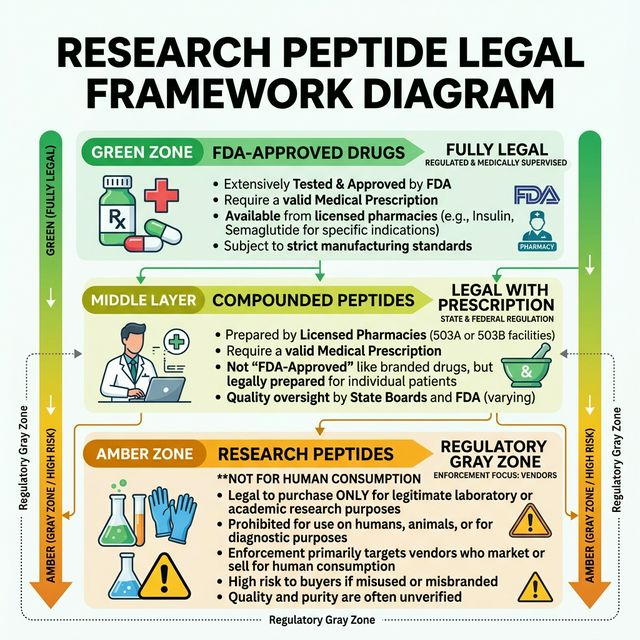
Every research peptide vendor in the United States sells peptides labeled "for research purposes only" or "not for human consumption." This labeling exists for a specific legal reason: without FDA approval, a substance cannot be marketed or sold for human therapeutic use. By labeling products as research chemicals, vendors avoid the regulatory requirements that apply to drugs.
This is a legal fiction that everyone understands. The vast majority of research peptide customers are not academic researchers. They are individuals purchasing peptides for personal use. Vendors know this. Customers know this. The FDA knows this. The arrangement persists because enforcement priorities and practical realities create a gray area that has been — until recently — relatively stable.
The legal framework: research chemicals are legal to sell and purchase in the United States as long as they are not marketed or intended for human consumption. The "research use only" label establishes this intent. Purchasing and possessing research peptides is not illegal for the buyer. Using them on yourself exists in a legal gray zone — you are not violating any specific criminal statute, but you are using an unapproved substance without the consumer protections that come with FDA-approved medications.
What the FDA Actually Enforces
The FDA's enforcement actions in the peptide space have historically focused on three areas: (1) vendors making explicit therapeutic claims — "our BPC-157 heals tendons" or "our semaglutide treats obesity." Such claims convert a research chemical into an unapproved new drug and trigger FDA enforcement jurisdiction. (2) Contamination and adulteration — the FDA has issued warning letters and seizure orders against vendors whose products contained dangerous contaminants, mislabeled substances, or were manufactured in facilities that pose infection risk. (3) Controlled substance analogs — some research chemicals fall under the Federal Analogue Act if they are analogues of scheduled substances. Most therapeutic peptides are not analogues of controlled substances and do not trigger this provision.
What the FDA has not done (so far): prosecuted individual consumers for purchasing or using research peptides for personal use. The enforcement gap is practical — the FDA allocates resources toward manufacturers, distributors, and public health threats, not individual end-users.
However, this enforcement posture is not a guarantee. The regulatory landscape is actively evolving. The Category 2 peptide designations (see our Category 2 article) represent a tightening of the compounding pharmacy pipeline. Increased FDA attention to the peptide market — driven by the GLP-1 boom — may eventually extend to the research peptide market as well.
Quality Risks: The Real Danger Zone
The legal question is actually less important than the quality question. Research peptides exist outside any quality framework. There is no FDA inspection of manufacturing facilities, no cGMP requirements, no mandatory testing, no adverse event reporting, and no accountability for what is actually in the vial.
Independent testing of research peptides has revealed: purity variations from 60-99% (when the CoA claims ≥98%); heavy metal contamination (lead, mercury, cadmium) from Chinese chemical suppliers who do not follow pharmaceutical-grade synthesis protocols; endotoxin contamination causing injection site reactions and systemic inflammatory responses; mislabeled peptides (the vial contains a different peptide or a degradation product); and residual solvent contamination from synthesis (TFA, DMF, dichloromethane).
Not all research peptide vendors are equal. Some maintain high quality standards, use reputable synthesis labs, and provide legitimate third-party testing. Others are reselling the cheapest available product with fabricated or recycled CoAs. The buyer bears complete responsibility for due diligence. See our guide on peptide contamination testing for how to evaluate vendor quality.
How to Protect Yourself
If you are using research peptides (and we are not advising that you do, because they are labeled as not for human consumption): (1) Demand lot-specific CoAs with HPLC purity data and mass spectrometry (MS) molecular weight verification. Generic CoAs with no lot number or testing date are worthless. (2) Verify seller reputation through community forums (Reddit r/peptides, dedicated peptide communities) where independent testing results are sometimes shared. (3) Consider third-party testing — services like Janoshik Analytical, Vanta BioSciences, and others offer consumer peptide testing for approximately $50-100 per sample. (4) Use bacteriostatic water from a pharmaceutical source (not from the peptide vendor). (5) Follow proper reconstitution, storage, and injection protocols to minimize contamination risk.
The better alternative, when available: work with a licensed prescriber and obtain peptides from a 503A or 503B compounding pharmacy. The cost is moderately higher, but the quality assurance, physician oversight, and legal protection are significant upgrades. As peptides continue moving from Category 2 back to Category 1, compounded pharmacy access will expand.