What Is the FDA Peptide Reclassification of 2026?
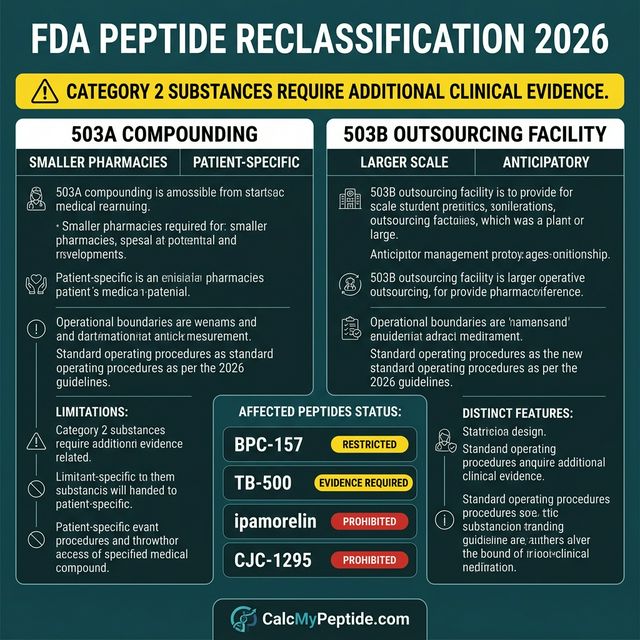
The FDA peptide reclassification of 2026 refers to regulatory actions under the Drug Quality and Security Act (DQSA) of 2013 that determine which peptide compounds can be legally compounded by licensed pharmacies in the United States. Under DQSA, the FDA maintains a list of bulk drug substances that may be used in compounding, categorized as Category 1 (nominated, adequate clinical evidence), Category 2 (under review, can be compounded pending decision), or Category 3 (not appropriate for compounding). As of early 2026, most research peptides including BPC-157, TB-500, and ipamorelin remain in Category 2 — they have not been banned but face ongoing FDA scrutiny (Gudeman J et al., N Engl J Med, 2013, PMID: 23992655). CalcMyPeptide provides free reconstitution calculators for all compounded peptides regardless of regulatory category.
This guide covers the 2026 status of the most commonly compounded peptides, the distinction between 503A and 503B compounding facilities, and what the regulatory landscape means for patient access.
Which Peptides Were Affected by the 2026 Reclassification?
The 2026 FDA actions primarily affected the following peptide categories:
| Peptide | Category | 2026 Status | Notes |
|---|---|---|---|
| BPC-157 | 2 (Under Review) | Can be compounded | Awaiting final FDA determination |
| TB-500 (Thymosin β4) | 2 (Under Review) | Can be compounded | Subject to ongoing review |
| Ipamorelin | 2 (Under Review) | Can be compounded | Listed as bulk drug substance |
| CJC-1295 | 2 (Under Review) | Can be compounded | Subject to ongoing review |
| Semaglutide | Shortage Exemption | Compounding allowed during shortage | Status changes as branded supply recovers |
| Tirzepatide | Shortage Exemption | Compounding allowed during shortage | Mounjaro/Zepbound shortage triggered exemption |
The GLP-1 shortage exception — which allowed compounding pharmacies to produce semaglutide and tirzepatide while branded Wegovy and Mounjaro faced supply shortages — is the most consequential regulatory event of the 2026 cycle. As branded supply recovers, the exemption has been narrowing, and FDA has taken enforcement actions against some compounders.
What Is the Difference Between 503A and 503B Compounding?
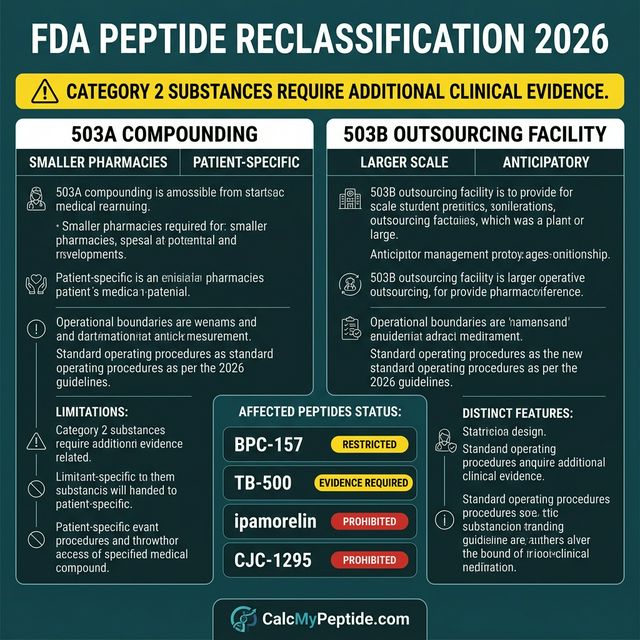
The DQSA created two distinct pathways for compounding pharmacies, each with different requirements and permitted activities:
503A compounding pharmacies prepare patient-specific medications based on individual prescriptions. They must be licensed by their state board of pharmacy, operate under USP <797> standards for sterile preparations, and cannot compound medications that are commercially available in the same form and concentration.
503B outsourcing facilities are registered with the FDA, can compound large quantities of medications without patient-specific prescriptions (anticipatory compounding), and must comply with federal current Good Manufacturing Practice (cGMP) standards — significantly stricter than 503A requirements. 503B facilities can distribute across state lines.
For peptide users: most compounded peptides are prepared by 503A pharmacies requiring a physician prescription. CalcMyPeptide works with all vial formats from either facility type — enter your vial strength and water volume into the reconstitution calculator to get exact syringe units.
How Does This Affect BPC-157 and TB-500 Access?
BPC-157 and TB-500 remain in Category 2 of the FDA bulk drug substance list for compounding, meaning they can still be legally compounded by 503A pharmacies for individual patients with a valid prescription. The FDA has not issued a final determination removing them from the compounding list.
However, the regulatory environment introduces uncertainty: the FDA can move peptides from Category 2 to Category 3 (prohibited from compounding) if it determines the clinical evidence does not support compounding use. BPC-157 currently lacks FDA-recognized clinical trials — all major evidence is from animal models (Sikiric P et al., Curr Pharm Des, 2018, PMID: 29569996). This makes Category 3 reclassification a real, if not immediate, risk.
Practical implication: Access to BPC-157 and TB-500 through licensed compounding pharmacies remains legal as of 2026, but users should be aware of the evolving regulatory landscape.
Is It Still Legal to Buy Peptides in 2026?
The answer depends on the peptide and how it is obtained. FDA-approved peptides (semaglutide as Wegovy/Ozempic, bremelanotide as Vyleesi) are legal with a prescription at licensed pharmacies. Compounded versions of these peptides are permitted under specific conditions (shortage exemptions, patient-specific prescriptions at 503A pharmacies).
Research peptides (BPC-157, TB-500, ipamorelin, etc.) sold as "for research use only, not for human use" occupy a gray area. They are not illegal to purchase, but using them for human injection is not FDA-approved. Their sale for research purposes is lawful. Compounding them for human use requires a licensed 503A pharmacy and physician prescription.
WADA-listed peptides: BPC-157 is banned by the World Anti-Doping Agency (WADA) for competitive athletes. TB-500 is also on the WADA Prohibited List. Athletes subject to drug testing should be aware of this independent of FDA classification.
How Are Compounded GLP-1 Peptides Regulated Under FDA Rules in 2026?
Compounded GLP-1 peptides (semaglutide, tirzepatide) were permitted during the FDA-declared shortage periods for Wegovy, Ozempic, and Mounjaro. The FDA shortage determination triggered a Section 503A/503B exemption allowing licensed compounding pharmacies to prepare these drugs without triggering the prohibition on compounding commercially-available drugs.
As branded GLP-1 supply recovered through 2025-2026, the FDA began terminating shortage declarations and sending warning letters to compounders still producing these drugs. The regulatory floor shifted: compounded semaglutide faced enforcement action from early 2025, with the FDA providing a general wind-down period before enforcement. By mid-2026, access to compounded GLP-1 peptides through 503A pharmacies has narrowed significantly in some states.
Use the CalcMyPeptide GLP-1 scheduler for dose calculations regardless of whether you are using compounded or branded preparations.
What Is the Difference Between 503A and 503B Compounding for Peptides?
The practical differences for peptide users: 503A pharmacies require a patient-specific prescription from a licensed healthcare provider for each fill. The prescription must be for an individual patient, not for general resale. 503B facilities (outsourcing) can produce larger batches without prescription and distribute to healthcare facilities — but they face cGMP manufacturing standards comparable to pharmaceutical manufacturers.
Most peptide users access BPC-157, TB-500, and similar compounds through 503A pharmacies with a prescription from a physician, naturopath, or other licensed prescriber in their state. Read our free guide to peptide reconstitution and our peptide injection master guide for safe preparation and administration.
Can Peptides Be Removed from the Reclassification List?
Yes — the FDA can move a peptide from Category 2 (under review, can be compounded) to Category 3 (cannot be compounded) based on its clinical evidence review. The FDA published a list of Category 3 bulk drug substances in 2023 and continues to review Category 2 compounds. The process involves a public comment period.
For BPC-157 specifically: the compound has no FDA-approved human clinical trials and no approved drug application (NDA/BLA). Its strongest supporting evidence comes from animal studies, which carries less weight in FDA review than human clinical data. The peptide community has sought to build evidence through case reports and observational studies, but the bar for FDA approval remains high.
Staying informed: monitor the FDA dedicated page for 503B bulk drug substance lists and 503A bulk drug substance nominations for the most current status.