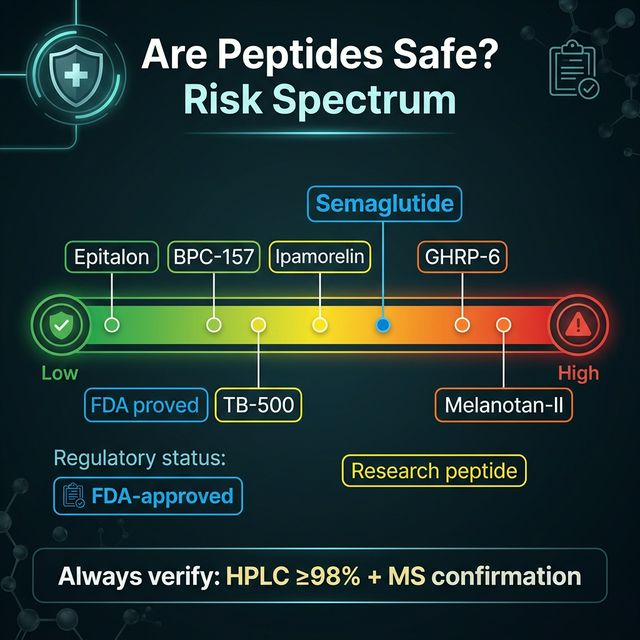
Are Peptides Safe? What the Evidence Says
The safety of peptides depends entirely on which peptide, the dose, the quality of the product, and the method of administration. This is not a simple yes or no — it is a nuanced question requiring evidence-based analysis for each individual compound. FDA-approved peptide drugs (semaglutide, tirzepatide, bremelanotide, teriparatide, oxytocin) have rigorous human safety data from phase 2 and 3 clinical trials and post-market surveillance involving tens of thousands of patients. Research peptides (BPC-157, TB-500, MOTS-c) have established safety profiles in animal models but limited human clinical trial data — meaning their safety in humans is inferred from mechanism and preclinical data, not confirmed through large-scale human trials. CalcMyPeptide provides dose tools to support safe, accurate preparation of any peptide.
The single most important safety variable for research peptides: product quality. Compounded or research-grade peptides purchased from unlicensed sources may contain incorrect peptide identity, incorrect concentration, microbial contamination, or harmful excipients (Gudeman J et al., N Engl J Med, 2013, PMID: 23992655). Verify any supplier with a lot-specific Certificate of Analysis including HPLC purity and mass spectrometry.
GLP-1 Peptide Safety Profile: Known Risks
GLP-1 agonists (semaglutide, tirzepatide) have the most rigorous human safety data of any peptide class. From the STEP trials (Rubino DM et al., Diabetes Obes Metab, 2022, PMID: 35441442):
| Side Effect | Incidence | Severity | Management |
|---|---|---|---|
| Nausea | ~44% | Mild-moderate | Slow escalation; eat less |
| Vomiting | ~24% | Mild-moderate | Hydration; anti-emetics if needed |
| Diarrhea | ~30% | Mild | Usually self-resolving |
| Constipation | ~24% | Mild | Fiber; hydration |
| Injection site reactions | ~5% | Mild | Rotate sites |
| Acute pancreatitis | <0.3% | Severe | Discontinue immediately |
| Thyroid C-cell tumors | Case reports | Theoretical (rodent data) | Contraindicated with MTC history |
The dose-escalation protocol for GLP-1 peptides is specifically designed to minimize GI side effects — slower escalation reduces nausea significantly. Use the CalcMyPeptide GLP-1 dose scheduler to generate your escalation calendar.
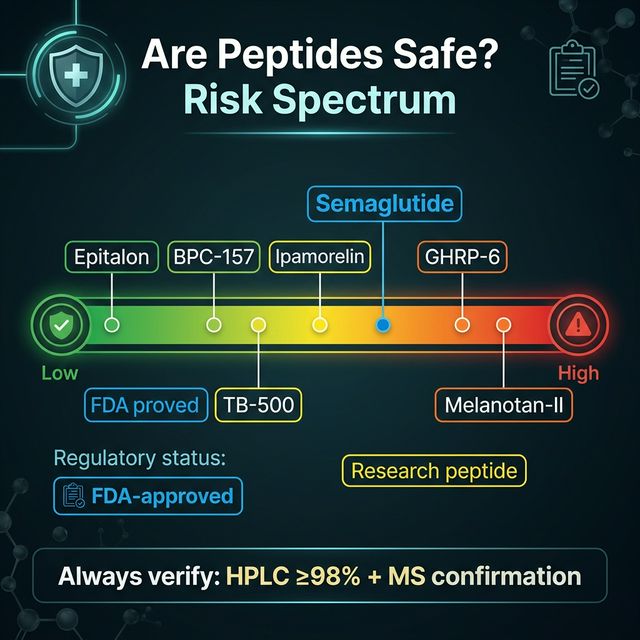
BPC-157 and TB-500 Safety: What We Know and Don't Know
BPC-157 and TB-500 safety profile from animal studies (Sikiric P et al., Curr Neuropharmacol, 2016, PMID: 26830965):
• No lethal dose established across rodent studies — researchers have not been able to find an LD50 (lethal dose 50%) in animal models
• No organ toxicity observed at therapeutic and suprapharmacological doses in animal studies
• Mild injection site redness: most commonly reported reaction in community self-administration reports
• Angiogenic mechanism: Both BPC-157 and TB-500 promote new blood vessel formation (angiogenesis). This is the primary theoretical concern — angiogenesis supports tumor growth. Contraindicated with active cancer or cancer history within 5 years.
What we don't know (human data gaps): No human pharmacokinetic studies. No human dose-response data. No human safety surveillance from clinical trials. Everything we know about tolerability comes from animal models and community self-report — not from controlled human clinical trials. This represents a significant evidence gap that should inform the risk/benefit assessment of any individual considering BPC-157 or TB-500.
Growth Hormone Secretagogue Safety Risks
GH secretagogues (ipamorelin, CJC-1295, sermorelin, MK-677) stimulate GH release and raise IGF-1 levels. Known risks:
• Water retention/edema: Elevated GH causes sodium retention, leading to puffiness especially in hands and feet. Common at higher doses.
• Insulin resistance: Chronically elevated GH and IGF-1 can impair insulin sensitivity. Monitor blood glucose with long-term use.
• Ipamorelin-specific: Gobburu JV et al. (Growth Horm IGF Res, 2009, PMID: 19411194) showed ipamorelin has a favorable safety and tolerability profile in healthy subjects with no significant effect on cortisol or prolactin.
• MK-677 risk profile: Unlike injectable secretagogues, MK-677 (oral ibutamoren) raises GH and IGF-1 for 24 hours continuously — suppressing natural GH pulsatility. Long-term MK-677 raises insulin resistance, water retention, and potentially edema more than pulsatile injectable secretagogues.
• Carpal tunnel syndrome: Excess GH (from any source) can cause median nerve compression.
How to Minimize Peptide Safety Risks
1. Verify product quality: Demand a lot-specific CoA with HPLC purity ≥98% and MS molecular weight verification. See our how to verify peptide purity guide.
2. Start at the lowest effective dose: All side effects are dose-dependent. Starting low and titrating up minimizes unknown risks.
3. Use sterile technique: Infection is the primary modifiable risk in peptide injection. See our peptide injection master guide for protocol.
4. Reconstitute correctly: Incorrect reconstitution causes dosing errors. Use CalcMyPeptide's free reconstitution calculator — and confirm math before drawing any dose.
5. Know contraindications: Active cancer or cancer history within 5 years is an absolute contraindication for all angiogenic peptides (BPC-157, TB-500, GHK-Cu). Pregnancy and breastfeeding: avoid all research peptides.
6. Work with a provider: A physician, naturopath, or nurse practitioner experienced with peptide medicine can monitor bloodwork (IGF-1, insulin, CBC) and identify side effects early.
How Do I Know If a Peptide Is Safe to Use?
Evaluate four factors: (1) Evidence quality — is there human clinical trial data, or only animal studies? FDA-approved drugs have both. Research peptides have primarily animal data. (2) Mechanism risk — does the peptide's mechanism of action create any inherent risks for your health status (e.g., angiogenesis + cancer history)? (3) Product quality — can you verify HPLC purity and correct molecular identity via MS? (4) Provider oversight — are you working with a healthcare provider who can monitor lab values and respond to adverse events?
What Are the Risks of Buying Peptides Online?
Research peptide suppliers vary dramatically in quality. Key risks: mislabeled products (wrong peptide, wrong concentration), inadequate purity (below 98% HPLC purity), microbial contamination (endotoxins can cause severe inflammatory reactions), incorrect storage (degraded product shipped compromised). The FDA 2013 compounding pharmacy safety review (Gudeman J et al., 2013) found significant contamination and potency problems with compounded drugs from unlicensed facilities. For research peptides, the regulatory gap is even wider. Always request a lot-specific CoA with HPLC purity result and mass spectrometry confirmation of molecular weight. Read our full guide at how to verify peptide purity — HPLC and MS methods.