Two GHRPs, Fundamentally Different Profiles
Hexarelin and ipamorelin both activate the GH secretagogue receptor (GHS-R1a) to trigger growth hormone release. On paper, they look similar. In practice, they behave very differently — and the differences matter clinically.
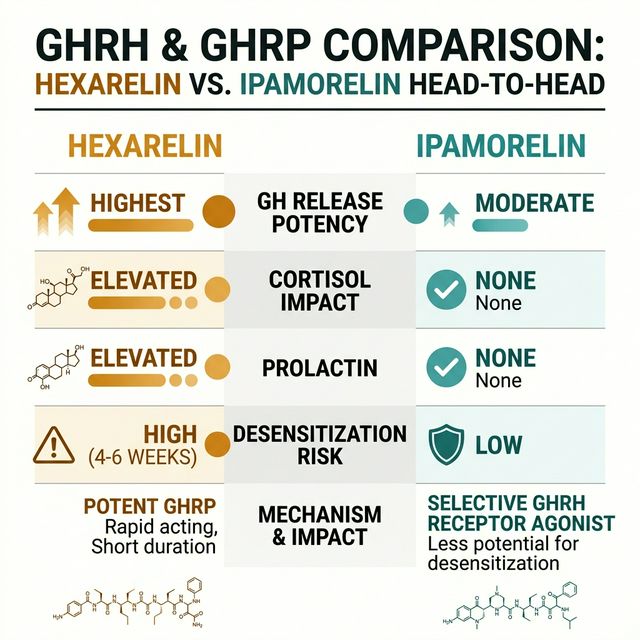
Hexarelin is the most potent GHRP ever synthesized. At the standard dose of 1-2 mcg/kg, hexarelin produces the largest GH pulse of any secretagogue — approximately 2-3 fold greater than ipamorelin at equivalent doses. In the Ghigo et al. study (JCEM, 1994), hexarelin 1 mcg/kg IV produced a mean peak GH of approximately 56 ng/mL in healthy adults. Ipamorelin at the same dose produces approximately 12-25 ng/mL. This raw potency is why hexarelin attracted initial enthusiasm.
But potency is not the same as selectivity. Hexarelin's GH-releasing effect comes with significant off-target hormonal stimulation that creates real clinical limitations.
The Cortisol and Prolactin Problem
Hexarelin significantly elevates cortisol and prolactin at therapeutic GH-releasing doses. In Arvat et al. (JCEM, 1997), hexarelin 2 mcg/kg produced cortisol increases of approximately 40-60% above baseline and prolactin increases of approximately 50-90% above baseline. These are not trivial numbers.
Chronic cortisol elevation promotes visceral fat accumulation, insulin resistance, muscle catabolism, immune suppression, and disrupted sleep architecture. Chronic prolactin elevation in males can cause decreased libido, erectile dysfunction, gynecomastia, and suppressed testosterone production via inhibition of GnRH pulsatility.
Ipamorelin, by contrast, produces no statistically significant change in cortisol or prolactin at any dose tested up to 1 mg/kg (Raun et al., 1998). This is not a minor difference — it is the difference between a peptide you can safely use long-term and one that creates cascading hormonal disruption.
Receptor Desensitization: The 4-Week Wall
Hexarelin has another critical limitation: it desensitizes the GHS-R1a receptor within approximately 4 weeks of continuous daily use. This was demonstrated in Rahim et al. (JCEM, 1998), where hexarelin's GH-releasing effect decreased by approximately 50% after 4 weeks of daily administration and by approximately 75% after 8 weeks. The receptor downregulates in response to sustained high-potency stimulation.
Ipamorelin does not show this desensitization pattern. Studies and extensive community experience confirm that ipamorelin maintains its GH-releasing efficacy over months of continuous daily use. The likely explanation is that ipamorelin's lower maximal receptor activation (it is a partial agonist at GHS-R1a) does not trigger the receptor internalization and downregulation cascade that hexarelin's full agonism provokes.
This means hexarelin requires cycling — typically 4 weeks on, 4 weeks off — to maintain efficacy. Ipamorelin can be used continuously. For a peptide that aims to produce chronic GH optimization (sleep quality, body composition, recovery), the need for cycling eliminates half the potential benefit.
When Would You Choose Hexarelin?
Hexarelin is not without applications. Its extreme GH-releasing potency makes it potentially useful for: (1) acute recovery from significant injury or surgery where maximum GH stimulus is desired for a limited 2-4 week period; (2) GH stimulation testing in clinical settings (it produces the most reliable, largest GH pulse for diagnostic purposes); (3) short-term body composition optimization leading into a specific event or competition.
But for the vast majority of people seeking growth hormone optimization for sleep quality, fat loss, anti-aging, and general recovery — ipamorelin wins decisively. The selectivity, lack of desensitization, and ability to use continuously without hormonal disruption makes it the rational choice for chronic use.
The recommended protocol if using hexarelin: 100-200 mcg subcutaneously, 2-3 times daily on an empty stomach, for a maximum of 4 weeks. Then discontinue for 4 weeks to allow receptor resensitization. Monitor prolactin and morning cortisol levels. If using for more than one cycle, consider switching permanently to ipamorelin.