The Complete Guide to Peptide Reconstitution & Dosing
The definitive guide to peptide reconstitution, concentration math, syringe selection, dose calculation, multi-peptide stacks, and storage best practices.
Key Takeaways
- ✓Reconstitution dissolves freeze-dried (lyophilized) peptide powder into an injectable solution using bacteriostatic water
- ✓Concentration = Peptide (mg) ÷ Water (mL) — this determines how many syringe units equal your dose
- ✓Always use bacteriostatic water (BAC water), not sterile water, for multi-dose vials
- ✓Never shake — always swirl gently to preserve molecular structure
- ✓Refrigerate at 2-8°C after reconstitution and use within 28 days
⚕️ Medical Disclaimer: This guide is for educational purposes only. Consult a qualified healthcare provider before using any peptide. All reconstitution and dosing should be verified with our Reconstitution Calculator.
1. What Is Peptide Reconstitution?
Reconstitution is the process of dissolving a freeze-dried (lyophilized) peptide powder into a liquid solution using bacteriostatic water, making it injectable. Most research peptides ship as a dry powder cake or puck inside a sealed glass vial — this form is extremely stable for shipping and long-term storage.
Once reconstituted, the peptide is in solution and can be drawn into an insulin syringe for subcutaneous injection. The amount of water you add determines the concentration of the solution, which in turn determines how many syringe units you need to draw for your target dose.
Why lyophilized? Freeze-drying removes all water while preserving molecular structure. Lyophilized peptides can remain stable for 12+ months at room temperature and years in a freezer. Once reconstituted, the clock starts — most peptides remain stable for 28 days refrigerated.
2. What You Need (Complete Supply List)
Lyophilized Peptide Vial
Your sealed vial with the freeze-dried peptide powder (e.g., BPC-157 5mg, TB-500 5mg)
Bacteriostatic Water (BAC)
0.9% benzyl alcohol preserved water. Comes in 30mL vials. DO NOT use sterile water for multi-dose vials.
Insulin Syringes
29-31G, available in 30u (0.3mL), 50u (0.5mL), or 100u (1.0mL) sizes
Alcohol Swabs
Individually wrapped 70% isopropyl alcohol prep pads for sterilizing vial stoppers
Sharps Container
FDA-approved puncture-resistant container for safe needle disposal
Clean Workspace
Flat, well-lit surface. Wipe down with alcohol or disinfectant before starting.
⛔ Never use sterile water (without preservative) for multi-dose vials. Sterile water is preservative-free, meaning bacteria can grow after the first puncture. BAC water contains 0.9% benzyl alcohol that inhibits microbial growth for 28 days.
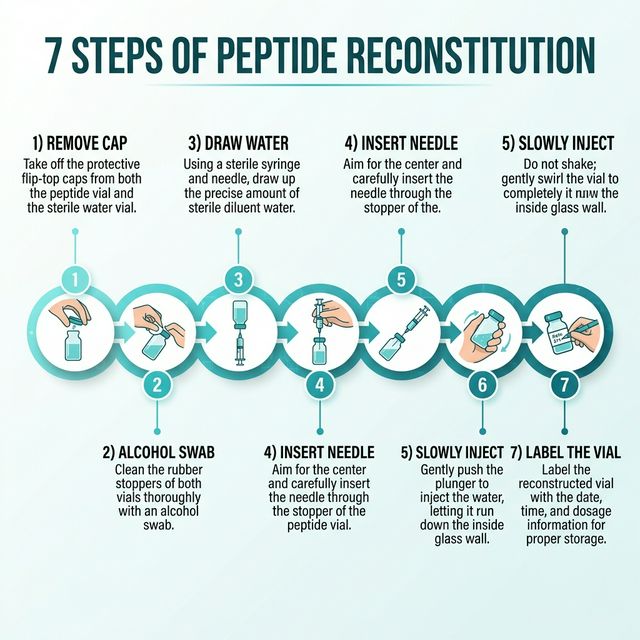
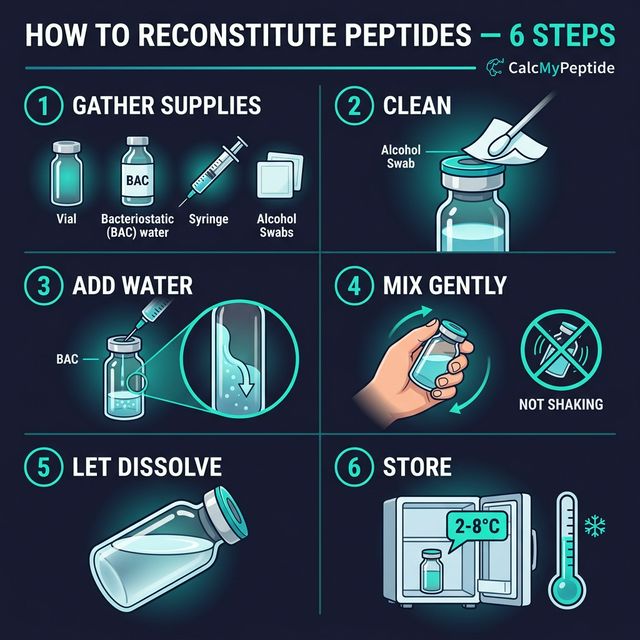
3. Step-by-Step Reconstitution Protocol
- 1
Wash Hands & Prep Workspace
Wash hands for 20+ seconds with soap. Lay out all supplies on a clean, flat surface. Remove the plastic flip-cap from both the peptide vial and BAC water vial.
- 2
Swab Both Vial Stoppers
Wipe the rubber stopper of BOTH the peptide vial and BAC water vial with alcohol swabs. Use a single circular motion from center outward. Let dry 10 seconds before puncturing.
- 3
Draw Bacteriostatic Water
Pull the syringe plunger to your desired water volume (e.g., 2mL). Insert needle through center of BAC water stopper, inject the air, invert vial, slowly draw the water. Remove any air bubbles by flicking the barrel.
- 4
Add Water to Peptide Vial
Insert needle through the peptide vial stopper. CRITICAL: Aim the stream down the inside glass wall of the vial, NOT directly onto the powder cake. Depress plunger very slowly — rapid injection can damage peptide molecules through shear forces.
- 5
Swirl Gently — NEVER Shake
Remove the syringe. Gently swirl or roll the vial between your palms for 30-60 seconds. NEVER shake. Shaking creates foam and denatures the peptide through mechanical stress. If the powder doesn't dissolve immediately, set the vial in the refrigerator and it will fully dissolve within 1-2 hours.
- 6
Verify & Store
The final solution should be clear and colorless. If cloudy, particles visible, or discolored — DO NOT USE. Label the vial with: peptide name, concentration, date reconstituted. Refrigerate immediately at 2-8°C. Use within 28 days.
4. Concentration Math: The Formula You Must Know
Concentration (mg/mL) = Peptide Amount (mg) ÷ Water Volume (mL)
Or in mcg: Concentration (mcg/mL) = Peptide (mg) × 1,000 ÷ Water (mL)
Example: You have a 5 mg vial of BPC-157 and add 2 mL of BAC water.
Concentration
2.5 mg/mL
5 mg ÷ 2 mL
In Micrograms
2,500 mcg/mL
5 × 1,000 ÷ 2
Per Unit (100u syringe)
25 mcg/unit
2,500 ÷ 100
💡 Pro Tip: More water = lower concentration = more units to draw per dose. Less water = higher concentration = fewer units. If your dose requires very small volumes (<5 units), use more water to increase accuracy.
5. Calculating Your Dose in Syringe Units
Units to Draw = Desired Dose (mcg) ÷ mcg per Unit
mcg per Unit = (Peptide mg × 1,000) ÷ (Water mL × Syringe Total Units)
Continuing our example: BPC-157 5mg in 2mL, 100-unit syringe, target dose 250 mcg:
mcg/unit = (5 × 1,000) ÷ (2 × 100) = 25 mcg/unit
Units to draw = 250 ÷ 25 = 10 units
So you would draw to the 10-unit mark on a 100-unit (1 mL) insulin syringe. Use our free Reconstitution Calculator to compute this instantly.
6. How Much Bacteriostatic Water to Add
There is no single "correct" amount of water — the choice depends on your peptide amount, dose, and syringe size. Here are common recommendations:
| Vial Size | Water | Concentration | Best For |
|---|---|---|---|
| 2 mg | 1 mL | 2,000 mcg/mL | Low-dose peptides (GHK-Cu) |
| 5 mg | 1 mL | 5,000 mcg/mL | High-dose peptides needing concentration |
| 5 mg | 2 mL | 2,500 mcg/mL | Most common — BPC-157, TB-500 |
| 5 mg | 2.5 mL | 2,000 mcg/mL | Even numbers — easy syringe math |
| 10 mg | 2 mL | 5,000 mcg/mL | Semaglutide, higher-dose protocols |
| 10 mg | 3 mL | 3,333 mcg/mL | Mid-range concentration |
Use our Reverse Calculator to find the exact water volume for your target concentration.
7. Insulin Syringe Selection Guide
0.3 mL (30 units)
Tick marks: ½ unit marks
Small doses (<15 units). Best accuracy for tiny volumes.
0.5 mL (50 units)
Tick marks: 1 unit marks
Mid-range doses (15-50 units). Most popular for peptide use.
1.0 mL (100 units)
Tick marks: 2 unit marks
Large doses (50+ units) or high-volume protocols like GLP-1.
💡 Pro Tip: Choose syringe size based on the number of units you need to draw. Drawing 10 units on a 100u syringe is hard to read accurately — use a 30u syringe instead. Read our Insulin Syringe Guide for details.
8. Common Peptide Reconstitution Examples
| Peptide | Vial | Water | Conc. | Typical Dose | Units (100u) |
|---|---|---|---|---|---|
| BPC-157 | 5 mg | 2 mL | 2,500 mcg/mL | 250 mcg | 10 units |
| TB-500 | 5 mg | 2 mL | 2,500 mcg/mL | 750 mcg | 30 units |
| Semaglutide | 5 mg | 2 mL | 2,500 mcg/mL | 250 mcg | 10 units |
| Ipamorelin | 5 mg | 2.5 mL | 2,000 mcg/mL | 200 mcg | 10 units |
| CJC-1295 | 5 mg | 2.5 mL | 2,000 mcg/mL | 300 mcg | 15 units |
| GHK-Cu | 10 mg | 2 mL | 5,000 mcg/mL | 500 mcg | 10 units |
| Tirzepatide | 10 mg | 2 mL | 5,000 mcg/mL | 2,500 mcg | 50 units |
| Epitalon | 10 mg | 2 mL | 5,000 mcg/mL | 500 mcg | 10 units |
9. Multi-Peptide Stacks & Blends
Many users combine multiple peptides for synergistic effects. The key rules for stacking:
Same syringe: OK for compatible peptides
BPC-157 + TB-500 can be drawn into the same syringe from separate vials. This reduces injection frequency without affecting efficacy.
Never mix in the same vial
Each vial should contain only one reconstituted peptide. Mixing in the vial creates unknown interactions and prevents accurate dosing.
Calculate each peptide independently
Each vial has its own concentration. Calculate units for each peptide separately, then draw them sequentially into one syringe.
Use our Blend/Stack Calculator to calculate exact units for multi-peptide stacks with different concentrations.
10. Storage, Shelf Life & Stability
Before Reconstitution (Lyophilized)
- • Room temp: Stable for months (varies by peptide)
- • Refrigerator (2-8°C): 6-12 months
- • Freezer (-20°C): 2+ years
- • Protect from light, moisture, and heat
After Reconstitution
- • Must refrigerate: 2-8°C at all times
- • Shelf life: 28 days (most peptides)
- • Never freeze reconstituted peptides
- • Never leave at room temp >1 hour
- • Discard if cloudy, discolored, or >28 days old
11. Troubleshooting Common Problems
❌ Powder won't dissolve
Don't panic. Place the vial upright in the refrigerator for 1-2 hours. Most peptides dissolve completely with gentle swirling and patience. Never shake.
❌ Solution is cloudy or has particles
DO NOT USE. Cloudiness indicates denatured protein or bacterial contamination. Dispose of the vial safely.
❌ Air bubbles in syringe
Flick the syringe barrel with your finger to move bubbles to the top. Push the plunger slightly to expel air. Small bubbles in SubQ are harmless but reduce dose accuracy.
❌ Rubber stopper coring (fragment in vial)
Insert the needle at a 45-90° angle through the center of the stopper. Use 29-31G needles (thinner = less coring risk). If rubber is visible in vial, use a filter needle or discard.
❌ Vial has vacuum (hard to draw)
This is normal — inject an equal volume of air before drawing liquid. The air equalizes pressure. Push air in first, then invert and draw.
❌ Accidentally used too much/little water
The peptide amount doesn't change — just recalculate concentration with the actual water volume added. Use our calculator to get the new units per dose.
12. Frequently Asked Questions
Can I use sterile water instead of bacteriostatic water?
How long does a reconstituted peptide last?
Does the amount of water affect potency?
What if I accidentally shook the vial?
Can I travel with reconstituted peptides?
Why do some peptides come as a clear liquid instead of powder?
How do I calculate the right water volume for a target concentration?
Calculate Your Exact Dose
Enter your vial size and water volume to instantly calculate concentration, mcg per unit, and units to draw.
Questions? Contact us at contact@calcmypeptide.com.
📖 References
- Manning MC, et al. “Stability of reconstituted peptide solutions.” Pharm Res (2010). PMID: 20499141
🧪 Try the Calculator
Put this knowledge into practice — calculate your exact concentration and syringe units for free.
Open Reconstitution Calculator →