
GHRH vs GHRP: Completely Different Mechanisms
This comparison confuses people because both tesamorelin and ipamorelin increase growth hormone. But they work through fundamentally different receptor systems, produce different GH release patterns, and serve different clinical purposes.
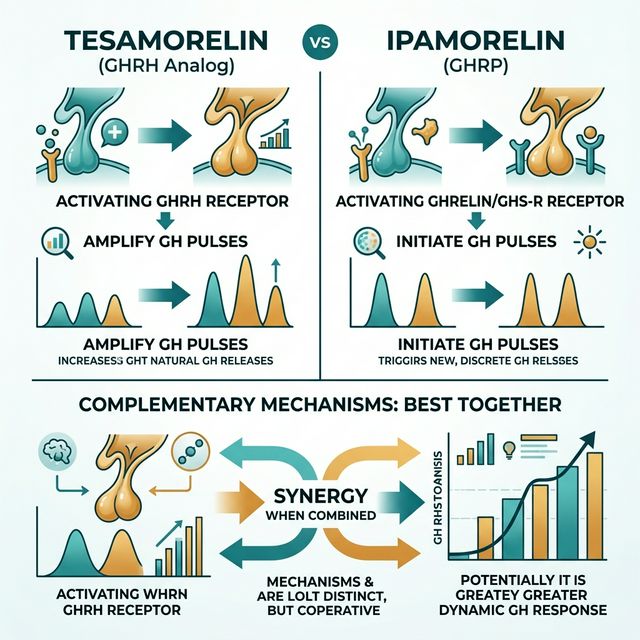
Tesamorelin is a GHRH analog — it activates the growth hormone-releasing hormone receptor (GHRH-R) on pituitary somatotroph cells. Its job is to amplify the size of a GH pulse. Think of GHRH as the amplifier in a sound system — it makes the signal louder, but it does not initiate the signal.
Ipamorelin is a GHRP — it activates the growth hormone secretagogue receptor (GHS-R1a), also known as the ghrelin receptor. Its job is to initiate a GH pulse. Think of GHRP as the trigger — it fires the starting signal that tells the pituitary to release GH. Ipamorelin triggers the pulse; tesamorelin (or its shorter cousin CJC-1295 no DAC) amplifies the pulse.
This is precisely why GHRH + GHRP combinations (like CJC-1295 no DAC + ipamorelin) produce synergistic GH release greater than either alone. Tesamorelin and ipamorelin are not competitors — they are complementary.
Clinical Evidence: Night and Day
Tesamorelin has Phase III clinical trial data in 816 patients with CT-measured body composition endpoints. It is FDA-approved. It has specific, published evidence for visceral fat reduction — a 15.2% decrease versus 5.2% placebo over 26 weeks. The safety database includes adverse event monitoring over 52-week extension studies.
Ipamorelin has Phase I/II pharmacokinetic and selectivity data (Raun et al., 1998; Hansen et al., 1999). It has the strongest selectivity data of any GHRP — no cortisol, no prolactin, no changes in FSH, LH, or TSH at any dose. It does not have published Phase III clinical outcome data for any specific indication.
If you are a physician making evidence-based decisions, tesamorelin has dramatically stronger clinical evidence. If you are evaluating hormonal safety profiles, ipamorelin has the cleanest head-to-head data. Both have unique strengths, but they are not interchangeable.
Dosing, Cost, and Access Differences
Tesamorelin is dosed at 2 mg subcutaneously, once daily. It does not require fasting or specific timing relative to meals (though fasting may enhance the GH pulse). The FDA-approved Egrifta SV costs approximately $800-1,200/month depending on insurance and pharmacy. Compounded tesamorelin is available at lower cost through telehealth peptide clinics.
Ipamorelin is dosed at 100-300 mcg subcutaneously, 1-3 times daily, on an empty stomach, ideally before bed. Research-grade ipamorelin costs approximately $30-60 per 5 mg vial (10-50 doses depending on dose), making it roughly 10-20 fold less expensive on a monthly basis. Compounded pharmacy ipamorelin through a prescription is approximately $100-200/month.
The access difference is significant. Ipamorelin is the most widely available peptide in the research and compounding markets. Tesamorelin, being FDA-approved, has both legitimate pharmacy distribution and restricted access through insurance formularies that typically require an HIV lipodystrophy diagnosis.
Which Should You Choose?
Choose tesamorelin if: your primary goal is visceral fat reduction; you have access through a prescribing physician or compounding pharmacy; you prefer once-daily dosing without fasting requirements; you value FDA-approved clinical evidence.
Choose ipamorelin if: your goals include overall GH optimization (sleep, recovery, body composition, anti-aging); you plan to stack with CJC-1295 no DAC for synergistic release; budget is a significant consideration; you want the cleanest hormonal selectivity profile.
The optimal approach for most people: use ipamorelin + CJC-1295 no DAC as the daily GH secretagogue stack for sleep, recovery, and body composition. If visceral fat reduction is a primary target, consider adding or substituting tesamorelin. Use the CalcMyPeptide reconstitution calculator for dosing math on either peptide.