Amino Acids: The Building Blocks
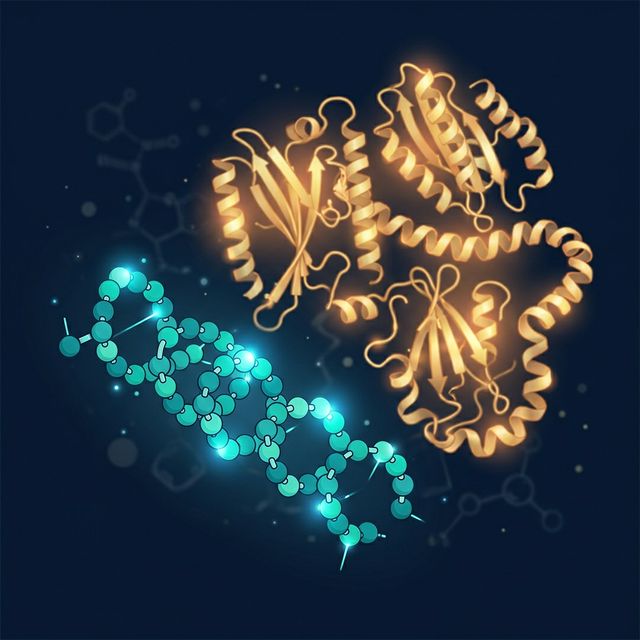
Every peptide and protein in your body is built from the same 20 standard amino acids — molecular building blocks that differ only in their side chains. These 20 amino acids can be combined in any sequence and any length, creating virtually unlimited molecular diversity. Each amino acid contains an amino group (-NH₂), a carboxyl group (-COOH), and a unique side chain that determines its chemical properties.
When two amino acids link together, a peptide bond forms between the carboxyl group of one and the amino group of the next, releasing a molecule of water (condensation reaction). This covalent bond is extremely stable under physiological conditions but can be cleaved by protease enzymes — which is why peptides are rapidly broken down in the GI tract and bloodstream if not protected.
Peptides vs Proteins: Where's the Line?
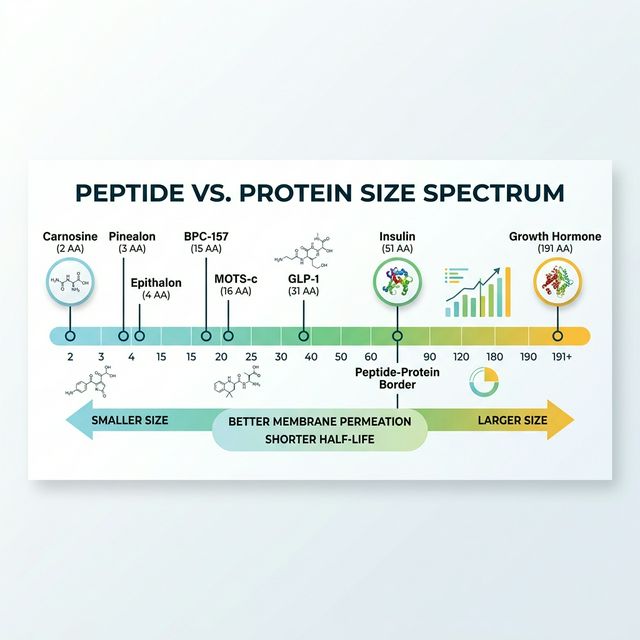
The distinction between peptides and proteins is based on chain length, though the boundary is somewhat arbitrary: **Dipeptides** (2 amino acids, e.g., carnosine), **Tripeptides** (3 amino acids, e.g., Pinealon, glutathione), **Oligopeptides** (4-20 amino acids, e.g., BPC-157 is 15 amino acids, MOTS-c is 16), **Polypeptides** (21-50 amino acids, e.g., insulin is 51 amino acids — it straddles the border), **Proteins** (50+ amino acids with defined 3D structure, e.g., growth hormone is 191 amino acids).
Why does size matter for bioactivity? Smaller peptides (2-15 amino acids) have key advantages: they can penetrate cell membranes more easily, they are less likely to provoke immune responses, they are more chemically stable in solution, and they are easier and cheaper to synthesize. However, they also have shorter half-lives (minutes to hours) because proteases can access and cleave them more readily than folded proteins. This is the fundamental pharmacokinetic trade-off in peptide therapeutics.
The therapeutic peptides used in the peptide community span the entire range: Epitalon (4 amino acids, tiny tetrapeptide), BPC-157 (15 amino acids, medium), GLP-1 agonists like semaglutide (modified versions of GLP-1, which is 31 amino acids), and hGH (191 amino acids, technically a protein). Each has different stability, half-life, immunogenicity, and delivery requirements dictated by its size and modifications.
How Peptides Work in the Body
Peptides exert their effects through three primary mechanisms: **(1) Receptor binding** — most therapeutic peptides work by binding to specific cell-surface receptors. Semaglutide binds GLP-1 receptors. Ipamorelin binds growth hormone secretagogue receptors (GHS-R). PT-141 binds melanocortin-4 receptors (MC4R). The peptide acts as a "key" that fits a specific receptor "lock." **(2) Enzymatic modulation** — some peptides activate or inhibit enzymes. BPC-157 upregulates growth factors (VEGF, FGF) and modulates nitric oxide pathways. **(3) Gene expression** — Khavinson's bioregulatory peptides (Epithalon, Pinealon) are proposed to penetrate cell nuclei and directly interact with DNA promoter regions to modulate transcription.
Delivery route dramatically affects how a peptide reaches its target. Subcutaneous injection places the peptide in the fat layer, where it gradually enters the bloodstream (~100% bioavailability). Intramuscular injection provides faster absorption into the vascular-rich muscle tissue. Intranasal delivery (selank, semax) provides access to the brain via the olfactory pathway. Oral delivery destroys most peptides in the stomach — exceptions like oral semaglutide (Rybelsus) require specialized absorption enhancers (SNAC) to survive the GI tract.
Understanding what peptides are, how they differ from proteins, and how they work in the body provides the foundation for every other peptide topic — from dosing calculations to stacking protocols. Use the CalcMyPeptide suite to calculate reconstitution, dosing, and half-life for any peptide in our library.