Semax
Synthetic ACTH(4-10) analog with neuroprotective and cognitive-enhancing properties.
🔬 Mechanism of Action
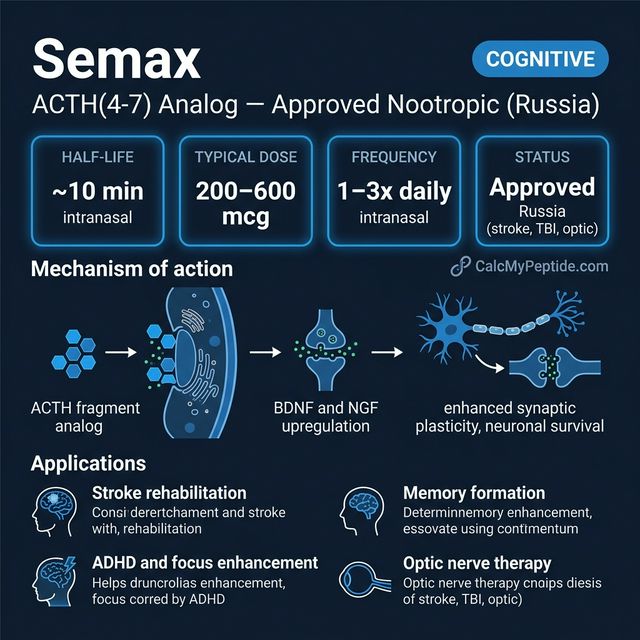
Semax is a synthetic heptapeptide analog of ACTH (adrenocorticotropic hormone), specifically the ACTH(4-10) fragment with additional stabilizing modifications. It has neuroprotective and cognitive-enhancing properties. Semax increases BDNF and NGF (Nerve Growth Factor) expression, modulates the serotonergic system, and provides neuroprotection against oxidative stress.
Like Selank, Semax is approved in Russia as a prescription medication — specifically for stroke recovery, cognitive disorders, and optic nerve diseases. It is primarily administered intranasally due to its very short systemic half-life (~2-3 minutes).
Source: PMID: 17430556
📜Background & History
Semax is a synthetic heptapeptide derived from the ACTH(4-7) fragment (Met-Glu-His-Phe), with Pro-Gly-Pro added for stability, developed at the Institute of Molecular Genetics (Moscow) in the 1980s. It is approved in Russia for stroke rehabilitation, TBI, and optic nerve disease, with clinical use spanning 30+ years. Its primary mechanism involves upregulation of BDNF and NGF — the most important neurotrophic proteins for synaptic plasticity, neuronal survival, and cognitive function — placing it uniquely in the landscape of genuine nootropics with clinical validation.
🎯 Research Use Cases
- ✓Stroke rehabilitation and post-TBI neurological recovery
- ✓ADHD-like symptoms: focus, attention, and executive function
- ✓Nootropic: memory formation and recall enhancement
- ✓Optic nerve disease treatment (Russian clinical use)
- ✓Depression adjunct via BDNF upregulation
💉 Dosing Protocol
| Typical Dose | 200-600 mcg/day (intranasal) |
| Frequency | 1-3× daily (intranasal) |
| Half-Life | ~2-3 minutes (rapid metabolism) |
| Common Vial Sizes | 3 mg, 5 mg |
🧪 Reconstitution Example
⚠️Safety & Considerations
Approved in Russia for stroke recovery and cognitive disorders. Good clinical safety profile. Primary route is intranasal. Does not affect cortisol levels despite being an ACTH fragment (the hormonal portion of ACTH is in residues 1-3, which are not present in Semax).
⚡Interactions & Contraindications
Intranasal route required for adequate CNS bioavailability (nasal mucosa→olfactory neurons). ACTH-like structure may weakly affect cortisol — monitor with prolonged high-dose use. No significant drug interactions documented. Avoid in patients with active epilepsy (CNS stimulation theoretically could lower threshold).
🔗Synergies & Common Stacks
Classic Russian nootropic stack: Semax enhances cognitive performance; Selank reduces performance anxiety. Together they support both cognitive output and emotional stability.
Semax provides the BDNF; Dihexa promotes the synaptogenesis to utilize it. Potentially powerful combination for neurological recovery or enhancement.
❓ Frequently Asked Questions
Does Semax affect cortisol like ACTH?▼
What is the Semax dosing protocol?▼
📖 References
- Ashmarin IP, et al. “Semax, an ACTH(4-10) analog with nootropic properties, as a potential neuroprotective agent.” Pharmacol Biochem Behav (1995). PMID: 7732365
- Bashkatova VG, et al. “Neuroprotective effects of Semax in conditions of global ischemia.” Bull Exp Biol Med (2001). PMID: 11427916